By Coral Gables Gazette staff
Coral Gables commissioners voted unanimously Tuesday to send four charter amendments to the November 3 ballot, including a question that would let the mayor serve four-year terms and another, rewritten after an unusually pointed floor debate, that would require 60 percent voter approval before the city could sell parks, golf courses or the War Memorial Youth Center.
Each item passed 5-0. But the votes masked real disagreement: several commissioners said they support putting the questions to voters even though they oppose the underlying changes, and two of the four items drew extended public comment and, in one case, a live rewrite of the ballot language on the dais.
Two items advance with little debate
The first two questions drew no discussion and no public comment.
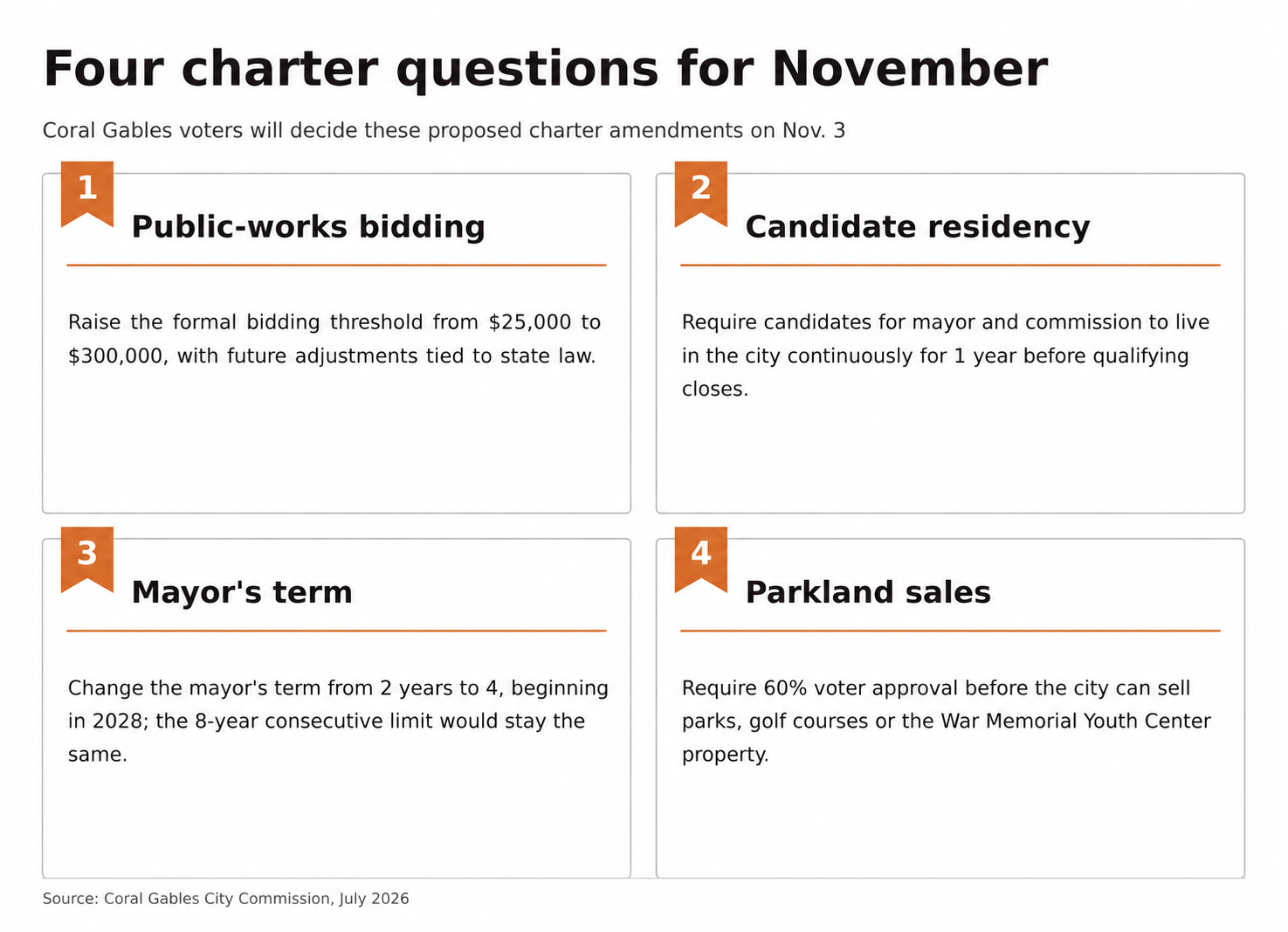
One would raise the dollar threshold above which the city must use formal competitive bidding for public-works projects, from $25,000 to $300,000, aligning the charter with a state-law standard that adjusts annually and is already closer to $400,000.
The other would require candidates for mayor and commission to have lived in the city continuously for at least a year before the close of qualifying, which now falls in June under the city’s move to November elections.
Both were presented by Deputy City Attorney Stephanie Throckmorton as recommendations that emerged from former Mayor Don Slesnick’s Charter Review Committee, and both passed without a single question from the dais.
Four-year mayoral term draws election-year questions
The third item would let the mayor serve a four-year term beginning with the November 2028 election, matching the four-year terms commissioners already serve, without changing the charter’s separate eight-year limit on consecutive mayoral service.
City staff noted that Mayor Vince Lago, if reelected this November, would already reach that eight-year limit and would not be eligible to run for mayor in 2028 regardless of the outcome. The change would apply to his successor.
Coral Gables has been here before. The city moved to a four-year mayoral term in 2005 and back to two years in 2009, making Tuesday’s proposal the third time in two decades that voters have been asked to decide the question.
Two residents used public comment to make the case against it. Maria Cruz told commissioners the city has “already changed it and it didn’t work” once, and raised a pointed question about motive.
“As far as I know, nobody present or not present has expressed an interest in running for mayor in 2028,” she said, “but you never know — there may be somebody in the wings.”
Jackson Holmes, one of two challengers running against Lago this November, argued that two-year terms preserve voters’ ability to force rapid change if they are unhappy with city government, saying a four-year term would let public “outrage” build without an election to act on it.
Commissioner Melissa Castro made clear her yes vote was not an endorsement.
“I disagree with changing it to four years,” she said, “but I do agree with putting it out on a referendum for having the people vote.”
The item passed 5-0.
Parkland-sale question tightened on the floor
The fourth item began as a comparatively simple proposal: require voter approval before the city sells a park, golf course or other open space. It ended, after nearly 30 minutes of discussion, as a broader restriction requiring 60 percent voter approval, a threshold added by amendment during the meeting itself.
The debate arrived already charged.
Lago used the item to respond at length to what he described as rumors circulating on local blogs and social media that the city intends to sell Granada Golf Course or redevelop the War Memorial Youth Center. He called Granada a protected historic golf course that cannot legally be redeveloped, and said a Miami Herald story about a separate, unrelated land donation to the city had been misread by residents as evidence of a plan to develop parkland.
That donation sreferenes the University of Miami’s proposed conveyance of the Lee Lincoln Site to the city, which the Gazette reported June 22 would become a public park, called Centennial Park, under the university’s pending development agreement with the city.
Lago also used the discussion to press his case in a separate, long-running dispute with the War Memorial Youth Center Association, the private nonprofit that has held oversight rights over the Youth Center property since a 1958 deed.
He said the association had not filed required nonprofit paperwork in five years, questioned its financial transparency and criticized its board as self-perpetuating. The characterization extends a position Lago has pressed since directing the city attorney to investigate the association’s records in July 2025, an effort the Gazette has reported on extensively.
The association’s past president, Kirk Menendez, is a former commissioner who ran against Lago for mayor in 2025 and lost. Castro and Commissioner Ariel Fernandez have both said publicly that they view the city’s pursuit of the association as political retaliation tied to that race, a characterization Lago disputes. The Gazette has also reported that supporters of the association dispute the claim that it lost its nonprofit status, saying government records do not establish that it did.
Vice Mayor Rhonda Anderson questioned during the hearing whether a sale requirement alone would be enough, noting the city could lease or change the land use of a property without technically selling it.
Lago said he had discussed the point with the city attorney and that no city parks are currently leased. City Attorney Cristina Suárez confirmed the ordinance implementing the charter language could define “sale” to exclude land swaps or other transfers.
Resident Maria Cruz pressed the same concern in public comment, arguing the language as written would not stop a lease or a transfer to another entity, and pointed to the city’s history with the University of Miami as an example of agreements that have been altered over time. Holmes, returning to the podium, called the broader push to remove the Youth Center’s reverter clause “an attack on children.”
After further discussion among commissioners about how to strengthen the measure, Lago proposed raising the threshold for voter approval to 60 percent, a change Anderson accepted as an amendment to the motion.
Castro, after some confusion on the dais about the exact language being voted on, ultimately supported the amended question, calling elements of the broader protection “smoke and mirrors” because leases and land-use changes remain unaddressed. But she said she would vote yes “to no selling parks or recreation,” as the resolution states.
Fernandez said he had supported the measure from the outset.
The amended item passed 5-0.
What comes next
All four measures now go to Coral Gables voters on November 3, alongside the city’s first fall municipal election and a separate statewide constitutional amendment on property-tax exemptions. A related item on the Youth Center’s reverter-clause dispute was also on Tuesday’s agenda but was not discussed.

Author: Coral Gables Gazette News Staff
Originally established in 1996 and relaunched as a digital publication in February 2025, the Coral Gables Gazette is an independent local news organization dedicated to factual, objective and accountable community journalism. Our newsroom reports on the people, policies, institutions and events shaping Coral Gables, Florida, providing residents with timely, informative coverage of the issues affecting their community. Our reporting includes City Hall, local government, municipal elections, public spending, real estate development, business, education, arts and culture, and neighborhood affairs throughout the City Beautiful. We follow City Commission decisions, examine public records and report on the businesses, organizations and individuals contributing to Coral Gables. We believe informed residents are essential to a healthy, engaged community. Stories published under the Coral Gables Gazette News Staff byline are prepared or compiled by the publication's editorial team. We strive for accuracy, fairness, transparency and clear distinctions between news reporting, opinion and advertising. Readers are encouraged to submit news tips, corrections, editorial inquiries and story suggestions through our Contact page and learn more about our standards through our Editorial Policy.