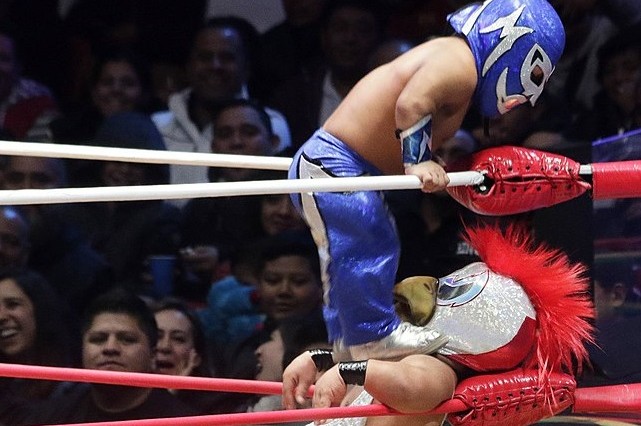
Little-person wrestlers have been dropped from a Lucha Libre exhibition planned for Coral Gables’ Oct. 31 Day of the Dead celebration, according to sources close to the city, hours after members of the Parks and Recreation Advisory Board criticized the planned performance.
The exhibition is still expected to go forward without the micro-estrellas, or microstars, as little-person wrestlers are known in Mexican lucha libre. It is part of a larger festival organized by the Mexican Consulate in Coral Gables, scheduled for 4 to 9 p.m. at Ponce Circle Park, with traditional performances, music, dance and food.
The city has not said publicly who decided to remove the performers, why, or whether the wrestlers were consulted. Calls and messages to the consulate were not returned. City Communications Director Martha Pantin did not answer questions about the event’s origins or how it was vetted. She replied late in the day that she did not expect to have the information by day’s end and directed questions to the consulate. A link to the Day of the Dead celebration on the city’s Halloween events listing was still working as of press time.
Board members question the exhibition
The board discussed the festival at its Thursday morning meeting, where Community Recreation Director Fred Couceyro walked members through the city’s Halloween activities until the conversation reached the Lucha Libre exhibition.
Board member Michelle White objected as soon as she heard about the little-person wrestlers. “It’s like putting people in a circus,” she said, arguing that the performance risked turning the wrestlers into objects of ridicule.
Couceyro said wrestling is a legitimate profession for the performers and part of the Mexican culture the festival is meant to celebrate.
“That’s their career. That’s what they make money doing,” he said. He also said the city has limited control over special event permits: “I’m not allowed to deny a permit for something that is legal and able to be done just because I don’t like the subject matter.”
“So women can do mud wrestling in bikinis?” White asked.
“I’m not saying you could do that. But you have to look at it on a case by case basis,” Couceyro replied.
Board member Maite Halley questioned how far the city should go in regulating expression on public property. “I’m appalled,” Halley said. “My issue is how much can city police (free) expression on public property.”
White said she worried that spectators would post images of the performance on social media and mock the wrestlers, and that the city bears responsibility for what happens on its property. Several members described the planned exhibition as obscene.
Near the end of the meeting, White returned to the subject after doing some initial research. She said she had found evidence that little-person wrestlers had been mistreated in lucha libre. “Just because something has historical relevance at some point doesn’t mean it should be continued or endorsed,” she said.
Board member Kirk Menendez said the city should be careful about the events it permits but doubted anything could be done about this year’s. “This year might be too late,” Menendez said. “But between now and next year we should see if there is some way to address the concerns.”
Within hours, the city told board members that the wrestling exhibition would proceed without the little-person wrestlers.
Critics and performers have long disagreed about little-person wrestling
Little-person wrestling in Mexico has a long and disputed history. A 2018 ESPN report by Nathaniel Janowitz traced the first bouts involving little people to around 1950, when they were a sideshow. Their popularity soared in the 1970s, when little people headlined matches, and faded in the 1980s, when the sport’s leading promotion stopped including them on its cards. For years afterward, little people were often relegated to the role of mascotas, sidekicks to larger wrestlers.
ESPN reported that the Consejo Mundial de Lucha Libre, Mexico’s most prominent wrestling federation, launched a micro-estrellas division in 2017 with eight wrestlers, aiming to have them headline matches as athletes in their own right. The report said discrimination limits job opportunities for people of short stature in Mexico, and that wrestling is one of the few places some can find work.
ESPN also noted that the role of little people in wrestling is contested among little people themselves, in both terminology and the part they play in the ring. One wrestler, Gallito, told ESPN he had experienced discrimination in Mexico and also said, “I enjoy my work, truthfully. I really enjoy it.”
That range of views is the backdrop to the Coral Gables decision. Board members raised the risk of mockery, while the performers’ own accounts, as reported by ESPN, describe pride in their work. The consulate and the city have not said whether the wrestlers in the planned exhibition were asked for their views.
What remains unanswered
The city has not said who decided to drop the performers, whether the city, the consulate or an event sponsor requested the change, what vetting the exhibition received, what authority the city has over content at events in its parks or whether the wrestlers themselves were consulted. Those questions remain unanswered.