Cuban music has always been a conversation among continents, and a Saturday night program in Coral Gables sets out to follow that conversation from its deepest roots to some of its most recognizable sounds.
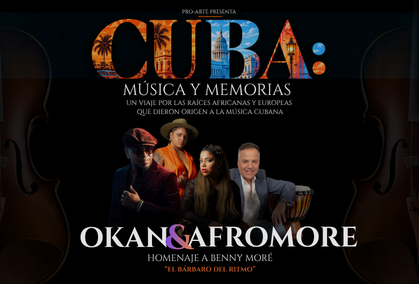
“Cuba: Música y Memoria” moves from African-rooted rhythms and spirituality through the Spanish and European traditions that also shaped the island’s music, then into the sones, boleros, guarachas and mambos of Cuban popular culture. The journey ends with a tribute to Benny Moré, whom the organizers call one of Cuba’s great musical legends.
The concert begins at 8 p.m. Saturday, Oct. 10, at Sanctuary of the Arts, 410 Andalusia Ave. Tickets start at $52.
The program has a deliberate progression. Afro-Cuban duo OKAN opens from the music’s African roots. Maestro Lázaro Horta represents the Spanish and European influences brought to the island. AfroMore then turns to the Cuban popular forms that grew from those converging traditions before the evening closes with Moré’s music.
The result is less a conventional concert program than a musical timeline, built around the idea that the sounds associated with Cuba carry layers of history with them.
OKAN begins at the roots
OKAN is led by Cuban-born violinist and vocalist Elizabeth Rodriguez and percussionist and vocalist Magdelys Savigne.
The duo takes its name from the word for “heart” in the Afro-Cuban religion of Santería and blends Afro-Cuban traditions with jazz, folk and contemporary influences. Its songs move among Spanish, Yoruba and Spanglish, while drawing on chants and rhythms connected to Afro-Cuban spiritual traditions.
Rodriguez and Savigne are two-time Juno Award winners, and both have received Grammy and Latin Grammy nominations. OKAN has also performed for NPR’s Tiny Desk, where the group appeared with a five-piece ensemble and presented music steeped in Afro-Cuban spirituality and the experience of migration.
That makes the duo a natural starting point for a concert interested in origins.
OKAN’s music does not attempt to reproduce traditional forms unchanged. Instead, the group treats them as living material, combining ancestral chants and percussion with jazz harmony, classical training and contemporary songwriting.
That approach also suits the evening’s larger premise: Cuban music as the product of traditions meeting, changing and becoming something new.
Spanish influences meet Cuban popular music
The program then turns toward Cuba’s Spanish and European inheritance, represented by Maestro Lázaro Horta, before AfroMore carries the story into the popular genres that emerged on the island.
Those styles reflect the same cultural exchange.
Son, which became one of Cuba’s defining musical forms, combines African rhythmic and call-and-response traditions with Spanish-derived melody and string instrumentation. The bolero brought a slower, romantic form; the guaracha favored speed, wit and dance; and the mambo eventually filled ballrooms far beyond Cuba.
By the middle of the 20th century, those sounds had become international. The Smithsonian notes that son emerged from a synthesis of African and Spanish musical traditions and that mambo reached the height of its American popularity in the 1950s.
Benny Moré closes the circle
Few figures embody that range better than Benny Moré.
Born in 1919, Moré received no formal musical training but became one of the dominant voices of Cuba’s mid-century popular music. He sang son, bolero, mambo and guaracha with equal authority and became known as El Bárbaro del Ritmo, the Barbarian of Rhythm.
His career took him from Cuba to Mexico, where he performed with Dámaso Pérez Prado’s orchestra, before returning home and forming his own Banda Gigante in 1953. The ensemble combined the scale and brass power of a jazz big band with Afro-Cuban percussion, allowing Moré to move freely among boleros, mambos and guarachas.
Moré died in 1963 at just 43, but his recordings remain foundational to Cuban popular music.
That makes him an especially fitting destination for a program built around cultural convergence. The music associated with Moré gathered African, Spanish, rural Cuban and big-band influences into a sound unmistakably his own.
A historic church turned concert hall
Sanctuary of the Arts occupies the historic First Church of Christ, Scientist campus at Andalusia Avenue and Le Jeune Road, across from Coral Gables City Hall. Preservationist and attorney Mike Eidson established the nonprofit after securing a long-term lease on the property, and the performing arts center officially opened in April 2022.