The Coral Gables Historic Preservation Board deferred a Miami-Dade County proposal to improve pedestrian safety at Columbus Plaza on Nov. 19, after members objected that the redesign could compromise the historic character of the five-way intersection.
Led by Chairperson Michael Maxwell, board members challenged several elements of the proposal, from landscaped pedestrian islands to new lighting, and questioned whether county engineers had adequately considered the plaza’s architectural significance.
The objections came despite a recommendation from city preservation staff to approve the plan with conditions. The board instead asked county officials to return with color renderings and a revised design that better respects the historic landmark.
County proposes safer pedestrian crossings
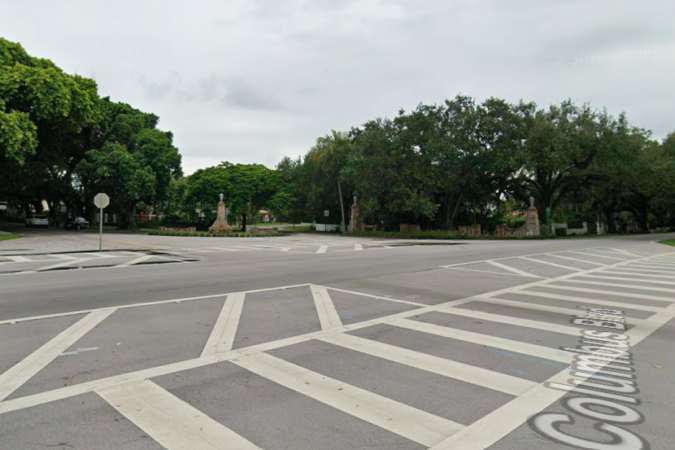
Columbus Plaza sits at the intersection of Coral Way, Columbus Boulevard and Indian Mound Trail. Designed as part of the city’s original 1920s plan, it features historic architectural elements associated with landscape architect Frank Button and artist Denman Fink.
The intersection presents unusual challenges for pedestrians. Vehicles traveling east and west on Coral Way move without stopping, while traffic entering from Columbus Boulevard and Indian Mound Trail is controlled by stop signs.
The Miami-Dade County Department of Transportation and Public Works developed the proposal after residents requested safer crossings.
County representatives told the board that traffic counts showed approximately 1,300 vehicles during peak morning and afternoon periods, while pedestrian counts exceeded 20 during the morning peak. The nearest designated pedestrian crossing along Coral Way is more than 3,000 feet away, according to the county’s presentation.
The county’s proposed improvements, submitted for the board’s Nov. 19 review, would reduce the amount of pavement at the intersection, add landscaped pedestrian refuge islands and shorten crossing distances.
The design also includes new and redesigned crosswalks, updated pedestrian ramps, sidewalk improvements, resurfacing, additional green space and lighting. A rectangular rapid-flashing beacon would alert motorists when pedestrians use a new crosswalk across Coral Way, east of Columbus Boulevard.
County engineers said the islands would organize turning movements, encourage lower speeds and provide protected areas where pedestrians could pause while crossing.
The plan would preserve the intersection’s general traffic pattern while making adjustments to roadway geometry.
Board challenges impact on historic plaza
Maxwell immediately questioned the adequacy of the presentation, saying board members could not evaluate such significant changes to a historic landmark without color renderings showing the completed intersection.
“This is insufficient information,” Maxwell said.
He said the board had previously requested more detailed visual presentations for public works projects and argued that Columbus Plaza deserved particular attention.
Miguel Soria, an assistant director with the county’s transportation department, acknowledged the concern and offered to provide a color rendering.
Soria explained that the areas highlighted in the engineering drawings would be sodded and that the proposed islands would help guide vehicles while giving pedestrians shorter, more protected crossings.
Some board members expressed support for improving pedestrian safety but questioned how the new features would affect the historic pillars, walls and other architectural elements surrounding the intersection.
Maxwell argued that the proposed configuration would diminish the plaza’s circular character and introduce materials incompatible with its historic setting.
“This is not appropriate to historic property designated in the 1920s,” he said, comparing the design unfavorably with previous county traffic changes at Granada Circle.
Board member Dona Spain, a former Coral Gables historic preservation officer, zoning administrator and assistant city manager, also cautioned against excessive landscaping.
Spain, who said she regularly walks through the intersection, argued that the city’s original plazas were intended to preserve open spaces beneath the tree canopy rather than fill them with additional trees and shrubs.
City preservation staff had reached a different conclusion in its written report.
The Historical Resources Department found that the proposed changes would not adversely affect the historic plaza features and that additional landscaping would provide a larger buffer between those features and vehicular traffic.
Staff recommended approval with three conditions: keeping landscaping low enough to preserve visibility, providing specifications for new lighting and incorporating comments from the city’s Public Works Traffic Division.
Lighting dispute sharpens disagreement
The discussion became especially contentious when Maxwell turned to the proposed lighting.
The county’s plan includes four additional light poles along Coral Way, with officials explaining that the fixtures would be coordinated with Florida Power & Light and the city’s existing lighting arrangements.
Maxwell argued that the metal poles should be painted to blend with their historic surroundings.
“All metal posts need to be painted out,” he said.
He urged the county to work more closely with city staff and the preservation board rather than presenting what he regarded as a conventional engineering solution.
When county officials explained that the lighting followed existing arrangements coordinated with the city, Maxwell pushed back.
“We all know that, so what’s your point?” he asked.
“We are telling you that you should do something else, this board has that power and that opportunity.”
County traffic engineering chief Yamilet Senespleda defended the proposal, saying the department was responding to years of requests from Coral Gables for pedestrian-safety improvements, including concerns involving parents and children.
She acknowledged that county traffic engineers were not landscape designers and said additional coordination with the city could address the board’s aesthetic concerns, although revisions could delay the project.
Maxwell said he understood the safety concerns but wanted the county to reconsider the design from a preservation perspective.
County asked to revise plan
The board ultimately deferred the application, asking county officials to return with color renderings and a revised proposal that better addresses Columbus Plaza’s historic character.
The deferral leaves the pedestrian-safety improvements awaiting further preservation review.
The Coral Gables Historic City Plan was designated a local historic landmark in 2018, requiring proposed alterations to its historic street configuration to undergo additional scrutiny.
Under the city’s zoning code, the Historic Preservation Board reviews such changes and recommends whether to grant a Special Certificate of Appropriateness. The City Commission makes the final decision.
For now, the county must reconcile its proposed safety improvements with the board’s preservation concerns before the project can advance through the city’s approval process.

Author: Coral Gables Gazette News Staff
Originally established in 1996 and relaunched as a digital publication in February 2025, the Coral Gables Gazette is an independent local news organization dedicated to factual, objective and accountable community journalism. Our newsroom reports on the people, policies, institutions and events shaping Coral Gables, Florida, providing residents with timely, informative coverage of the issues affecting their community. Our reporting includes City Hall, local government, municipal elections, public spending, real estate development, business, education, arts and culture, and neighborhood affairs throughout the City Beautiful. We follow City Commission decisions, examine public records and report on the businesses, organizations and individuals contributing to Coral Gables. We believe informed residents are essential to a healthy, engaged community. Stories published under the Coral Gables Gazette News Staff byline are prepared or compiled by the publication's editorial team. We strive for accuracy, fairness, transparency and clear distinctions between news reporting, opinion and advertising. Readers are encouraged to submit news tips, corrections, editorial inquiries and story suggestions through our Contact page and learn more about our standards through our Editorial Policy.