
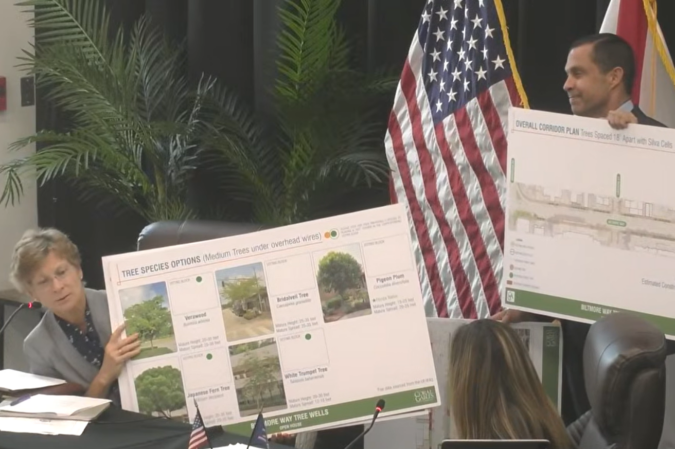
Coral Gables commissioners approved a long-awaited Biltmore Way streetscape contract Aug. 25 for about 25% more than the city had estimated when it sought bids, a difference that went undiscussed as debate instead turned to whether residents had ever seen the final design.
The discussion then became personal. Mayor Vince Lago told Commissioner Melissa Castro she was “only embarrassing yourself” after Castro questioned city staff about the public process and whether the completed plans had been brought back to residents.
The commission voted 4-0 to award HG Construction Development & Investment Inc. an estimated $1,119,214 contract, accepting the chief procurement officer’s recommendation that the Miami-based company was the lowest responsive and responsible bidder. The resolution states that the award is not to exceed budgeted funds. Commissioner Ariel Fernandez was absent.
Bid exceeds city estimate by $223,614
The price difference does not appear in the commission discussion, but it is clear in the procurement record.
In a June 5 addendum, issued after a prospective bidder asked, “What is the estimated budget for this project?,” Coral Gables answered: $895,600. The same addendum said the project plans had been approved.
HG Construction’s winning price is $223,614 higher — almost exactly 25%.
The contract amount was stated when the item was introduced last week. The earlier $895,600 estimate was not mentioned, and no commissioner asked why the winning bid exceeded it or how the difference was being absorbed.
The distinction matters: the June addendum called $895,600 the project’s “estimated budget,” but the Aug. 25 resolution authorized the higher contract amount while specifying that spending could not exceed budgeted funds. The materials reviewed by the Gazette do not explain whether additional money had subsequently been budgeted, whether existing project funds were sufficient or how the difference between the estimate and contract price was accommodated.
The city’s solicitation describes the project as redevelopment of the public right-of-way along both the north and south sides of Biltmore Way.
HG Construction, led by President Roberto M. Hernandez, cited extensive public-sector experience in its bid package. Among its other Coral Gables work, the company listed the Phillips Park renovation, with a contract value of about $3.88 million and a November 2025 contract date, and a 2019 passive-parks project worth about $1.22 million. HG identified itself as the prime contractor on both.
Its references also included roadway improvements for the City of West Park and work for the City of Sunrise and Miami-Dade County.
Resident says final plan never returned to public
Officials used different starting points Tuesday in describing how long Biltmore Way has been under discussion.
Vice Mayor Rhonda Anderson said the effort goes back “close to 18 to 20” years. Lago repeatedly referred to nearly a decade of discussions. Sheryl Gold, a Biltmore Way-area resident whose written comments were read into the record because she could not attend, said she has advocated for the streetscape for 10 years.
“In that time, the city has hired several consultants and held meetings that went nowhere, wasting both taxpayer money and residents’ time,” Gold wrote.
Her objection Tuesday centered on what happened after the most recent public meeting.
Gold said residents at the May 2025 meeting were shown large and medium tree options but no final plan. She wrote that another meeting was promised but never held and that staff continued developing the design without presenting the finished version to residents.
“For a project of this scale and importance to the neighborhood, the final design should have been presented to the residents before it was put out for bid,” Gold wrote.
She also disputed the assertion that residents had agreed to let city staff select the final tree species and objected to what she described as Anderson advancing her own preferences. Gold urged commissioners to delay the contract until residents could see the final streetscape design and comment on it.
Anderson rejected that characterization.
“I didn’t choose the trees,” she said.
“The consensus is of everybody except Ms. Gold,” Anderson added. “If we had 99 people, there was one dissenter, and that was Ms. Gold.”
Anderson said the majority of residents at the earlier meeting wanted smaller trees on the sidewalks and did not want to sacrifice parking spaces to accommodate larger canopy trees.
Staff says final choices came from options residents saw
Castro asked Public Works Director Hermes Diaz directly whether the finished design had been presented to Biltmore Way residents.
Diaz said the May 28, 2025 meeting had included a palette of tree and landscaping choices and that the species ultimately chosen were among those options.
He also said discussion at that meeting ended with residents allowing staff to choose from the presented alternatives because staff had the technical expertise to make the final selections. Asked about residents who disputed that account, Diaz acknowledged he could not speak for every person who attended but said that was the consensus captured on video.
Castro then asked whether anything had been presented to residents after May 28.
“No,” Diaz replied, explaining that staff took the results of the meeting, coordinated with the consultant and began finalizing the construction drawings. He emphasized, however, that the resulting plan remained within the range of options residents had already seen.
Later, Diaz said the final plan used roughly three tree species from the five or six that had been shown, along with ground-cover options from the same presentation.
Physical constraints also affected the design. Diaz and other officials said utility lines and underground parking structures prevented large canopy trees from being planted in some locations. In one area, staff said the underground garage extends beneath the public right-of-way, making it impossible to penetrate or overload the structural slab with a large tree.
Lago-Castro exchange turns personal
The disagreement intensified as Castro continued questioning the process and Lago sought to move the item forward.
Lago urged Castro to watch the video of the 2025 meeting, saying he had done the same with other public meetings when preparing for commission discussions. He said the Biltmore Way project had been debated for years and that continued delay made little sense.
“We have to move forward,” Lago said. “We’ve been talking about this for 10 years.”
Castro eventually interjected: “I can finish my argument now.”
“Argument?” Lago replied. “I don’t know what you’re arguing about, but you’re not arguing with me.”
Castro responded point by point.
“Number one, let this be the last time you interrupt me. The floor was mine,” she said. “Number two, I didn’t ask for your recommendation. I’m not your daughter and I’m not your employee.”
“Stay there in your lane,” Castro continued. “And number three, my duty here is to represent the residents of Coral Gables.”
She said she had intended all along to vote for the contract but wanted residents’ concerns entered into the record.
Lago responded that Castro’s comments were “one of the most ridiculous things I’ve ever read in my life.”
“Just be prepared and watch the meeting minutes,” he said. “Don’t just come here not knowing what you’re doing and then ask other people to give you an opinion.”
“You’re not prepared for a meeting and you’re only embarrassing yourself because you don’t even know what you’re voting on.”
Before the vote, Lago returned to Castro’s reference to being neither his daughter nor his employee.
“With my own daughters, I tell them just be prepared when you go to an event or before you speak because at the end of the day, not only do you embarrass yourself, you embarrass everyone around you,” he said. “So, it has nothing to do with that.”
Castro laughed, then voted yes. Lara, Anderson and Lago also voted yes.
The vote moves the Biltmore Way project toward construction after years of debate. It did so without another public presentation of the completed design — and without any commission discussion of why the accepted bid came in almost a quarter of a million dollars above the estimate the city had given prospective bidders.

Author: Coral Gables Gazette News Staff
Originally established in 1996 and relaunched as a digital publication in February 2025, the Coral Gables Gazette is an independent local news organization dedicated to factual, objective and accountable community journalism. Our newsroom reports on the people, policies, institutions and events shaping Coral Gables, Florida, providing residents with timely, informative coverage of the issues affecting their community. Our reporting includes City Hall, local government, municipal elections, public spending, real estate development, business, education, arts and culture, and neighborhood affairs throughout the City Beautiful. We follow City Commission decisions, examine public records and report on the businesses, organizations and individuals contributing to Coral Gables. We believe informed residents are essential to a healthy, engaged community. Stories published under the Coral Gables Gazette News Staff byline are prepared or compiled by the publication's editorial team. We strive for accuracy, fairness, transparency and clear distinctions between news reporting, opinion and advertising. Readers are encouraged to submit news tips, corrections, editorial inquiries and story suggestions through our Contact page and learn more about our standards through our Editorial Policy.










Dear Coral Gables Gazette:
Thank you for your excellent reporting.
You raise questions that deserve answers.
Mr. Lago’s dictatorial ways are harmful to Coral Gables.
Sincerely,
Jackson Rip Holmes
Mayor Lago complains about embarrassing other people around him when he is speaks without being prepared!?! Earlier in that meeting he proclaimed false legal advice to Attorney David Winker about what constitutes competent substantial evidence for fraudulent testimony that he refuses to have our new Inspector General investigate. He lies about reducing property taxes, having an independent search committee vet and negotiate the salary of a city manager, spending money in a fiduciary manner and increasing civility and transparency. City Code Section 2-78(a)(4) requires the Mayor “to preserve decorum and order” and “remain objective.” Section 2-81(a)(2) states that “a member, once recognized, should not be interrupted when speaking.” Section 2-83(d)(1) states that “no person shall . . . disturb any person having the floor.” Section 2-77(a)(2) requires commission meetings to be governed by Robert’s Rules of Order. As to the Mayor’s conduct, Rule 58 states that “he should set an example of courtesy, and should never forget that to control others it is necessary to control one’s self.” Coral Gables has never had a mayor that is this inept at running a meeting and who purposefully and repeatedly breaks the law. Despite Section 2-80, the City Attorney refuses to act as the parliamentarian – probably because she wants to keep making her excessive salary. Sadly, Lago is not embarrassed but proud of his improper conduct because it is consistent with his sole goal – provide Zoning Code exceptions to developers who pay money to his political machine so he can control Coral Gables for his own personal benefit.
For years, our neighborhood has asked for large canopy trees. The wide street needs them: to scale down the open space, provide shade and protection for pedestrians, mitigate urban heat island effects, calm traffic, lower energy costs, and capture stormwater. Medium and small trees don’t deliver the same benefits and get lost among the high-rises. The existing sidewalks provide ample space for large canopy trees with silva cells, without sacrificing parking. Right tree, right place is basic urban forestry practice.
As an engaged resident and citizen urban forester for almost four decades, I’ve advocated for an appropriate streetscape on Biltmore Way— including engaging, pro bono, a highly respected landscape architect to draft a preliminary plan, which was ignored.
Despite that record, the commission process was built on misleading claims. Hermes Diaz said electrical wires would prevent large trees, but told me privately otherwise. Even where wires could be an obstacle, large trees can be planted elsewhere along the two blocks. Mayor Lago said an underground garage precludes planting large trees in front of a building — true, but again, not everywhere on the street. His legacy will be a disappointing streetscape that fails to take advantage of the opportunity to protect the public from climate challenges and will resemble other mismanaged CIP projects.
Rhonda Anderson’s claims don’t hold up either. She said she didn’t select species, yet is on record preferring Verawood — and saying residents liked it — before that option was ever presented to residents at the May 2025 meeting. And she conflates parking loss with planting large trees. Parking doesn’t have to be sacrificed for large trees: the sidewalks with silva cells accommodate both. This fits a pattern: Anderson meets selectively with individual residents, then presents the result as resident consensus — as she did with Biltmore Way and the controversial dog park.
The city’s website for Envision Biltmore Way states “Community members will be invited to weigh in on these conceptual design alternatives during several workshops and public meetings.”
All of the above raises real questions: Why was this project pushed through without the normal opportunity for residents to weigh in at each stage and on the final design? Why did the city spend hundreds of thousands of dollars on consultants when staff ended up designing the landscape plan anyway? Why claim consensus when only 15 or so of the roughly 1,000 residents on this street attended the sole presentation, held over a year ago? Why present large tree options to residents if, according to the city, they cannot be planted? Why was the contract price 25% higher than the estimate?
If you’re tired of the lack of transparency, process abnormalities, manipulated outcomes and decisions made for residents instead of with them, cast a protest vote in November. Demand genuine public engagement and real resident representation.
Sheryl Gold is spot on. The residents are being disrespected and our opinions are being disregarded.
November is coming…protest votes send a message.
Vote for ANYONE BUT LAGO!