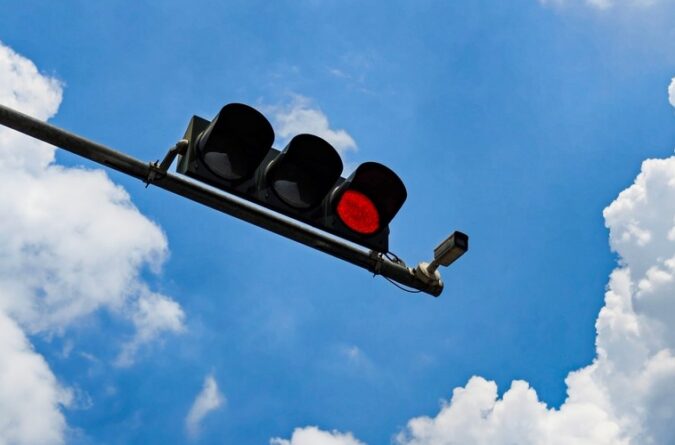
Coral Gables issued 16,777 red-light camera notices of violation in the year ending June 30, up 63 percent from 10,313 a year earlier. The city retained $712,413 of the money collected, more than three and a half times the $194,628 it kept the year before.
Total collections rose 71 percent, from $1.28 million to $2.18 million.
The figures appear in the Police Department’s 2025-26 response to the Florida Department of Highway Safety and Motor Vehicles’ annual red-light-camera survey, obtained by the Gazette.
Commissioners accepted the report Sept. 29 on a 4-0 vote with no public comment. Major Cordell Atherly of the Police Department’s Specialized Enforcement Division told them the program was producing positive results, citing declines in crashes at three intersections.
No commissioner asked about the increase in notices or revenue.
More notices, more paid
Nearly every enforcement measure increased from the previous year.
Of the 16,777 notices issued, 12,494 were paid, up from 6,794 the year before. That means about 74 percent of notices were paid, compared with about 66 percent in 2024-25.
Another 2,853 notices resulted in uniform traffic citations, more than double the 1,223 issued a year earlier. About 17 percent of this year’s notices led to citations, compared with 12 percent the year before.
A notice of violation is the first step in Florida’s red-light-camera enforcement process. The registered vehicle owner can pay the $158 penalty, contest it or submit an affidavit under circumstances allowed by law. An unpaid and uncontested notice can later result in a uniform traffic citation.
At the Sept. 29 meeting, Atherly said 71 notices were contested, with 60 upheld and 11 dismissed.
The state survey is less clear. It lists 71 notices in a field labeled “contested, but pending final outcome,” while also listing 60 upheld and 11 dismissed. Those two latter figures add up to 71. The survey does not explain the discrepancy.
City share rises sharply
Most of the $2.18 million collected did not remain with Coral Gables.
The survey says $1,086,968 was remitted to the Florida Department of Revenue, up from $617,271 the year before.
Coral Gables retained $712,413.38, compared with $194,627.57 last year. Its reported share of total collections therefore rose from about 15 percent to nearly 33 percent.
The survey does not explain the increase.
Last year’s written report accounted for the entire $1.28 million collected: $617,271 went to the state, $464,278 was paid to red-light-camera vendor RedSpeed and $194,627.57 remained with Coral Gables.
This year’s survey identifies RedSpeed as the city’s vendor but does not ask how much the company was paid.
Subtracting the amount sent to the state and the amount retained by the city from total collections leaves $385,086 not accounted for by those two survey fields. The Gazette cannot determine from the survey whether all or any of that amount went to RedSpeed.
Survey and presentation differ on camera count
The documents also leave an unanswered question about how many cameras were operating.
The survey says Coral Gables had 10 red-light cameras at 10 intersections on July 1, 2025. By June 30, 2026, according to the same form, the system had fallen to six cameras at six intersections.
At the Sept. 29 meeting, Atherly told commissioners something different: that the city had six intersections with “10 cameras completing the total count.”
The survey says no cameras were relocated during the reporting year.
The documents do not explain when or why the system would have gone from 10 cameras to six, or whether the year-end figure on the state survey is incorrect.
Police cite fewer crashes
Atherly told commissioners that crashes had fallen 26 percent at U.S. 1 and Granada Boulevard, 29 percent at U.S. 1 and Riviera Drive and 62 percent at Bird Road and Le Jeune Road.
“So it shows that this initiative that we’ve had going since 2015… is working, and we’re having some positive results,” he said.
The presentation did not identify the comparison periods behind those percentages or specify what kinds of crashes were included.
The annual survey says Coral Gables has not conducted an independent red-light-camera analysis. It lists crash numbers and pedestrian safety among the factors the city uses to judge the success or failure of individual camera locations. Revenue is not listed as a factor.
The city also told the state that red-light-camera footage has been used in crash investigations and criminal investigations.
Right-turn numbers left blank
One section of the survey is incomplete.
Coral Gables answered “yes” when asked whether it issues red-light-camera notices for improper right turns on red.
But when the survey asks how many right-turn notices were issued, paid, contested, upheld, dismissed or converted to uniform traffic citations, every field is blank.
Florida law prohibits issuing a red-light-camera notice when a driver makes a permissible right turn in a “careful and prudent manner.” It also requires municipalities’ annual reports to include the number of right-turn violations in each of the major reporting categories.
Asked on the survey how Coral Gables determines whether a right turn is careful and prudent, the Police Department listed two considerations: pedestrians at the intersection and whether the driver failed to yield to vehicles with the right of way while making a left turn.
The survey does not explain why the corresponding right-turn totals were omitted.
Coral Gables told the state that it intends to continue operating the red-light-camera program through the reporting year ending June 30, 2027.