By Coral Gables Gazette staff
Coral Gables commissioners got their first detailed look Wednesday at the city’s proposed $318.4 million budget for the 2026-2027 fiscal year, a spending plan that keeps the property tax rate unchanged while setting the stage for what city leaders expect will be difficult decisions if Florida voters approve a sweeping expansion of the state’s homestead exemption.
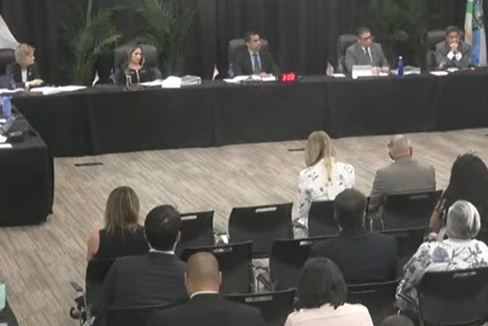
Although Deputy Finance Director Paula Rodriguez’s presentation focused on the hard numbers, including revenues, expenditures, staffing and capital projects, much of the nearly two-hour discussion centered on long-term fiscal policy.
Mayor Vince Lago repeatedly defended the administration’s conservative approach, criticized hiring decisions made under the previous city administration, and proposed creating a blue-ribbon committee to recommend ways the city could reduce spending and potentially lower taxes in future years without sacrificing essential services.
Budget numbers and tax rate
The proposed budget would maintain the city’s operating millage rate at 5.559 mills for the 12th consecutive year while increasing overall spending to $318.44 million. Operating expenditures total $252.3 million, capital improvements account for roughly $51.7 million, including vehicle replacements, and debt service totals about $10.6 million.
The budget adds just one new full-time employee, bringing the city’s workforce to 956 full-time positions, while continuing more than $50 million in infrastructure investments, including sewer improvements, historic preservation projects, parks, transportation upgrades and sea-level-rise mitigation.
In reference to a question posed by Commissioner Richard Lara, Finance Director Diana Gomez told commissioners the city continues to maintain a strong financial position, noting the city’s pension plan is expected to be 98 percent funded in 2031, and over funded by 2032, under current actuarial assumptions.
Uncertainty about looming property tax cuts
Despite those strengths, officials repeatedly returned to what they see as the city’s greatest financial uncertainty: a proposed constitutional amendment expected on the November ballot that would substantially expand Florida’s homestead exemption.
“We are the poster child for fiscal responsibility according to what the state tells us,” City Manager Peter Iglesias told commissioners. “However, we have been caught in this wash of tax reduction because of various other counties and municipalities.”
Iglesias said staff had already begun evaluating multiple scenarios to prepare for the potential revenue loss while protecting core city services and capital investments.
“Our feeling is do not cut services and do not cut capital,” Iglesias said. “There are a lot of areas we can look at that are nice to have. There are a lot of scenarios we need to look at.”
Among the areas he suggested for future review were subsidies for residential solid waste collection and other discretionary spending.
Lago praised staff for presenting what he described as one of the leanest budgets in years, emphasizing that only one employee was added despite significant increases in healthcare and personnel costs.
The mayor contrasted that approach with budgets approved under former City Manager Amos Rojas and a previous commission majority, arguing the city added too many permanent positions that will continue generating pension and healthcare obligations for years to come.
“We’re tightening our belts,” Lago said, warning that future commissions could struggle if revenues decline while personnel costs continue rising.
That prompted another pointed exchange with Commissioners Melissa Castro and Ariel Fernandez, continuing a pattern of disagreements over decisions made by previous commissions. The debate also revived lingering disagreements over the 2024 decision to finance a cost-of-living adjustment for employees, with Lago arguing borrowing for the raises extended repayment obligations while supporters defended the move as necessary to retain employees during a competitive labor market.
The discussion unfolded against a political backdrop. Lago and Castro are both seeking reelection this fall, while Fernandez is not running again, and disagreements over past financial decisions frequently resurfaced throughout the workshop.
Different amounts given for potential property tax loss
Although the property tax reform would bring significant decreases to city revenues, exactly how much was not made clear during the presentation. There was confusion among city staff during the meeting, with varying amounts given on how much the property tax would decrease city revenues in the first years if it is approved. During her presentation, Rodriguez said that the decrease would be $5.7 million next year, with that number rising to $11.4 million in the subsequent year, following a 150,000 and 250,000 increased homestead exemption, respectively.
At another point in the meeting, however, City Manager Peter Iglesias said the decrease would be $5.7 million in 2028, and $5.7 in 2029, for a total of $11.4 million. Lago said the estimates went from $5.7 million in year one of the tax cuts, if approved, to $12 million in year two.
Blue Ribbon Panel proposed to look at pending property tax cuts
Looking beyond the upcoming budget, Lago proposed establishing a blue-ribbon committee composed of appointees from the commission and city manager to study the city’s long-term finances and recommend potential spending reductions and related issues before projected revenue declines take effect.
The panel, he said, should examine everything from capital priorities and sea-level-rise investments to land acquisition, solid waste subsidies and other discretionary expenditures.
“I believe there should be tax cuts,” Lago said, particularly for longtime residents, retirees and first-time homebuyers. But he added that meaningful reductions require careful planning rather than politically popular short-term decisions.
Vice Mayor Rhonda Anderson supported creating the committee but said its membership should reflect a broad cross-section of the community to encourage a robust discussion about future priorities. Anderson also said conversations she had with state lawmakers suggested Coral Gables itself was a model for other cities.
“What I heard from our elected leaders in Tallahassee is they were very pleased with the City of Coral Gables,” Anderson said. “They were not upset by our millage rate. What they were upset at were other cities that raised their millage rate” and approved spending they viewed as excessive.
Castro said she does not plan to renew last year’s proposal to reduce the city’s tax rate by a quarter mill but intends to seek a smaller reduction during this year’s budget discussions.
“I’m going to be proposing at least some reduction, something that’s not going to affect the budget much, but showing a point that, hey, we care,” Castro said.
Commissioners are expected to formally vote on the proposed millage rate and discuss creation of the blue-ribbon committee at an upcoming commission meeting before two public hearings in September, when the city’s spending plan will be finalized.

Author: Coral Gables Gazette News Staff
Originally established in 1996 and relaunched as a digital publication in February 2025, the Coral Gables Gazette is an independent local news organization dedicated to factual, objective and accountable community journalism. Our newsroom reports on the people, policies, institutions and events shaping Coral Gables, Florida, providing residents with timely, informative coverage of the issues affecting their community. Our reporting includes City Hall, local government, municipal elections, public spending, real estate development, business, education, arts and culture, and neighborhood affairs throughout the City Beautiful. We follow City Commission decisions, examine public records and report on the businesses, organizations and individuals contributing to Coral Gables. We believe informed residents are essential to a healthy, engaged community. Stories published under the Coral Gables Gazette News Staff byline are prepared or compiled by the publication's editorial team. We strive for accuracy, fairness, transparency and clear distinctions between news reporting, opinion and advertising. Readers are encouraged to submit news tips, corrections, editorial inquiries and story suggestions through our Contact page and learn more about our standards through our Editorial Policy.