
By Coral Gables Gazette staff
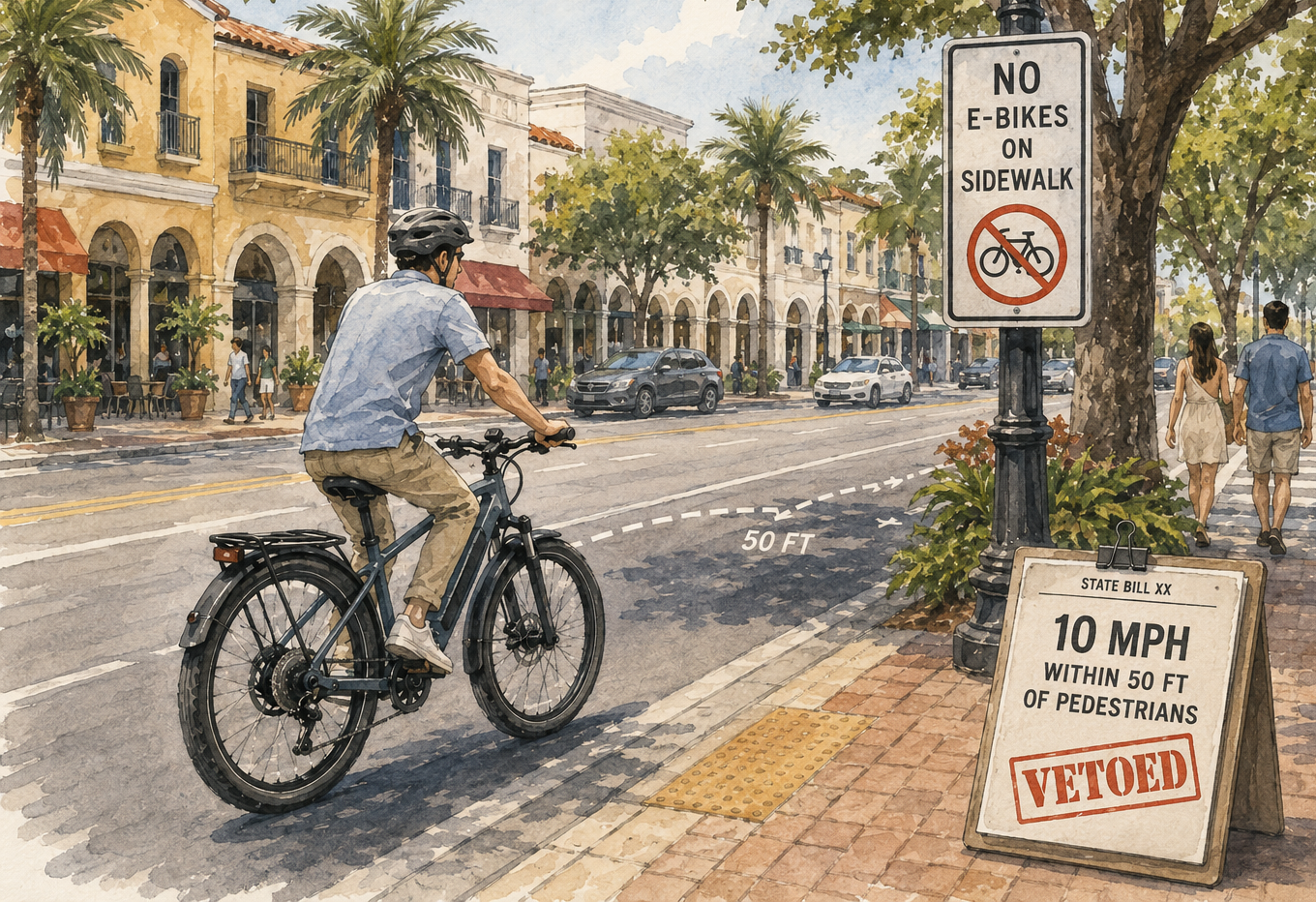
Coral Gables’ campaign to make its streets and sidewalks safer for pedestrians hit a setback last week when Governor Ron DeSantis vetoed legislation that city leaders had hoped would give local governments stronger statewide tools to regulate electric bicycles and other micromobility devices.
In February, the Coral Gables City Commission voted unanimously to prohibit the use of electric bicycles on city sidewalks, part of a broader effort to address the growing number of high-speed micromobility devices sharing space with pedestrians in the city’s busiest commercial districts. The action reflected the city’s continuing effort to embrace new transportation options while balancing safety concerns in its walkable downtown.
At the time, city staff told commissioners they would continue working with Coral Gables’ lobbying team in Tallahassee to pursue additional statewide safety measures governing electric bicycles and similar devices. While lawmakers ultimately approved one of those proposals, DeSantis vetoed the bill before it could become law.
A statewide bill dies in Tallahassee
Senate Bill 382 would have prohibited riders from traveling faster than 10 mph when within 50 feet of a pedestrian, created a statewide Micromobility Device Safety Task Force to recommend future regulations and required more detailed reporting of crashes involving micromobility devices.
Why the governor rejected it
In his veto message, DeSantis said the bill’s 50-foot pedestrian buffer would be nearly impossible for riders to judge while operating a bicycle. He also expressed concern that enforcing the speed limit could require expanded speed-detection technology or surveillance and questioned creating a state task force without a specified expiration date.
The city says the effort isn’t over
Despite the setback, Coral Gables officials say the city has no intention of backing away from the issue.
“While we respect the state’s decision to veto SB 382, the City of Coral Gables remains committed to improving safety for everyone who uses our streets, sidewalks, and shared public spaces,” Parking, Sustainability and Mobility Services Director Monica Beltran said.
Beltran said city officials remain particularly concerned about the operation of electric bikes and other micromobility devices in the downtown, where pedestrians, businesses and visitors all compete for limited sidewalk space.
“Our focus is on finding practical, balanced solutions that encourage responsible use while protecting pedestrian safety,” she said, adding that the city will continue evaluating educational outreach, operating standards, minimum age requirements and other local safety initiatives while working with state and local partners.
A push for a minimum riding age
That commitment was reinforced during a recent meeting of the Coral Gables Waterfront Communities HOA Board, where members received an update on the governor’s veto and urged Mayor Vince Lago to bring new safety measures before the City Commission, including establishing a minimum riding age of 16 and expanding public education efforts.
Balancing new mobility with pedestrian safety
The debate reflects Coral Gables’ broader philosophy toward emerging transportation technologies. City officials have expanded mobility options over the past several years through trolleys, Freebee on-demand vehicles, shared scooters and other alternatives intended to reduce automobile dependence. At the same time, commissioners have emphasized that innovation cannot come at the expense of pedestrian safety, particularly in the city’s dense downtown and historic neighborhoods.
Vice Mayor Rhonda Anderson has frequently warned that sidewalks should remain first and foremost for pedestrians, arguing during previous commission discussions that city infrastructure must be designed so people with disabilities, parents pushing strollers and other pedestrians are not forced into the street by new mobility devices.
Residents have echoed those concerns. During February’s commission meeting, Coral Gables resident Maria Cruz voiced strong support for the sidewalk ban, telling commissioners that people living near the University of Miami regularly witness students rushing to class on electric bikes. Riders, she said, often travel so quickly that pedestrians must “look both ways and sometimes look again because the electric bikes do not look. They just go fast.”
For Coral Gables, the governor’s veto may have delayed additional statewide regulation, but city leaders say their effort to find a measured balance between embracing new mobility options and protecting pedestrians is far from over.













Thank you for providing this News.
I agree with the City’s position on this.
I wasn’t present for the debate in February, but the status quo sounds like a nightmare.
Gov. DeSantis is endangering public safety, in my opinion.
Sincerely,
Jackson Rip Holmes
On a different subject, the upcoming Property Tax Reform Referendum, as a Candidate for Mayor, given my research that this only results in a 10% reduction in City Revenue, I support it.
In my 28 years of attending Coral Gables Commission Meetings, I have found dishonesty about taxation by the City, and the attitude of the City and County that they are ABOVE ECONOMIC LAW THAT APPLIES TO CITIZENS, to be morally wrong.
I support the upcoming Property Tax Reduction Referendum.
Sincerely,
Jackson Rip Holmes
Candidate for Mayor
Could always just build the supporting infrastructure to allow people to safely coexist in the right of way. The city has continuously blocked efforts to build world class infrastructure in favor of studies that get shelved, plans that get stalled, bans and paint on the ground labeled as infrastructure.
You are correct and the biggest obstacle to safe infrastructure – Vicente Lago.
The City’s ordinance to ban the use of e-bikes on sidewalks was a step in the right direction and we should find ways to do more locally. For example, would the City be able to create a local ordinance introducing the speed limit and expanding the definition of e-bikes to include electric scooters?
Scooters and bikes on sidewalks are a major hazard. They are fine on public park areas; not on city sidewalks or other pedestrian areas. My wife and I have already experienced very frightening incidents of near collision with teens going at high speed and missing us by mere inches. They are also rude, disrespectful, and unapologetic — in ways that elicit escalation, including a pedestrian’s rightful actions in self defense. The police is apparently unable to assist because they told me that they lack clear guidance from City government. This issue has already become a clear and present problem, and some preventable disasters are just waiting to happen. Not if but when. The business community (Chamber of Commerce) downtown should be a stakeholder as well, because customers are no longer safe on sidewalks accessing stores and places of work.
The city does not enforce its existing code prohibiting scooters, bikes and skateboards on Miracle Mile and Ponce. And it has confusing and conflicting information as to which sections of Ponce this code applies. It is not safe for any of our sidewalk users to have to share them in conditions that entail serious consequences. The city government has sidestepped this issue for too long by not enforcing and claryfing a code it already has.
I have seen teen’s in my neigborhood riding these e-bikes at speeds as if they were motorcycles. They have no concerns for their safety and that of others. It is a fact that since e-bikes became a defacto trend for both teens and adults, more accidents have been recorded.
But how do you control it? That remains a question because enforcement of any kind would be almost impossible and very costly.
Perhaps is to have those merchants that sell these bikes, to send a notification to the city as to the age and address, or perhaps enforce some sort of licensing. After all, these are motorized vehicles.
I’d love to be able to ride my bike comfortably to and around our downtown, but that’s impossible as it’s not safe on the streets and not lawful (or pleasant) on ‘major’ sidewalks. As Jessica said, we need safe spaces for all.
Sidewalks are for walking, period. Apparently it will take more injuries and a lawsuit against the city arising out of these injuries for the city to abandon its obsessive craving for “new technologies.”
Here’s something new for the Commission: common sense.