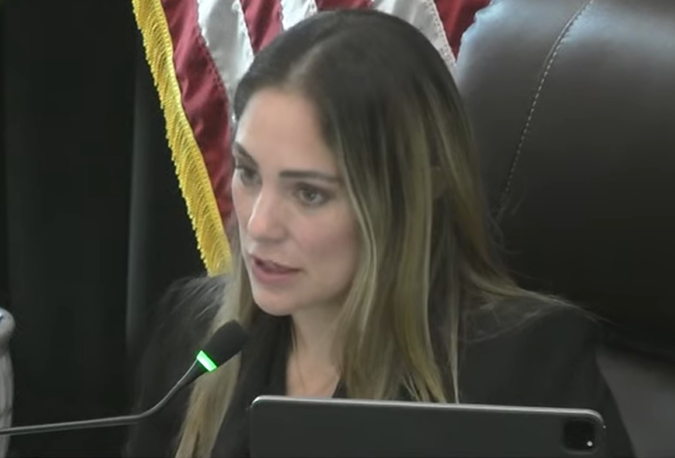
A campaign finance ordinance sponsored by Commissioner Melissa Castro died on the Coral Gables Commission floor Sept. 15 without a second, ending, at least for now, her latest attempt to bar campaign contributions from vendors, certain lobbyists and real estate developers.
Before the item collapsed, Castro used it to present a list of contributions made to a political committee aligned with Mayor Vince Lago on two days in June by people and firms she linked to the Crystal Residences development.
A legal problem Castro couldn’t overcome
The ordinance, modeled on a similar Miami Beach law, would have restricted campaign contributions from certain vendors, lobbyists and real estate developers, including those with specified matters pending before the city.
The City Attorney’s Office told Castro that Florida law preempts such restrictions. Florida Statute 106.08(11) expressly bars local governments from adopting contribution limits that differ from the state’s and separately prohibits any local limitation or restriction involving contributions to a political committee. Coral Gables First, which has reported more than $2.35 million in contributions since it began filing reports, is registered as a political committee.
Castro repeatedly pointed to Miami Beach, which still lists similar restrictions in its campaign-finance rules. But a city attorney declined to offer an opinion on Miami Beach’s ordinance or how it is enforced and advised Coral Gables against adopting a restriction preempted by state law.
The attorney told Castro that disclosure requirements might provide a legally defensible alternative. Castro asked the office to work with her on something that could address her concerns while complying with state law.
Later in the discussion, Castro characterized proceeding despite the legal objection as “a risk worth taking.” It was, by her own account, not the first time she had brought a version of the proposal and deferred it.
A donor list from two days in June
Before the motion failed, Castro displayed a graphic naming contributions to Coral Gables First that she said were connected to Crystal Residences, the Fifield Companies development the Commission approved 3-1 on Aug. 25 over her dissent.
Those contributions were not made in the 48 hours before that vote. Records show they landed on June 25 and 26, 11 to 12 days before the project’s first reading July 7 and about two months before final approval. The city’s official record confirms the project advanced on first reading July 7 and received final approval Aug. 25.
Among the contributions Castro highlighted were $10,000 from Fifield Companies founder Steven Fifield on June 25, a contribution the Gazette has previously reported; $500 from Tim Hyman on June 26, whom Castro described on the record as “a Fifield outreach consultant”; $2,000 from attorney Iris Escarra on June 26, whom Castro connected to land-use work on the project; $1,000 from Modis Architects on June 26; and $1,000 from Ricardo Caporal on June 25, whom Castro linked to a prior ownership interest in the property.
The Gazette independently confirmed the contributors’ names, dates and amounts against Coral Gables First’s public filing. Castro’s specific characterization of each contributor’s connection to Crystal Residences reflects her presentation and has not been independently verified by the Gazette, apart from Fifield’s and Hyman’s roles.
Coral Gables First refunded Hyman’s $500 contribution Aug. 28, three days after the final Crystal Residences hearing. During that hearing, opponents identified Hyman while presenting allegations that several project supporters had used false addresses while testifying under oath. Hyman himself was not accused of giving false testimony; he was identified as a link between people who had appeared in support of development proposals at separate proceedings. The public campaign-finance filing gives no reason for the refund.
The June 25-26 filing also contained contributions Castro did not include in her presentation, among them $25,000 from broker Sid Perkins and $25,000 from Ponce Park Residences LLC on June 25. Those were the two largest individual contributions reported during the two-day period.
Castro was careful to frame the pattern as a question rather than an accusation.
“I’m not saying this is an illegal contribution in any sense,” she said. She said her concern was whether the system created an appearance that affected public confidence.
She returned to the distinction later: “I’m not accusing anyone of doing anything, but these are the facts, people. This is what’s happening.”
Commissioner Richard Lara pressed her directly on that distinction.
“Commissioner Castro, are you stating right now for the record that the contributions that you’ve identified caused a particular vote to be taken?” he asked.
Castro did not claim they had.
“I’m saying there’s a correlation,” she said.
When Lara asked again whether she could establish that a contribution caused, influenced or was exchanged for a vote, Castro said she could not.
“I could tell you that there’s an appearance of conflict,” she said.
Nothing in the campaign-finance filings establishes that any contribution influenced a Commission vote.
Pushback from the dais
Lago responded before Castro displayed the graphic, saying he understood that it concerned him. He argued that the proposal, even if adopted, could not restrict contributions to political committees and called the effort “pure political theater” that “only embarrasses the city of Coral Gables.”
He also used the exchange to address Castro’s reelection campaign directly.
“You’re not running against me,” Lago told her. “You’re running against Nestor Menendez, which I hope everyone in this community votes for.”
The discussion later veered into Castro’s pending state ethics case and increasingly personal exchanges before returning to the ordinance.
Castro ultimately sought to redirect the matter toward review by state authorities. No commissioner offered a second, and the item died. The Commission moved on.