For the first time in its more than 100-year history, Coral Gables is holding its municipal elections in November rather than April. With voting already underway by mail and at early-voting sites, residents are choosing among seven candidates for three City Commission seats and deciding four proposed changes to the City Charter. Election Day is Tuesday, Nov. 3.
Polls will be open from 7 a.m. to 7 p.m. at assigned precinct locations. Early voting continues through Sunday, Nov. 1, and completed mail ballots must reach Miami-Dade County election officials by 7 p.m. Tuesday.
This guide explains who is running, what the four charter questions would change, where residents can vote and what they need to know before casting their ballots.
Election at a glance
| Election Day | Tuesday, Nov. 3 |
| Polling hours | 7 a.m. to 7 p.m. |
| Early voting ends | Sunday, Nov. 1, at 7 p.m. |
| Mail-ballot deadline | Received by 7 p.m. Nov. 3 |
| City offices on ballot | Mayor, commission Groups IV and V |
| City charter questions | Four |
| Possible runoff | Tuesday, Dec. 1 |
| Voter assistance | Miami-Dade Elections: 305-499-8683 |
Voters can confirm their polling places and registration information through the Miami-Dade Supervisor of Elections.
Why this election is different
Coral Gables has held its municipal elections in April for more than a century, apart from the state and national election calendar. That tradition ends this year following an April 21 referendum in which voters approved moving city elections to November of even-numbered years.
The measure received 5,678 yes votes, or 66.04 percent of ballots cast on the question, in a mail-only election that drew participation from 8,598 voters, about 28 percent of the city’s 30,342 registered electorate, the Gazette reported.
Mayor Vince Lago championed the change, arguing that combining city elections with state and national contests would increase participation and reduce election costs. Commissioners Melissa Castro and Ariel Fernandez opposed the proposal, expressing concern that local issues could be overshadowed by national politics and a crowded ballot.
The change also shortened several current officials’ terms by approximately four months.
Cost was another central argument. The city estimated that a stand-alone municipal general election cost approximately $125,000, compared with about $20,000 to include the municipal contests on November’s general-election ballot. Those figures do not include the cost of a possible December runoff, which the city estimated could cost another $125,000.
The last regularly scheduled April municipal election, in 2025, drew 29.62 percent turnout, with participation falling to 23.14 percent in the runoff.
Tuesday’s election will provide the first opportunity to assess participation under the new calendar, although the different contests and voting circumstances will complicate direct comparisons with past municipal elections.
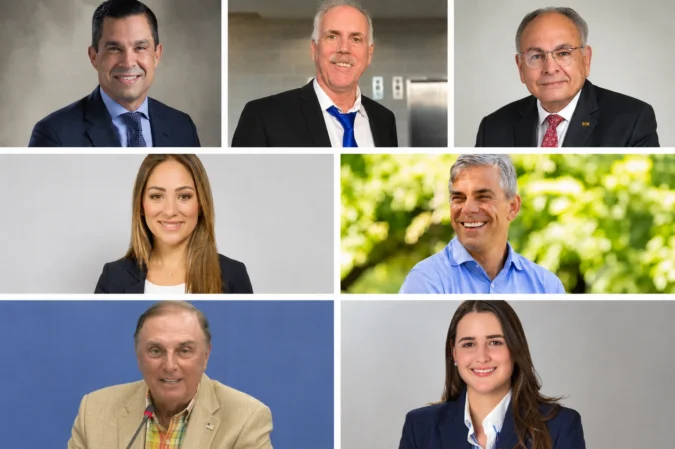
Seven candidates compete for three seats
Three of the City Commission’s five seats are on the ballot. All three races are nonpartisan, and voters may select one candidate in each contest.
Mayor, Group I
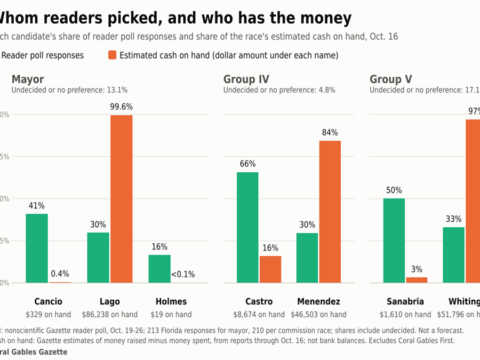
Three candidates are seeking the mayor’s seat: Laureano Cancio, Jackson “Rip” Holmes and incumbent Vince Lago.
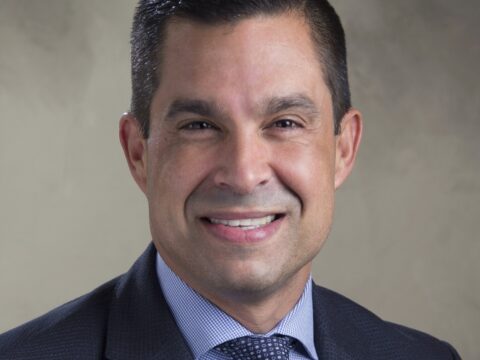
Lago, who has served as mayor since 2021 after eight years as a commissioner, is seeking a fourth consecutive mayoral term. If reelected, the city’s eight-year consecutive-service limit would prevent him from running again in 2028.
Cancio, an attorney, unsuccessfully sought a commission seat in 2025. Holmes has previously run for municipal office and frequently addresses the City Commission.
The mayor serves a two-year term under the current charter.
Commissioner, Group IV
Incumbent Melissa Castro, first elected in 2023, is seeking a second four-year term against challenger Nestor Menendez.
Menendez, an attorney, previously served on the city’s Planning and Zoning Board, Transportation Advisory Board and Charter Review Committee.
Commissioner, Group V
Gonzalo Sanabria and Dominique “Nikki” Whiting are competing for the open seat being vacated by Commissioner Ariel Fernandez, who is not seeking reelection.
Sanabria serves on the city’s Planning and Zoning Board and previously ran for the commission. Whiting, listed on the ballot as Nikki Whiting, is director of development for the Adam Smith Center at Florida International University and has worked in government and political communications.
The Gazette previously profiled the seven qualified candidates and examined their positions on major city issues.
Readers also can review the Gazette’s analysis of the election’s implications for City Hall and its investigation of campaign contributions and expenditures.
Four charter questions could change city government
In addition to the three candidate races, Coral Gables voters will decide four proposed amendments to the City Charter.
The City Commission voted unanimously in July to place the questions on the ballot, although individual commissioners expressed differing views about the proposals themselves.
A yes vote approves the proposed charter change; a no vote leaves the existing provision in place.
Referendum 1: Public-works bidding threshold
The first question would raise the value of public-works projects requiring formal competitive solicitation from $25,000 to $300,000, with future adjustments under state law.
Supporters of the change have argued that the current $25,000 threshold is outdated and impractical given modern construction costs. The Charter Review Committee unanimously recommended the increase.
The issue is how much purchasing flexibility the city should have before the charter requires formal competitive solicitation.
Approval would raise that threshold. Rejection would retain the current charter requirement.
Referendum 2: Candidate residency requirements
The second question would require candidates for mayor and commissioner to have lived continuously in Coral Gables for at least one year immediately before the end of the qualifying period.
The existing charter measures the one-year residency requirement before Election Day.
The proposed change would establish an earlier deadline for meeting the residency requirement and explicitly require continuous residency during that period.
The City Attorney’s Office proposed the change in response to questions about candidate residency requirements, and the Charter Review Committee supported it.
Referendum 3: Four-year mayoral terms
The third question would increase the mayor’s term from two years to four, beginning with the November 2028 election.
Commissioners already serve four-year terms.
The existing eight-year limit on consecutive service as mayor would remain unchanged. The amendment would not extend the term of whoever wins Tuesday’s mayoral election.
Lago supports the proposal, arguing that a four-year term would allow a mayor to spend more time governing and less time campaigning. Opponents contend that retaining two-year terms gives voters more frequent opportunities to evaluate the mayor’s performance.
Coral Gables voters have considered this question before. They approved four-year mayoral terms in 2005, then restored two-year terms in 2009.
The Gazette previously examined the proposal and its history in its coverage of the July charter-amendment debate.
Referendum 4: Voter approval for certain city-owned property transactions
The fourth question would require approval by at least 60 percent of voters in a citywide special election before Coral Gables could sell, exchange, convey or lease for 10 years or longer certain city-owned property used for parks, recreation, golf courses or open park space.
The measure would apply to property used for those purposes as of Nov. 3, 2026, as well as property later acquired for such uses. The 10-year lease threshold would include applicable renewal and option periods.
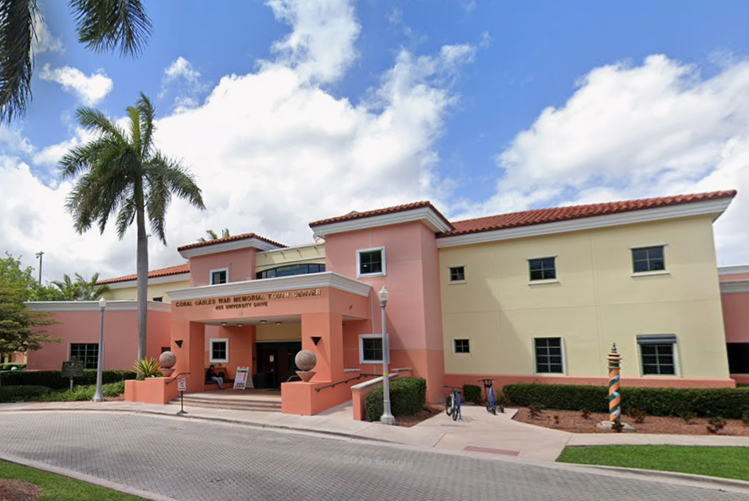
Lago, who proposed the measure, has cited properties including Granada Golf Course, Salvador Park and the War Memorial Youth Center.
The proposal would give voters direct authority over covered transactions, although the supermajority requirement also could prevent a transaction supported by a simple majority of voters.
The question itself requires only a simple majority to pass Tuesday. If approved, the 60 percent threshold would apply to future transactions covered by the amendment.
Voters can review all four questions on the official Miami-Dade sample ballot, available in English, Spanish and Haitian Creole.
Where to vote on Election Day
On Tuesday, voters must cast their ballots at their assigned precinct polling place. All Election Day polling places will be open from 7 a.m. to 7 p.m.
The 16 precincts serving Coral Gables voters are assigned to 14 polling locations.
| Precinct | Polling place | Address |
|---|---|---|
| 601, 608 | Country Club of Coral Gables | 997 N. Greenway Drive |
| 604 | American Legion Post 98 | 303 Alhambra Circle |
| 607 | Coral Gables Congregational Church | 3010 De Soto Blvd. |
| 611 | Coral Gables Senior High School | 450 Bird Road |
| 612 | St. Augustine Catholic Church | 1400 Miller Road |
| 613 | Ponce de Leon Middle School | 5801 Augusto St. |
| 614 | Coral Gables Fire Station 2 | 525 S. Dixie Highway |
| 615 | Coco Plum Woman’s Club | 1375 Sunset Drive |
| 617 | Coral Gables Fire Station 3 | 11911 Old Cutler Road |
| 618, 646 | Pinecrest Branch Library | 5835 SW 111th St., Pinecrest |
| 633 | Wesley United Methodist Church | 133 Ponce de Leon Blvd., Miami |
| 635 | Christ Congregational Church | 14920 SW 67th Ave., Palmetto Bay |
| 636 | Coral Gables Branch Library | 3443 Segovia St. |
| 640 | Watsco Center, University of Miami | 1245 Dauer Drive |
Source: Miami-Dade County Supervisor of Elections’ Oct. 15 polling-place list, cross-referenced with Coral Gables precinct information.
Some polling places serving Coral Gables residents are outside city limits, including locations in Miami, Pinecrest and Palmetto Bay.
Voters should confirm their assigned polling place before traveling. Miami-Dade provides a personalized voter-information and precinct lookup.
The county has announced temporary polling-place changes affecting some voters. Individual precinct assignments should be checked against the most current official information.
Unlike early voting, Election Day voting is restricted to each voter’s assigned polling place.
Early voting continues through Sunday
Early voting continues through Sunday, Nov. 1, at 28 Miami-Dade County locations.
All early-voting sites are open daily from 7 a.m. to 7 p.m.
The Coral Gables Branch Library, 3443 Segovia St., is an early-voting site. Registered Miami-Dade voters may use any county early-voting location, regardless of their assigned Election Day precinct.
The county provides early-voting locations and additional election information online.
There is no early voting Monday, Nov. 2.
Mail ballots must arrive by Tuesday evening
The deadline to request a vote-by-mail ballot passed Oct. 22. Residents who already have a ballot must ensure that it reaches the Miami-Dade Supervisor of Elections by 7 p.m. Tuesday.
A ballot postmarked by Election Day but delivered afterward will not meet the deadline.
Through Sunday, completed mail ballots may be returned to staffed secure ballot-intake stations at any early-voting location during voting hours.
After early voting ends, mail ballots may be returned to the Elections Department’s headquarters at 2700 NW 87th Ave. in Doral or its downtown branch office at the Stephen P. Clark Government Center, 111 NW First St., Miami, before the deadline.
Mail ballots cannot be dropped off at regular Election Day polling places.
Voters can check whether their mail ballots have been received through the county’s voter-information portal.
What identification to bring
Voters casting ballots in person must present current, valid identification bearing a photograph and signature.
Acceptable forms include a Florida driver’s license, Florida identification card, U.S. passport, military identification and other identification permitted under state law.
If a photo ID does not contain a signature, voters may present a second approved document containing one.
Those without acceptable identification may still cast a provisional ballot. If the only problem is missing identification, the ballot can be counted if election officials determine that the voter is otherwise eligible and the signature matches the registration record.
Voters who cast provisional ballots because of other eligibility questions may need to provide additional documentation. The deadline to submit supporting evidence or correct certain deficiencies is 5 p.m. Thursday, Nov. 5.
For assistance, contact Miami-Dade Elections at 305-499-8683 or consult the county’s provisional-voting instructions.
Anyone in line when polls close at 7 p.m. Tuesday is entitled to vote.
What happens if no candidate wins a majority?
Coral Gables retains a majority-vote requirement in municipal elections. In April, voters rejected a proposed charter amendment that would have eliminated runoff elections.
If no mayoral candidate receives a majority Tuesday, the two candidates receiving the most votes will advance to a runoff on Tuesday, Dec. 1.
The two commission races each have two candidates and ordinarily would be decided Tuesday.
A longer ballot and a different electorate
For the first time, Coral Gables’ municipal contests appear on the November general-election ballot alongside statewide and federal races.
Depending on their districts, voters also will see contests for Florida governor, U.S. Senate, Congress, the state Legislature and other offices, along with state and county ballot questions.
Among the three proposed statewide constitutional amendments is Amendment 3, which would expand the homestead exemption for non-school property taxes to $150,000 in 2027 and $250,000 in 2028, with inflation adjustments thereafter. It also would lower the annual assessment-increase cap on non-homestead properties from 10 percent to 5 percent.
The proposal has potential implications for property-tax revenue available to local governments, including Coral Gables. Statewide constitutional amendments require at least 60 percent voter approval.
Voters can review their individual sample ballots to see all contests and questions applicable to their addresses.
The move to November was intended to bring more residents into municipal elections by aligning city voting with the larger general-election electorate. Critics questioned whether voters confronting a longer ballot would give local contests the same attention they receive in stand-alone municipal elections.
Tuesday’s turnout will provide an initial measure of participation under the new system. The implications for future city elections will become clearer after the votes are counted.
Gazette to publish election-night results and analysis
The Coral Gables Gazette will publish election-night results and analysis once the returns are substantially in.
Coverage will include the three municipal races, the four charter referendums and an examination of the results and their implications for the next City Commission. If a runoff is necessary, the Gazette will report on the contest ahead.
Readers can follow the Gazette’s Election 2026 coverage for reporting on candidates, campaign finances, city issues and election results.
Official election information and returns will be available through the Miami-Dade Supervisor of Elections.
For Coral Gables, Nov. 3 marks a historic change in the city’s political calendar: its first November municipal election in more than a century, with local contests appearing on the same ballot as state and national elections.

Author: Coral Gables Gazette News Staff
Originally established in 1996 and relaunched as a digital publication in February 2025, the Coral Gables Gazette is an independent local news organization dedicated to factual, objective and accountable community journalism. Our newsroom reports on the people, policies, institutions and events shaping Coral Gables, Florida, providing residents with timely, informative coverage of the issues affecting their community. Our reporting includes City Hall, local government, municipal elections, public spending, real estate development, business, education, arts and culture, and neighborhood affairs throughout the City Beautiful. We follow City Commission decisions, examine public records and report on the businesses, organizations and individuals contributing to Coral Gables. We believe informed residents are essential to a healthy, engaged community. Stories published under the Coral Gables Gazette News Staff byline are prepared or compiled by the publication's editorial team. We strive for accuracy, fairness, transparency and clear distinctions between news reporting, opinion and advertising. Readers are encouraged to submit news tips, corrections, editorial inquiries and story suggestions through our Contact page and learn more about our standards through our Editorial Policy.