Must a Haitian writer use a particular language to be considered authentic? Does recognition require leaving Haiti? And why have women’s voices so often been overlooked in accounts of the country’s literary history?
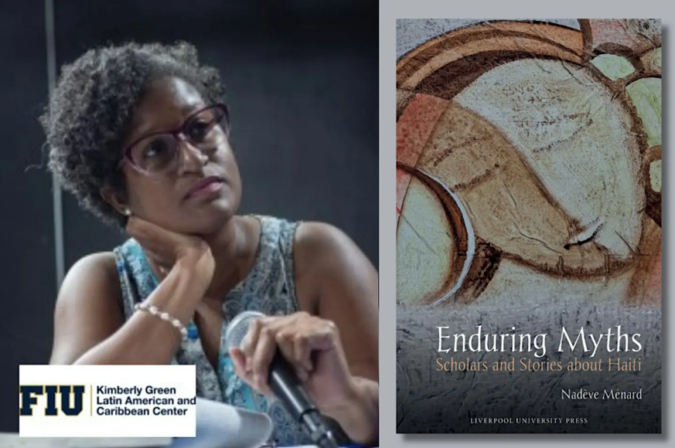
Haitian scholar Nadève Ménard challenges those assumptions in her new book, Enduring Myths: Scholars and Stories about Haiti, which she will present Friday, Oct. 30, at 7 p.m. at Books & Books, 265 Aragon Ave., in Coral Gables.
The free event is part of the Caribbean Book Series organized by Florida International University’s Kimberly Green Latin American and Caribbean Center in partnership with the independent bookstore.
The 332-page study, published by Liverpool University Press, examines how longstanding ideas about Haitian identity have shaped — and sometimes distorted — the interpretation of Haitian literature. Its central argument is that scholars’ assumptions about language, geography and gender can determine which writers receive recognition and which remain neglected.
Three myths that shape the literary canon
Ménard draws on literary scholarship produced in Haiti, France, Quebec, the United States and elsewhere, applying a Black feminist framework to reconsider what scholars have traditionally treated as authentic Haitian writing.
One target is the assumption of monolingual authenticity: the idea that legitimate Haitian literary expression must conform to a particular language. In a country with a complex relationship between French and Haitian Creole, that question carries implications for which works receive scholarly attention.
Another is the notion that exile is essential to the Haitian writer’s experience. Although migration and displacement have shaped much of the country’s literature, Ménard challenges the tendency to treat those experiences as prerequisites for literary significance.
The third concerns the supposed silence of Haitian women. Ménard examines how women writers have contributed to the country’s literary tradition, even when their work has received comparatively little attention.
The book also addresses the neglect of early Haitian narratives and assumptions about the origins of modern Haitian literature, including the role assigned to literary movements that emerged during the U.S. occupation of Haiti from 1915 to 1934.
Rather than simply revising a reading list, Ménard questions the critical standards used to construct the list in the first place.
Eight writers challenge conventional narratives
A distinctive feature of Enduring Myths is its use of short fiction to test those arguments. Each chapter concludes with an examination of one or two stories, connecting the broader scholarly debate to particular literary works.
The book’s published description and contents identify eight writers whose work spans the 19th through 21st centuries: Ignace Nau, Virginie Sampeur, Fernand Hibbert, Philippe Thoby-Marcelin, Marie-Thérèse Colimon-Hall, Évelyne Trouillot, Kettly Mars and Chantal Kénol.
Five are women, a selection that underscores Ménard’s challenge to the notion of women’s absence from Haitian literary history.
The authors also represent different generations and relationships with Haiti. Their inclusion resists the suggestion that one period, literary movement or experience of migration can define an entire national literature.
Ménard has explored these questions in earlier scholarship. In a 2024 article published in the journal Études françaises, she examined stories by Sampeur and Kénol to question the assumption that silence necessarily signifies weakness or submission.
Her analysis considers how silence in fiction can instead express strength, agency or resistance. The distinction illustrates the broader method behind Enduring Myths: reconsidering familiar interpretations by returning to the literary texts themselves.
According to the event description, Friday’s presentation will include readings from works by Nau, Trouillot and Mars, offering audiences examples from the tradition Ménard examines.
A scholar connecting Haiti and international literary studies
Ménard is a professor of Haitian literature at the École Normale Supérieure of the Université d’État d’Haïti in Port-au-Prince and has served as a visiting professor at FIU.
Her scholarship spans Haitian fiction, literary criticism, translation and the relationship between literature and national history.
She edited Écrits d’Haïti, a study of contemporary Haitian literature published in 2011, and wrote a critical study of novelist Lyonel Trouillot published in 2016.
She is also one of five editors of The Haiti Reader: History, Culture, Politics, published by Duke University Press in 2020. The collection brings together historical documents, literature and scholarship examining Haiti’s development and its place in the wider world.
Her translation work includes Louis-Joseph Janvier’s Haiti for the Haitians, a 19th-century examination of Haitian sovereignty and foreign influence made available to English-language readers in a 2023 edition.
That combination of literary criticism and historical translation informs a career devoted to expanding how Haitian texts are understood and who has access to them.
Free admission for Friday’s presentation
The Coral Gables appearance precedes the hardcover’s scheduled Nov. 13 publication date. Event organizers say copies will be available for purchase Friday.
The book is part of Liverpool University Press’ Contemporary French and Francophone Cultures series. Its electronic edition is included in JSTOR’s Path to Open program, which initially provides participating libraries with access to academic books before making them freely available in a later year.
Books & Books will open its doors at 6:30 p.m. for the 7 p.m. presentation. Admission is free, but an RSVP does not guarantee a seat. Attendees are encouraged to arrive early.
Registration is available through the Books & Books Eventbrite listing.
For an audience accustomed to hearing about Haiti primarily through political turmoil, migration and natural disasters, the evening offers a different perspective: a literary tradition extending across two centuries, and a scholar asking readers to reconsider how its history has been told.

Author: Coral Gables Gazette News Staff
Originally established in 1996 and relaunched as a digital publication in February 2025, the Coral Gables Gazette is an independent local news organization dedicated to factual, objective and accountable community journalism. Our newsroom reports on the people, policies, institutions and events shaping Coral Gables, Florida, providing residents with timely, informative coverage of the issues affecting their community. Our reporting includes City Hall, local government, municipal elections, public spending, real estate development, business, education, arts and culture, and neighborhood affairs throughout the City Beautiful. We follow City Commission decisions, examine public records and report on the businesses, organizations and individuals contributing to Coral Gables. We believe informed residents are essential to a healthy, engaged community. Stories published under the Coral Gables Gazette News Staff byline are prepared or compiled by the publication's editorial team. We strive for accuracy, fairness, transparency and clear distinctions between news reporting, opinion and advertising. Readers are encouraged to submit news tips, corrections, editorial inquiries and story suggestions through our Contact page and learn more about our standards through our Editorial Policy.