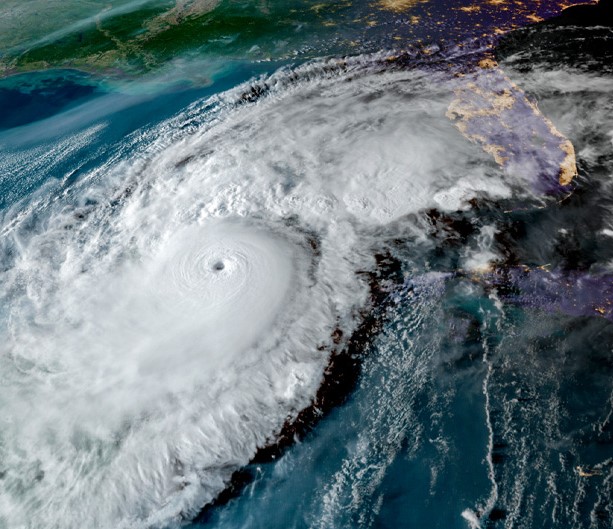
As the 2025 Atlantic hurricane season begins on Sunday, June 1, researchers at the University of Miami are sounding the alarm: above-normal activity is likely, driven by a mix of oceanic heat, weak wind shear, and a climate pattern in flux.
Forecasters at the National Oceanic and Atmospheric Administration (NOAA) predict a 60 percent chance of an above-normal season, with 13 to 19 named storms, six to 10 hurricanes, and three to five major hurricanes—those with sustained winds exceeding 111 miles per hour. While that level of activity is becoming more common, it still signals significant risk for coastal regions, particularly in Florida and the Gulf Coast.
At the UM Rosenstiel School of Marine, Atmospheric, and Earth Science, scientists monitoring key environmental indicators largely agree with NOAA’s assessment.
“This likely means another unusually busy season awaits,” said Dr. Ben Kirtman, professor of atmospheric sciences at the University of Miami’s Rosenstiel School of Marine, Atmospheric, and Earth Science and director of the Cooperative Institute for Marine and Atmospheric Studies. He cited a trio of contributing factors: persistently above-average sea surface temperatures, low vertical wind shear, and the current neutral phase of the El Niño-Southern Oscillation or ENSOclimate cycle.
Warming ocean still fuels storms
Although some Atlantic water temperatures are slightly cooler than last year’s record-setting heat, they remain well above historical averages.
“They’re not as crazy warm as in 2023 or 2024, but they’re still warmer than normal,” Kirtman said.
Brian McNoldy, a senior research associate and hurricane expert at UM, explained that while the surface temperatures across the Atlantic’s main development region (MDR) are only slightly above average, the ocean heat content—an indicator of the energy available in deeper water layers—is still significantly elevated.
“Heat content tells us more about the potential for storms to rapidly intensify,” McNoldy said. “Even if surface temperatures seem modest, there’s still a lot of fuel below.”
That fuel is especially potent in the Gulf of Mexico. Dr. Lynn “Nick” Shay, an oceanographer at UM, noted that the Gulf’s ocean heat content last year was 15 to 20 percent above average. The result: stronger and more quickly intensifying storms, like Hurricane Helene, which exploded in intensity before landfall.
This year, Shay and his team will deploy six EM-APEX profiling floats from hurricane reconnaissance aircraft to better monitor the upper ocean’s temperature and salinity in real time.
Climate patterns in flux
One of the biggest unknowns heading into the season is how long the ENSO pattern will remain in its current neutral phase.
“El Niño tends to suppress Atlantic hurricanes; La Niña enhances them,” McNoldy explained. “Right now, we’re in the middle. If that persists, it removes a key braking force.”
The Madden-Julian Oscillation (MJO), another atmospheric driver, could also influence storm activity on a week-to-week basis. “When it enters its active phase over the Atlantic, we often see a spike in storms,” Kirtman said. “But that’s something we can only monitor in real time, not months in advance.”
Dust outbreaks from the Sahara are another wild card. Dust can suppress storm formation, but their frequency and intensity vary year to year.
“Some of these sub-seasonal influences won’t be fully understood until we’re well into August,” Kirtman added.
Technology, forecasting get boost
While the environmental signals may point to a busier season, the tools available to forecasters are also evolving.
At UM’s CIMAS lab, Dr. Andy Hazelton and his team are refining the Hurricane Analysis and Forecast System (HAFS), a next-generation forecasting model now being tested by NOAA. One of its innovations is the use of “storm-following nests,” which zoom in on a storm’s structure, allowing for more accurate predictions of its intensity and behavior.
“This year, we’re deploying multiple nests to track several storms at once,” Hazelton said. “It’s a big step forward in giving the National Hurricane Center sharper, high-resolution insights.”
Elsewhere, Dr. Sharan Majumdar is leading a project examining how African easterly waves—disturbances that often serve as the seeds for Atlantic hurricanes—are modeled using artificial intelligence. His research compares the new European AIFS model to traditional physics-based systems, exploring which is better at spotting early signs of cyclonic development.
Gulf Coast in crosshairs?
As researchers and emergency managers watch for storm threats, attention is again turning toward the Gulf Coast. Last year, that region endured a series of hard-hitting landfalls, and the conditions that fueled them are still in place.
“With ocean temperatures so high and no El Niño to dampen activity, the Gulf is particularly vulnerable,” Shay said. “Rapid intensification close to land is a real concern.”
The Loop Current—an underwater conveyor belt that spins off hot eddies—adds another layer of risk. “Those eddies act like high-octane fuel,” Shay explained. “We saw it with Hurricane Milton. That kind of intensity near shore doesn’t leave much time to prepare.”
Season to watch closely
For South Florida, the stakes are clear. While no forecast can predict exactly when or where a storm will hit, the trends are worrisome. Warm oceans, a neutral ENSO pattern, and a lack of suppressive wind shear all combine to raise the baseline risk.
As Majumdar put it: “We’re entering a period of heightened potential. The key now is readiness—not just from emergency officials, but from residents too.”
The Atlantic hurricane season officially runs from June 1 to Nov. 30. With multiple long-range indicators flashing caution, this year’s message is simple: don’t wait.
“We can’t say exactly how many storms will form or where they’ll go,” Kirtman said. “But we can say this: the atmosphere is primed. And history tells us it only takes one.”

Author: Coral Gables Gazette News Staff
Originally established in 1996 and relaunched as a digital publication in February 2025, the Coral Gables Gazette is an independent local news organization dedicated to factual, objective and accountable community journalism. Our newsroom reports on the people, policies, institutions and events shaping Coral Gables, Florida, providing residents with timely, informative coverage of the issues affecting their community. Our reporting includes City Hall, local government, municipal elections, public spending, real estate development, business, education, arts and culture, and neighborhood affairs throughout the City Beautiful. We follow City Commission decisions, examine public records and report on the businesses, organizations and individuals contributing to Coral Gables. We believe informed residents are essential to a healthy, engaged community. Stories published under the Coral Gables Gazette News Staff byline are prepared or compiled by the publication's editorial team. We strive for accuracy, fairness, transparency and clear distinctions between news reporting, opinion and advertising. Readers are encouraged to submit news tips, corrections, editorial inquiries and story suggestions through our Contact page and learn more about our standards through our Editorial Policy.