
By Coral Gables Gazette staff
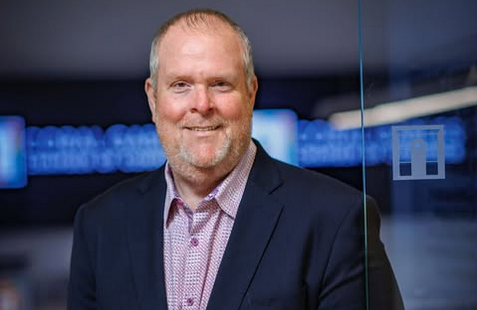
Coral Gables would keep its property-tax rate unchanged under the $318.44 million budget City Manager Peter Iglesias sent to the City Commission on July 1, even as the city warns that a statewide property-tax vote in November could reduce its revenue by millions of dollars within two years.
The proposal sets the terms for the budget debate residents will follow through September. The city’s property-tax rate helps determine what homeowners and businesses pay to City Hall, while the spending it supports shapes police and fire staffing, parks, infrastructure work, historic restoration and the pace of long-delayed public projects. This year, the city must weigh those priorities against slower taxable-value growth and a proposed homestead-exemption expansion on the November ballot that could begin affecting city revenue in the next fiscal year.
A flat rate, rising collections
The budget holds the millage at 5.559 mills, the rate Coral Gables has kept since the 2015-2016 fiscal year and, by the budget document’s count, the twelfth consecutive year at that level. Because the rate stays flat while values rose, the city would collect about $8.9 million more in property taxes than in the current year, raising property-tax revenue to $146.46 million. Property taxes account for 49 percent of operating revenue. The city’s preliminary 2026 taxable value reached $27.70 billion as of June 1, up 6.5 percent from $26.01 billion, with existing property at $27.44 billion and new construction adding $261 million, more than double the prior year’s $114 million.
Spending and staffing
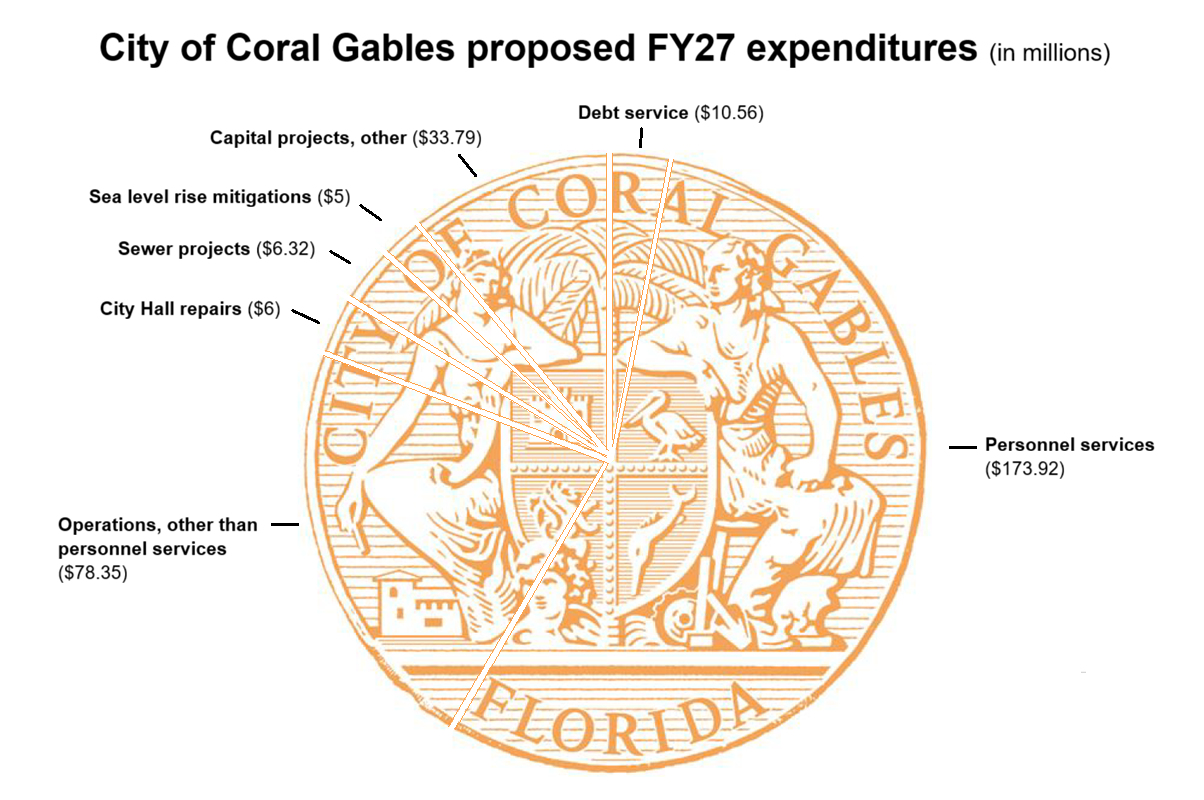
Measured net of transfers, operating, capital and debt spending totals $313.91 million, an increase of $4.56 million, or 1.47 percent, over the current year. Operating revenues are projected at $297.68 million, up 6.44 percent. Operating expenditures reach $252.28 million, up $6.53 million, or 2.66 percent, with nearly the entire increase in personnel, which rises $7.27 million to $173.92 million. Health insurance and retiree benefit costs climb $3.64 million on premium increases the city estimates at more than 20 percent. Spending outside personnel falls by about $740,000.
Labor agreements will shape the years ahead. The city’s contract with the Teamsters runs through September 2027, while its agreements with the Fraternal Order of Police and the International Association of Firefighters expire in September 2026, and the budget plans for new negotiations with both. Staffing changes are modest: the plan adds one full-time position, raising the full-time count to 956, and cuts part-time positions by two to 251.
Departments requested $3.4 million in new or additional operating funding, split between $2.28 million in recurring costs and $1.11 million in one-time items. The additions span police equipment and radio-system licensing, public works maintenance, recreation programming, employee training and facilities costs.
Capital and long-term projects
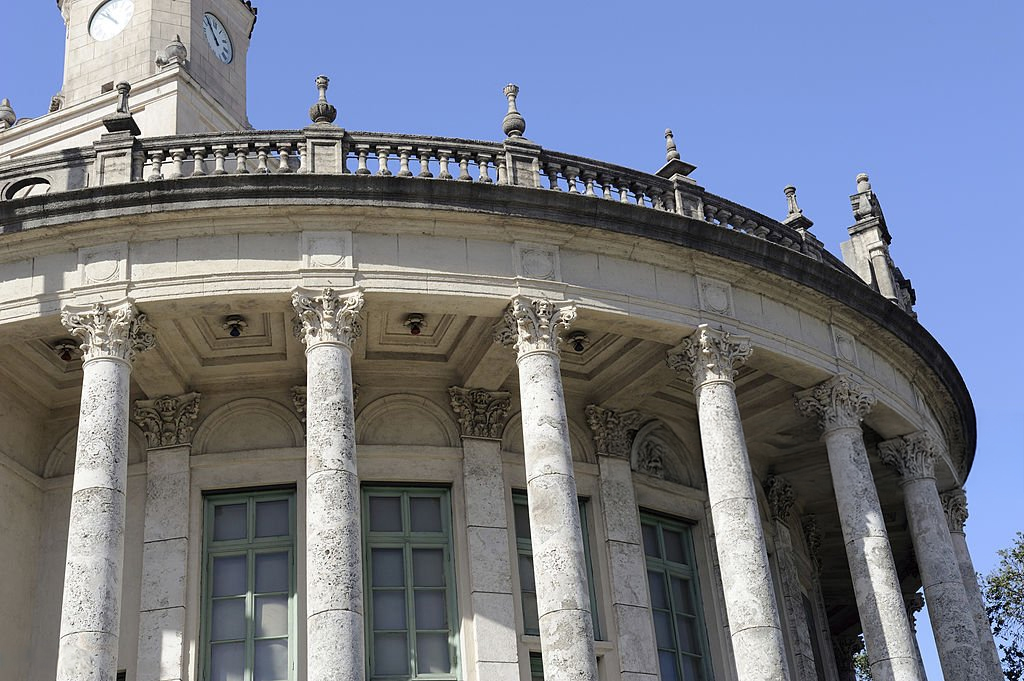
Capital spending edges down in the proposal. Measured net of transfers, the city budgets $51.07 million for capital in fiscal 2027, a decrease of $1.96 million, or 3.69 percent, from the $53.02 million adopted for the current year — even as operating costs climb $6.53 million. Together with $4.1 million for vehicle replacements in the operating budget, that brings the city’s broader capital commitment to about $55.1 million. Named projects include $9.3 million for historic facilities, of which $5.95 million funds a multi-year restoration of the City Hall complex; $11.33 million for aging sanitary sewer and stormwater systems, including $5.01 million for sea-level-rise mitigation; $2 million for sidewalk replacement and installation; $1.6 million for the Coral Gables Country Club; and $1 million for a biochar facility at 72nd Avenue. The plan also continues work on the Alhambra Water Tower, the Gondola Building, the Venetian Pool, Phillips Park, Ponce Circle Park, the Granada Golf Course and the Mobility Hub.
Debt, reserves and ratings
The city presents its balance sheet as a position of strength. Total outstanding principal debt will stand at $92.5 million at the close of fiscal 2026, and the $10.56 million in debt service equals 4 percent of the city’s operating and debt-service budgets, well under its self-imposed 8 percent limit. The general fund reserve was fully funded at $64.08 million at the close of fiscal 2025, meeting the commission’s 25 percent policy, and the city notes that Moody’s, S&P and Fitch have reaffirmed its AAA bond ratings.
What the November vote could cost
The budget’s caution points past this year. The constitutional amendment on the Nov. 3 ballot, approved by the Legislature, would raise the homestead exemption to $150,000 in 2027 and $250,000 in 2028. In its own analysis, the city projects the change would reduce Coral Gables property-tax revenue by about $5.7 million in fiscal 2028 and $11.4 million in fiscal 2029 and beyond. Homesteaded properties generate roughly 48 percent of the city’s property-tax revenue. City taxable-value growth remains below the post-pandemic surge, growing 6.5 percent this year after 5.8 percent in 2025, 7.94 percent in 2024 and increases above 11 percent in 2022 and 2023. The city says future increases are expected to return to the 4-to-5 percent range that prevailed before 2022.
The rate debate ahead
Whether the commission holds the rate at 5.559 or revisits it remains open. In prior budget cycles, some commissioners have questioned whether the city should keep the millage steady or move toward reductions, and the proposed rate is likely to remain a live issue before final adoption which requires four votes. The rate can still be amended before then. Under Florida’s truth-in-millage rules, a rate set above the rolled-back rate must be publicly advertised as a property-tax increase even when the millage number is unchanged, and the adopting ordinance must state how far the rate exceeds rollback.
What comes next
The commission takes up the plan at a budget meeting in the Police and Fire Headquarters Community Meeting Room, 2151 Salzedo Street, on Wednesday, July 8, at 9 a.m. Two public hearings follow in September, both at 5:01 p.m.: the first on Tuesday, September 15, and the final adoption hearing on Tuesday, September 29. TRIM notices listing each property’s proposed value and the proposed rates from all taxing authorities are mailed to residents in late August.









y06o7e
References:
Hitnspin freispiele https://mt-travel.ru/
References:
Hit n spin bewertung images.google.rs
References:
Best instant payid pokies australia real money https://raimusic.vn/
References:
Payid pokies aus https://gitea.4l3ks.com/
References:
Australia online pokies payid https://staffsagye.com/
References:
Lollybet Cashback http://toolbarqueries.google.com.ng/url?sa=i&url=https://qrlinkgenerator.com/janicevigano31
References:
Lollybet Mirror Link https://alenka.capital/info/go/?go=https://antoniofradique.net/romannapier04
Tôi đánh giá cao xn88 gaming vì hệ thống hoạt động ổn định và hỗ trợ tốt trên cả máy tính lẫn điện thoại. TONY07-20