
By Coral Gables Gazette staff
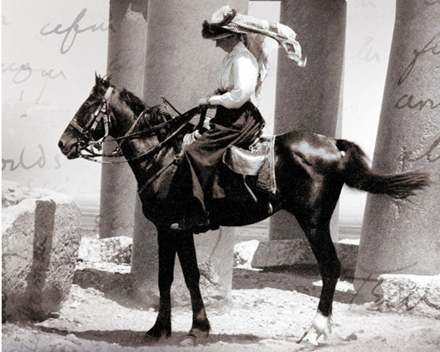
Ten years after it began its festival life, a documentary that reconstructs Gertrude Bell’s role in the making of modern Iraq largely through letters, diaries and century-old film will return to the big screen this weekend with both directors in attendance.
Coral Gables Art Cinema will present three screenings of Letters from Baghdad from Friday, July 31, through Sunday, Aug. 2. Directors Sabine Krayenbühl and Zeva Oelbaum will participate in a conversation with the audience after Sunday’s 2:15 p.m. screening.
Voiced and executive-produced by Tilda Swinton, the 95-minute documentary traces Bell’s passage from archaeological expeditions and desert travel into the inner circles of British power after World War I. She became an influential adviser on Iraq at a time when women rarely held formal authority in diplomacy or government—but she exercised that influence within a colonial system whose decisions continue to shape the region.
The cinema is billing the engagement as a 10th-anniversary presentation. The film appeared at international festivals in 2016 before its wider 2017 release, accounting for the apparent difference between the anniversary designation and the release year listed in the cinema’s program.
History told through its participants
Rather than relying on a conventional historian’s narration, Letters from Baghdad tells its story through the recorded words of Bell and the people who knew her.
Swinton reads from Bell’s extensive correspondence, while letters, diaries and official documents supply the voices of her contemporaries. Bell’s photographs and rarely screened archival footage place those accounts inside the cities, deserts and political gatherings they describe.
The method gives Bell a first-person presence without turning the film into a dramatic reenactment. Viewers hear her observations and judgments as she wrote them, while other voices offer admiration, criticism and competing interpretations of her character.
Bell is sometimes described as the “female Lawrence of Arabia,” a comparison that signals both her historical importance and the tendency to explain her through the better-known T.E. Lawrence. The documentary uses that label but also works against its limitations, presenting Bell as a political actor whose access, knowledge and influence exceeded those of many of the men around her.
An overlooked woman inside an imperial system
Bell traveled extensively through the Middle East, studied its languages, cultures and tribal relationships and was recruited into British intelligence during World War I. After the war, she became Oriental Secretary to the British administration in Baghdad and advised officials as Britain shaped the new state of Iraq from the former Ottoman provinces of Mosul, Baghdad and Basra.
Her influence on the postwar settlement was substantial. Bell was the only woman at the 1921 Cairo Conference, where British officials considered the political future of Iraq and other former Ottoman territories. She played an important role in the selection of Faisal I as Iraq’s first king and later helped establish what became the Iraq Museum, influencing how the country’s antiquities and emerging national identity would be presented. The political arrangements she helped shape, often driven by British strategic interests rather than the region’s ethnic and sectarian divisions, give the documentary what its promotional materials describe as an “eerily current” resonance.
That history gives the film a more complicated subject than a straightforward account of a woman overcoming the restrictions of her era.
Bell entered rooms from which women were generally excluded, but those rooms belonged to a colonial government making decisions about other countries and peoples. Her independence and intellectual authority coexist with her participation in an imperial project.
The documentary’s title suggests intimacy—private letters written across great distances—but the consequences of the decisions surrounding Bell were public and enduring. The filmmakers connect the personal record of an extraordinary life with political arrangements whose effects remain visible in Iraq and the wider region.
Two directors and a shared archival approach
Krayenbühl co-directed and edited the documentary. Her editing credits include the Oscar-nominated My Architect, Mad Hot Ballroom, The Bridge and the Emmy-winning The Hunt for Planet B. She is a member of the Academy of Motion Picture Arts and Sciences.

Oelbaum co-directed and produced the film. Her earlier documentary Ahead of Time examined the life of journalist and photographer Ruth Gruber, another woman whose work carried her into major events of the 20th century.
The filmmakers later reunited for Obsessed with Light, a documentary about Loïe Fuller, the American dancer and theatrical innovator whose experiments with fabric, movement and stage lighting influenced modern performance.
Taken together, the films reflect a recurring interest in women whose accomplishments were substantial in their own time but became less visible in the historical record.
Letters from Baghdad went on to air on PBS, the BBC and the European cultural broadcaster ARTE. Sunday’s appearance provides a chance to hear Krayenbühl and Oelbaum discuss both the years of archival research behind the film and how its portrait of Bell has aged since the documentary was completed.
Three screenings, one filmmaker conversation
The film will screen at 6 p.m. Friday, 5:45 p.m. Saturday and 2:15 p.m. Sunday. Only the Sunday presentation includes the post-film conversation with both directors.
The engagement is part of the cinema’s limited and one-time presentation series rather than its continuing repertory schedule.
If you go…
“Letters from Baghdad”: 10th anniversary
Friday, July 31, at 6 p.m.
Saturday, Aug. 1, at 5:45 p.m.
Sunday, Aug. 2, at 2:15 p.m., followed by a conversation with directors Sabine Krayenbühl and Zeva Oelbaum
Coral Gables Art Cinema
260 Aragon Avenue, Coral Gables
Runtime: 95 minutes
Not rated
English and Arabic
Tickets and information: Coral Gables Art Cinema












Just started my journey here and the onboarding process was surprisingly easy. The game categories are well organized so I never feel lost browsing through titles. It is nice to find a team that puts effort into smooth navigation. a88xgame
I appreciate how straightforward everything is from sign up to cash out. The slot tournaments are exciting and the rankings update in real time. Make sure to visit cowolay if you want a stress free betting environment
Just signed up last week and I am already hooked on how easy it is to navigate this site. The mobile version works perfectly and I never had to deal with any pop ups or glitches. Support agents are friendly and always ready to walk you through the payment options. 555rrbetlogin