By Coral Gables Gazette staff
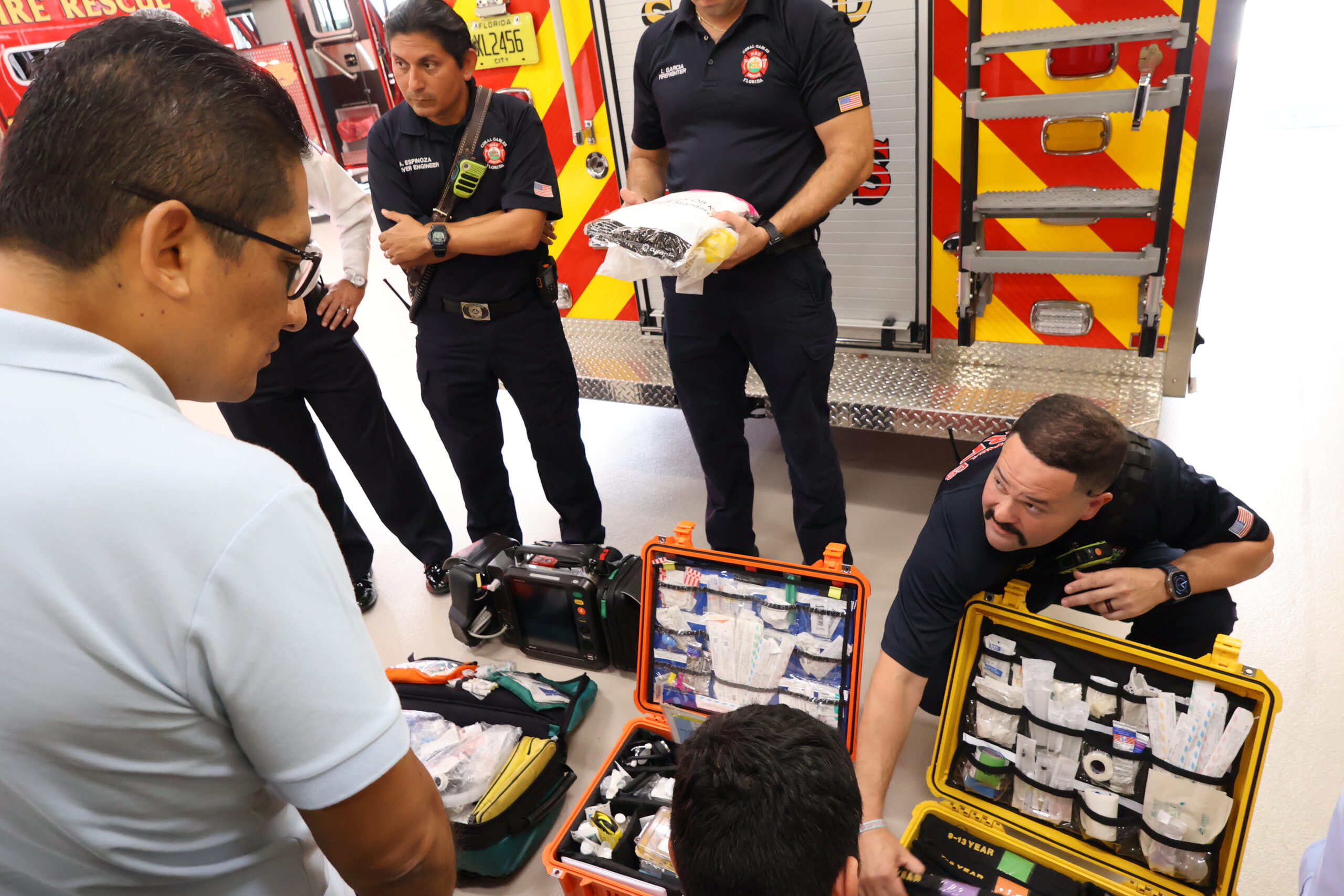
A recent visit by physicians and engineers from four South American countries to Coral Gables Fire Rescue became more than a tour of a municipal emergency-response operation when Division Chief Louis Fajardo described his deployment following last month’s devastating earthquakes in Venezuela.
The visitors, from Peru, Chile, Argentina and Colombia, came through a partnership between the city and Florida International University’s Healthcare Management Americas initiative. They received an overview of the department’s emergency medical services, disaster planning and coordination during large-scale emergencies, according to a city account of the visit.
Firefighters and paramedics also discussed the training and teamwork required to move from routine medical calls to disasters that may overwhelm local resources.
The international group included professionals working in medicine and engineering, fields that converge during emergencies involving damaged infrastructure, interrupted health systems and large numbers of casualties.
A disaster response still unfolding
Fajardo’s presentation brought an immediate real-world case study to the program.
He deployed to Venezuela with South Florida Urban Search and Rescue Task Force 2 after two major earthquakes struck the country June 24. The U.S. Geological Survey measured the earthquakes at magnitudes 7.2 and 7.5 and said they occurred less than a minute apart in northern Venezuela, west of Caracas.
The City of Coral Gables previously announced that Fajardo had joined the federal search-and-rescue team to assist with rescue operations. The city also opened its four fire stations as collection sites for relief supplies.
During the FIU visit, Fajardo discussed the challenges of coordinating emergency management and humanitarian assistance after a disaster of that scale, according to the city. His presentation addressed conditions responders face when damaged roads, buildings, utilities and medical facilities complicate efforts to locate victims and deliver care.
The earthquakes also generated extensive landslide and liquefaction risks. USGS assessments warned that earthquake-triggered landslides were likely to be significant in number or geographic reach, adding another hazard for residents and rescue personnel.
That experience gave the visiting professionals a recent example of why disaster response depends on more than fire and medical skills. Engineers assess whether buildings and infrastructure remain safe, while physicians and emergency personnel must make decisions about triage, transportation and treatment under conditions in which ordinary systems may no longer function.
From daily calls to major disasters
Coral Gables Fire Rescue handles fire suppression, emergency medical calls and disaster preparedness for the city. Fire Chief Marcos De La Rosa also serves as Coral Gables’ emergency manager, coordinating city departments and personnel during major incidents.
De La Rosa leads a department of 147 members and, in his emergency-management role, helps coordinate a city workforce of more than 800 employees, according to his FIU faculty profile. He also teaches as an adjunct professor in FIU’s Academy for International Disaster Preparedness.
The academy provides education in disaster management, humanitarian relief, emergency preparedness and homeland security, with an emphasis on combining academic study with the experience of working responders.
The visiting cohort came through a different FIU initiative, Healthcare Management Americas, which is based in the Robert Stempel College of Public Health and Social Work. The program uses research and professional training to improve health-care management, risk practices and patient safety, particularly across Latin America.
Bringing those professionals into a fire department connected the management and patient-safety focus with the operational realities of emergency care.
A relationship built around training
“Coral Gables has long been an international city and we are proud to share our experiences with professionals from around the world,” De La Rosa said in the city’s account of the visit. “Partnerships like this with FIU create meaningful opportunities to exchange knowledge, strengthen relationships and advance emergency response through collaboration.”
The department has worked with FIU beyond the latest visit.
Coral Gables has hosted FIU emergency-management interns, and the university has included city fire personnel and other South Florida responders in training designed to simulate complex disasters at home and abroad. An FIU field exercise held in May brought together graduate students, emergency responders and community partners for a full-scale disaster simulation.
Such exchanges allow international visitors to study how a local government organizes emergency medical services and prepares multiple departments to operate together during a crisis. They also allow Coral Gables personnel to compare their practices with the experiences of doctors, engineers and health-system leaders working in countries that face different resources, infrastructure and disaster risks.
For the latest group, the timing made that exchange particularly immediate. The presentation was not limited to emergency plans or hypothetical scenarios. It included lessons carried back by a Coral Gables responder from a disaster whose rescue and recovery work was still underway.