
By Coral Gables Gazette staff
When the University of Miami asked Coral Gables last month to allow hospital use on its campus, the request arrived as one element of a broader 30-year development agreement.
A closer reading of the filing shows the hospital provision reaches further. As drafted, a hospital of up to 100 beds would be a permitted use in the campus Multi-Use Zone, meaning it would not require a separate conditional-use vote on the hospital use itself.
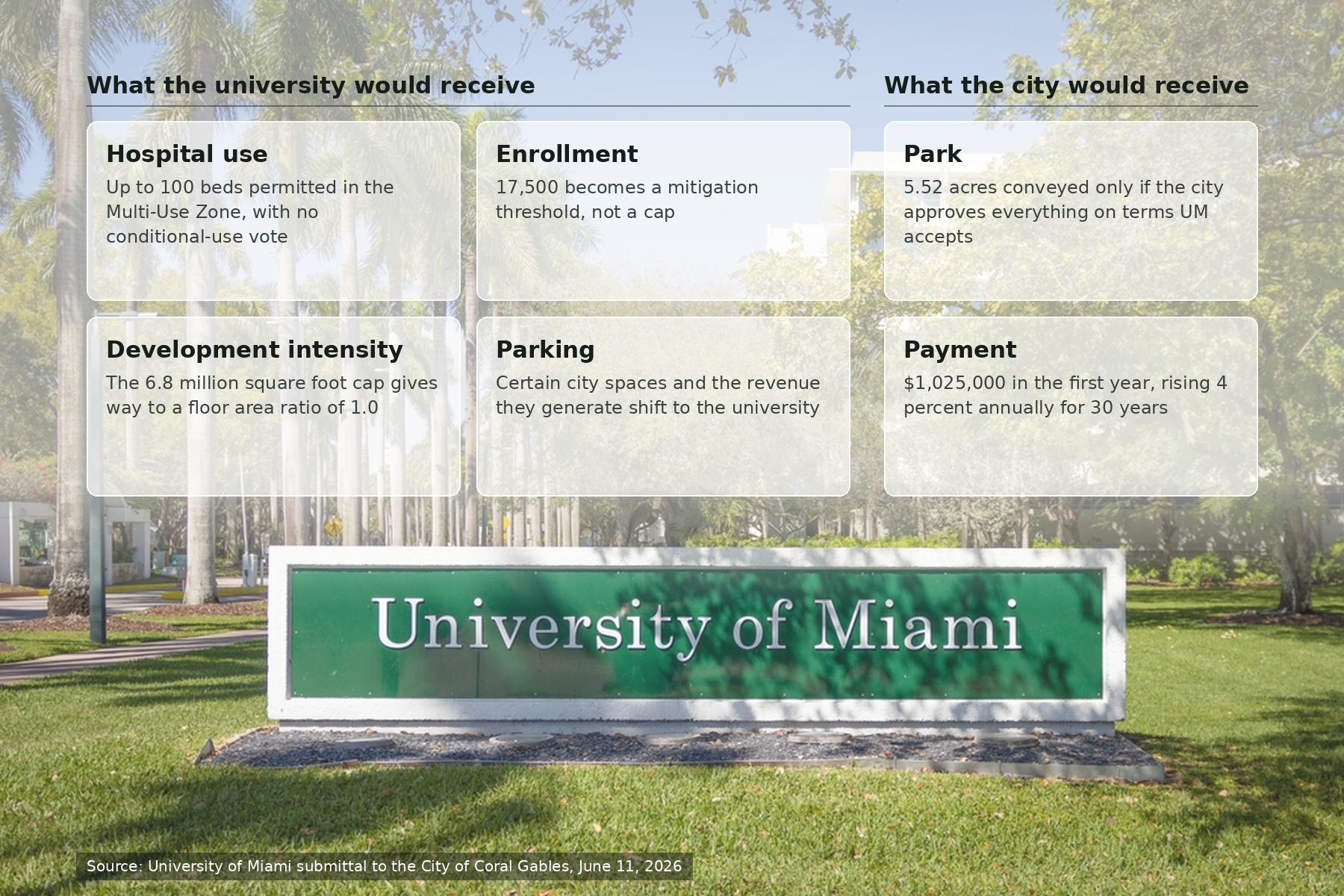
But the hospital provision is only one piece of the proposed bargain. The same package would treat 17,500 undergraduates as a mitigation threshold rather than an enrollment cap, shift control and revenue from certain city parking spaces to the university, replace the current 6.8 million-square-foot development cap with a floor-area-ratio standard the filing says would increase intensity without saying by how much, and allow a larger replacement dormitory tied directly to the agreement’s enrollment-mitigation formula.
The agreement also would give Coral Gables a 5.52-acre park site and an annual payment starting at $1,025,000, but the park transfer depends on all approvals being granted without conditions the university deems unacceptable.
The Planning and Zoning Board must review the package before it reaches the City Commission.
A hospital use without a separate conditional-use vote
Coverage of the filing to date, including the Gazette’s, has described the university as seeking permission to build a hospital. The submittal goes further than that description suggests.
Its proposed amendment to the Campus Sub-Areas Table in Appendix D.1.F lists a hospital of up to 100 beds as a permitted use in the University Multi-Use Zone. A hospital of more than 100 beds would require conditional-use approval. A footnote to both rows requires primary ingress and egress from Ponce de Leon Boulevard.
The distinction carries consequence. A conditional use requires a public hearing and a discretionary vote on whether the use belongs there. A permitted use does not. A hospital at or below 100 beds would still face site-plan review, design approval and ordinary permitting, but the question of whether a hospital may operate in that zone would already be settled.
The submittal defines the facility broadly. A Health Center, it states, means a medical facility, including a hospital, that serves both the university and the general public and provides outpatient and inpatient care, diagnostic services, radiation therapy, diagnostic imaging, chemotherapy, sports medicine, surgical services, emergency care and accessory uses customarily associated with such facilities.
The university has filed no hospital site plan and has said publicly that it has no specific proposal at present. What it seeks now is the authority.
Enrollment threshold, not enrollment cap
The filing also changes how enrollment is governed.
Both the Miami Herald and the student newspaper The Miami Hurricane have described the agreement as allowing the university to enroll up to 17,500 undergraduates. The filing describes something different.
It names 17,500 the Undergraduate Enrollment Mitigation Threshold. If full-time-equivalent undergraduate enrollment on the Coral Gables campus exceeds that number, the university must submit a report identifying the enrollment count, the beds built since the agreement took effect, the traffic mitigation already implemented and a plan addressing unmitigated traffic impacts caused by enrollment above the threshold.
The city then has up to 120 days to review and comment before the report reaches a City Commission agenda for consideration and approval by ordinance.
Nothing in the document sets a number at which enrollment must stop.
The obligation attached to growth can also be reduced. Under a provision the agreement calls the On-Campus Housing Credit, each new bed built on campus after the effective date earns a half-student credit against the university’s mitigation obligation. The filing supplies its own illustration: six new beds would mean the obligation is calculated as though enrollment rose by three.
The agreement records 4,228 beds on campus as of the execution date.
The practical effect is that passing 17,500 would trigger reporting and mitigation rather than a prohibition, and that building dormitories would shrink the mitigation owed.
A floor-area increase the filing does not quantify
The current agreement caps campus development at 6.8 million square feet. The proposed amendments would strike that figure and substitute a maximum campus floor area ratio of 1.0, a formula permitting one square foot of building for each square foot of land counted in the calculation.
The submittal acknowledges the direction of the change. The amendments modifying the maximum square footage to a campus floor area ratio of 1.0, it states, “will increase the intensity of the Master Plan.” That increase is what triggers the requirement for conditional-use approval of the amended Campus Master Plan.
The filing does not say how much.
Nowhere in the 217-page package does the university calculate the maximum floor area a ratio of 1.0 would produce across the campus or compare that total to the cap it would replace. The legal description at Exhibit A places the campus at approximately 240.61 acres, but the amended code would exclude from the calculation any property inside the University Campus District that the university does not own and control.
The exclusions are extensive. Off-street parking areas would not count toward the ratio. Neither would ground-floor lobbies, electrical rooms, fire command and pump rooms, phone and information-technology rooms, trash rooms, stairwells, elevators, trash chutes, balconies, porches, stoops, basements, uninhabitable attics, rooftop trellises covering up to half the roof, or the open upper volume of courtyards.
Constructed volume on the campus would exceed the nominal ratio by a margin the filing does not state.
City parking spaces and revenue would shift to the university
Paragraph 18 commits the city to obtain the approvals necessary to relinquish and transfer to the university the right to control, use and derive revenue from parking spaces identified elsewhere in Exhibit G.
The city also would enter a parking management agreement allowing the university to install and operate meters on Levante Avenue and would release a parking-meter easement recorded in Miami-Dade County public records on June 15, 2011.
Exhibit G, titled City of Coral Gables Pay by Phone Parking Spaces, identifies them on two maps. One shows six segments totaling 56 pay-by-phone spaces near the campus core. A second identifies additional pay-by-phone spaces on the public right-of-way near Levante Avenue.
The filing counts the spaces. It assigns them no value, and nothing in the package estimates what they currently generate or what the city would forgo across the 30-year term.
A larger dorm replacement tied to enrollment mitigation
The campus development chart filed with the package lists buildings slated to come down, including Mahoney and Pearson Residential Colleges, each at 167,166 gross square feet and holding 717 and 716 beds, respectively.
Also listed are the Mahoney-Pearson Dining Hall, the Mahoney-Pearson Commons, Utility Building 3, the Toppel Career Center and the Whitten Learning Center.
At 578,000 gross square feet, the planned replacement residential building would be about 73 percent larger than the two residential colleges it would replace. The chart states the replacement building’s square footage but not its bed count, though beds are the unit the housing credit uses. The Whitten Learning Center would be rebuilt at its existing size.
The replacement program matters beyond construction. New on-campus beds reduce the mitigation calculation if undergraduate enrollment passes 17,500, linking the demolition plan directly to the enrollment provision.
Park transfer depends on full approval
The most visible public benefit in the agreement is the conveyance of the 5.52-acre Lee Lincoln Site to the city for a park to be named Centennial Park, marking the centennials of the city and the university.
Mayor Vince Lago told the Miami Herald the land is estimated to be worth about $50 million. That figure does not appear in the filing.
The conveyance is conditional. Under Paragraph 19, the university would transfer the land only after the city grants the last final, non-appealable approval of every element of the package, and only if those approvals arrive without any condition the university, in its “sole and absolute discretion,” deems unacceptable.
Should any required approval fail, the obligation to convey becomes void.
The clause places the commission in a particular position. Conditions of approval are among the principal tools commissioners have for shaping a development agreement. Under the proposed language, the city may attach conditions, but the university would decide whether those conditions are acceptable.
The city also would grant the university a perpetual easement to continue using portions of the site for recreation.
What the city would receive
Exhibit H sets the university’s payment at $1,025,000 in the first year, rising 4 percent annually across the term. Applying that escalation over 30 payments produces total nominal payments of approximately $57.5 million, with the final year near $3.2 million. The exhibit offers no explanation of how the first-year figure was set.
The agreement continues an established slate of programs.
They include up to 80 hours a year of university consulting in areas such as information technology, procurement, architecture and design, and business processes, with unused hours forfeited rather than carried forward.
The Hurricane Athletics Ticket Program continues, including a buy-one-get-two-free offer for residents at one designated home football game and free general-admission tickets for men’s and women’s basketball and baseball. Four concerts, two cultural programs, a six-lecture series, the Meet the Docs program and the Gables Fellows internship all carry over.
Once additional seating at the Convocation Center is built out, the university would provide residents $20,000 in tickets each calendar year.
One older obligation carries forward as well. Under the 2010 agreement, the university committed up to $100,000 toward beautification of Ponce de Leon Boulevard between Red Road and Granada Boulevard and paid $59,486 in 2012. The proposed agreement records the balance at $40,514, payable if and when the city begins the remaining work.
What remains unresolved
The public record reviewed by the Gazette does not include an appraisal of the Lee Lincoln Site, a fiscal-impact analysis or any valuation of the development rights and use entitlements the agreement would grant.
The $1,025,000 payment appears without derivation. The floor area the new ratio permits has not been calculated in public. The parking spaces have not been valued, and their revenue has not been stated. The package is also structured so that the city’s ability to attach conditions is checked by the university’s ability to reject them.
None of that describes bad faith. It describes a negotiation whose terms are public, but whose full value has not been stated.
How to follow it
The Planning and Zoning Board must review the package before it reaches the City Commission. As of the Gazette’s review, the city’s file for the item did not list a Planning and Zoning hearing date.













Yet crooked Lago and Lara got paid $25,000 from UM to support this. When will PAY TO PLAY with these unscrupulous politicians stop. Please get these 2 out of our city.
it would really help to have maps included in the story to fully understand where all this is happening. thanks.
More of it every day, right out of city hall.
👎👎👎👎
I view something truly special in this web site.
I am confused. My appointments at the Lennar Medical Building on University of Miami’s Coral Gables campus bill Medicare and private insurance for the use of a hospital facility. So the campus already has an active hospital.