By Coral Gables Gazette staff
The Coral Gables City Commission spent part of Tuesday’s meeting examining how a series of property-tax reduction proposals under discussion in the Florida House could reshape the city’s finances. The review, Vice Mayor Rhonda Anderson and Finance Assistant Director for Management and Budget Paula Rodriguez led, outlined scenarios that could cut as much as $64 million from the city’s annual revenue if enacted.
Anderson introduced the item through a memo attached to the agenda outlining several property-tax reduction proposals advanced by House Speaker Daniel Perez (R-Kendall). The proposals range from eliminating local non-school property taxes on homesteaded homes to expanding exemptions and portability. Anderson said the goal was to understand “which proposal is helpful for residents and workable for the city—and which would set the city considerably on its heels.”
The city’s fiscal dependence on property taxes
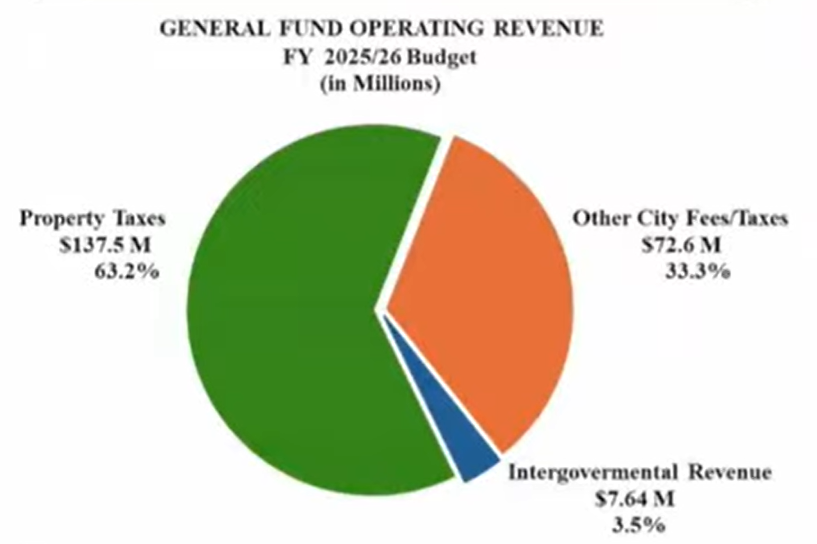
Rodriguez began by explaining that property taxes generate 63 percent of Coral Gables’ general-fund operating revenue and about half of the city’s total operating budget when enterprise funds are included. Homesteaded properties—owner-occupied primary residences—account for roughly 45 percent of that base.
To visualize the city’s exposure, she displayed a breakdown showing that fees and other city-controlled taxes provide about 33 percent of general-fund revenue, and intergovernmental revenue—state-shared sales-tax receipts—adds just 3.5 percent. “Each of the proposals from the House focuses only on homesteaded property,” Rodriguez said, “so the impact would fall squarely on nearly half of our property-tax collections.”
Projected revenue losses under legislative scenarios
Among the options outlined:
- Full elimination of non-school homesteaded property taxes would erase $63.8 million—45 percent of the city’s property-tax income.
- A new 25 percent exemption on homesteaded properties would cost $16.8 million, or 12 percent of property-tax revenue.
- An additional $100,000 exemption for insured homesteaded homes would remove $6.1 million (4 percent).
- A 10-year phase-out plan—gradually expanding exemptions until complete elimination—would cumulatively reach $83 million by Year 10, assuming property values rise 3 percent annually.
Rodriguez said the numbers highlight the city’s heavy reliance on ad-valorem revenue. “While maybe beneficial for homeowners, it would be a big impact here for the city,” she noted.
Consequences for city services
Anderson pressed the discussion toward practical effects. “The city would have to find revenue from another source such as fees,” she said, noting that fees carry no homestead exemption. Residents, she added, could face higher charges for essentials ranging from solid-waste pickup to park programs or police-vehicle maintenance.
Rodriguez agreed that the city would confront hard choices. “There’s not many ways to make up a $63 million loss,” she said. “Public safety funding would have to come first, and everything else—parks, planning, cultural services—would depend on new or increased user fees.” She described the model as “pay-for-play,” in which each service must cover its own cost through a dedicated fee.
Broader fiscal risks
City Manager Peter Iglesias cautioned that the effect could compound over time. “When you have these large discounts for having a homestead, that percentage may rise,” he said. “It can become a vicious cycle of continuous reduction in property tax.”
Anderson acknowledged the risk but noted that several House drafts include portability provisions—allowing longtime homeowners to downsize without losing tax benefits—potentially freeing larger homes for new families. Iglesias replied that portability might further increase the share of homesteaded properties, widening the revenue gap.
Anderson added that the changes could ultimately hurt those least able to absorb higher costs. “The impact could be worse for residents who need help the most,” she said. “There’s no homestead protection on a fee-based system—you pay the fee or you lose the service.”
She also urged the commission to engage state legislators on related cost pressures, particularly Florida’s rising property-insurance rates, and said those conversations should include windstorm coverage reforms. Anderson directed that Rodriguez’s full presentation be attached to the meeting agenda so residents can analyze the figures directly.
Watching Tallahassee and running the numbers
No action was taken, but commissioners agreed that the issue demands close monitoring during the upcoming legislative session. The finance department will continue evaluating potential scenarios and how the city might preserve core services if statewide tax reductions advance.
As Anderson concluded, she emphasized balancing homeowner relief with the city’s ability to maintain core services.

Author: Coral Gables Gazette News Staff
Originally established in 1996 and relaunched as a digital publication in February 2025, the Coral Gables Gazette is an independent local news organization dedicated to factual, objective and accountable community journalism. Our newsroom reports on the people, policies, institutions and events shaping Coral Gables, Florida, providing residents with timely, informative coverage of the issues affecting their community. Our reporting includes City Hall, local government, municipal elections, public spending, real estate development, business, education, arts and culture, and neighborhood affairs throughout the City Beautiful. We follow City Commission decisions, examine public records and report on the businesses, organizations and individuals contributing to Coral Gables. We believe informed residents are essential to a healthy, engaged community. Stories published under the Coral Gables Gazette News Staff byline are prepared or compiled by the publication's editorial team. We strive for accuracy, fairness, transparency and clear distinctions between news reporting, opinion and advertising. Readers are encouraged to submit news tips, corrections, editorial inquiries and story suggestions through our Contact page and learn more about our standards through our Editorial Policy.