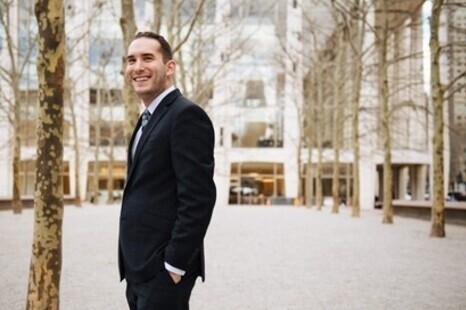
Pianist Mackenzie Melemed is on a musical journey across America, with an ambitious destination: all 50 states. His instrument is the piano, his repertoire spans nearly two centuries, and his larger question is what makes music distinctly American.
The tour brings him to Coral Gables on Sunday, Oct. 18, for a 4 p.m. recital at the University of Miami’s Newman Recital Hall, where works by Aaron Copland, Amy Beach and Florence Price will share the program with contemporary compositions.
Presented as part of the Frost Music Live season, “Keys Across America” arrives during the nation’s 250th-anniversary year, when questions about American identity and cultural heritage carry particular resonance.
Melemed, a Massachusetts native who has lived in Finland since 2020, has scheduled performances in 35 states through 2028, according to a public radio profile. His ultimate goal is to perform in all 50.
The tour explores what makes music American
The idea behind “Keys Across America” is deceptively simple: bring American piano music to American audiences.
But defining an American musical voice is considerably more complicated.
The composers announced for Sunday’s concert represent different generations, backgrounds and musical traditions.
Aaron Copland, born in Brooklyn in 1900, helped establish a recognizable American concert-music sound through open harmonies, vigorous rhythms and influences drawn from folk music. His ballet “Rodeo” remains one of the best-known examples.
Amy Beach, born in New Hampshire in 1867, belonged to an earlier generation. One of the first American women to achieve international recognition as a composer, she wrote music rooted in the European Romantic tradition while developing a distinctive style of her own.
Florence Price, born in Arkansas in 1887, brought another perspective. Her compositions drew on European classical forms while incorporating elements of African American spirituals, church music and dance rhythms.
Price made history in 1933 when the Chicago Symphony Orchestra premiered her First Symphony, the first large-scale composition by a Black woman performed by a major American orchestra.
Together, the three composers challenge the notion that American classical music developed along a single path.
Their music reflects different regions, traditions and experiences, suggesting that the country’s musical identity is better understood as a collection of voices than a single style.
Earlier recitals offer clues to Sunday’s program
The University of Miami has announced the composers but has not identified the individual works to be performed in Coral Gables.
Programs from earlier stops on Melemed’s tour offer a sense of his approach, although the selections can change from city to city.
At Lawrence University in Wisconsin last November, Melemed opened with Copland’s “Buckaroo Holiday” from “Rodeo,” followed by Beach’s Ballade, Op. 6.
The program also featured selections from Edward MacDowell’s “New England Idyls,” Louis-Moreau Gottschalk’s “Union,” works by Price and Arthur Foote, and Ned Rorem’s Piano Sonata No. 1.
Two compositions by living composers, Laura Kaminsky’s “Threnody…October 2024” and Avner Dorman’s “Lament and Variations,” were written for Melemed.
Those contemporary works are an important part of the tour’s premise.
A program devoted exclusively to composers of the 19th and early 20th centuries might present American classical music as a historical achievement. Including new compositions makes the argument that the tradition remains alive and continues to evolve.
Whether those particular works will appear in Coral Gables has not been confirmed.
An American pianist with an international career
Melemed has built a career that extends well beyond the United States.
He received an Avery Fisher Career Grant in 2022 and was a laureate of the 2021 American Pianists Awards.
He earned an Artist Diploma from the Juilliard School, where he studied with Robert McDonald and Emanuel Ax.
His performance credits include appearances with the Philadelphia Orchestra and Helsinki Philharmonic, among other ensembles. As a child, he performed at the White House.
His residence in Finland gives the American-music project an additional dimension: a pianist working internationally is returning to the musical traditions of his home country and presenting them to audiences across its regions.
The tour’s planned reach also distinguishes it from a conventional recital series. Rather than concentrating on major cultural capitals, the project seeks to bring American piano music to listeners throughout the country.
Newman Recital Hall offers an intimate setting
Sunday’s performance takes place in Newman Recital Hall at the Knight Center for Music Innovation, a $36.5 million facility that opened on the University of Miami campus in 2023.
The approximately 200-seat hall is one of two performance spaces in the center. A large window behind the stage overlooks Lake Osceola, providing a distinctive backdrop for concerts.
The building was designed to accommodate contemporary approaches to performance, teaching and musical collaboration while providing acoustically refined spaces for smaller ensembles and soloists.
A review published by South Florida Classical Review after the center opened praised the clarity and immediacy of the hall’s acoustics.
For a solo piano recital, those qualities can make a difference. The delicate passages of a Romantic ballade, the shifting rhythms of Copland and the subtle harmonies of newer compositions all depend on details that can be lost in a larger auditorium.
The setting offers listeners an opportunity to hear those contrasts at close range.
For Melemed, whose project asks audiences to consider what American music has been and what it is becoming, Coral Gables provides another stop in a journey that is still unfolding.
If you go…
What: Mackenzie Melemed, “Keys Across America”
When: Sunday, Oct. 18, at 4 p.m.
Where: Newman Recital Hall, Knight Center for Music Innovation, University of Miami, 5513 San Amaro Drive, Coral Gables
Tickets: $15 to $35, available through the University of Miami event page.

Author: Coral Gables Gazette News Staff
Originally established in 1996 and relaunched as a digital publication in February 2025, the Coral Gables Gazette is an independent local news organization dedicated to factual, objective and accountable community journalism. Our newsroom reports on the people, policies, institutions and events shaping Coral Gables, Florida, providing residents with timely, informative coverage of the issues affecting their community. Our reporting includes City Hall, local government, municipal elections, public spending, real estate development, business, education, arts and culture, and neighborhood affairs throughout the City Beautiful. We follow City Commission decisions, examine public records and report on the businesses, organizations and individuals contributing to Coral Gables. We believe informed residents are essential to a healthy, engaged community. Stories published under the Coral Gables Gazette News Staff byline are prepared or compiled by the publication's editorial team. We strive for accuracy, fairness, transparency and clear distinctions between news reporting, opinion and advertising. Readers are encouraged to submit news tips, corrections, editorial inquiries and story suggestions through our Contact page and learn more about our standards through our Editorial Policy.