
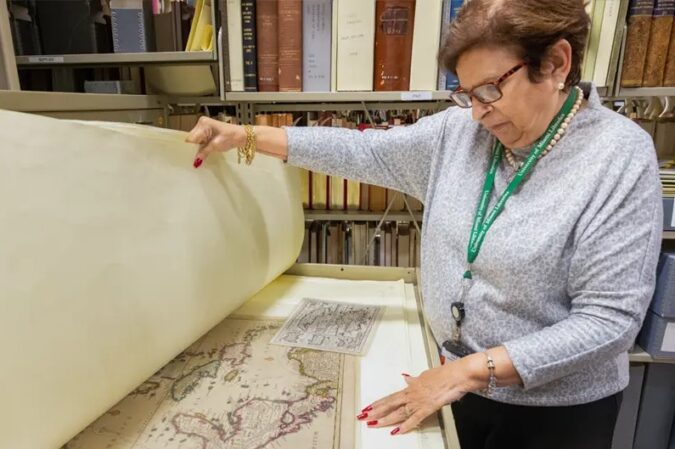
Visitors to the University of Miami’s Cuban Heritage Collection came to know Gladys Gómez-Rossié for several things: her ability to find a particular photograph, book or letter among thousands of archival materials, her elegant clothes and high heels, and the small cups of Cuban coffee she prepared herself.
But her contribution went far beyond helping visitors navigate the collection. She was one of five Cuban women whose determination to preserve their homeland’s history helped create what the university describes as the largest repository of materials on Cuba outside the island.
On Sept. 30, Gómez-Rossié retired after 59 years with the University of Miami Libraries, ending a career that began in 1967, long before the Cuban Heritage Collection formally existed.
She was serving as its community relations coordinator when she retired, the university announced.
From Pedro Pan child to keeper of Cuban history
Gómez-Rossié’s own life was part of the history she would help preserve.
Born in Havana, she came to the United States at age 14 through Operation Pedro Pan, the exodus that brought approximately 14,000 unaccompanied Cuban children to the United States between 1960 and 1962.
According to a 2011 university profile, she initially lived with extended family in Queens, New York, before returning to Miami a year later to live with the family caring for her younger brother.
Her first job at the university was in its Family Medicine Department. She subsequently joined the Otto G. Richter Library, working in its Periodicals Department.
It was there that she discovered how valuable the library’s Cuban materials could be to those rebuilding their lives in exile.
Cuban lawyers who had fled the island needed documentation establishing their professional credentials. Gómez-Rossié helped them locate official notices in Cuba’s Gaceta Oficial, sometimes using her lunch breaks to search for the records.
Over time, she joined four other Cuban women working in different parts of the library: Rosa Abella, Ana Rosa Núñez, Lesbia Orta Varona and Esperanza Bravo de Varona.
Together, they began gathering materials that documented the island they had left behind.
Maps, photographs, letters, official documents and periodiquitos — small newspapers serving Cuban communities — became the foundation of an expanding archive.
The work began decades before the Cuban Heritage Collection was formally established in 1998, when the university brought its growing Cuban holdings together under one program.
Today, the collection documents not only Cuba’s history but also the experiences of generations of exiles and the global Cuban diaspora.
Gómez-Rossié has said she still marvels at how the five women managed to begin the undertaking.
“We have preserved a precious part of our country’s history and culture,” she said in the university’s retirement announcement.
Bringing the collection into public view
Preservation, however, was only part of her work. Gómez-Rossié also wanted the broader community to know what the library held.
By 1994, she believed the collection was insufficiently known outside the university.
“We were the biggest kept secret for many years,” she recalled.
That year, she proposed creating a group of prominent community members who would serve as ambassadors and help raise funds for the collection.
The Amigos of the Cuban Heritage Collection was established in 1995, with former University of Miami President Henry King Stanford and philanthropist Elena Díaz-Versón Amos serving as its first co-chairs.
Over the following decades, the organization helped secure funding, support acquisitions, preserve oral histories and expand access to the collection.
One milestone came in 2003, when the Cuban Heritage Collection moved into the newly inaugurated Roberto C. Goizueta Pavilion, a 10,000-square-foot facility on the second floor of the Richter Library on the university’s Coral Gables campus.
Gómez-Rossié worked closely with Bravo de Varona, the collection’s former director, attending hundreds of community events, gallery openings and meetings involving Cuban exiles.
Their work connected scholars and students with people whose memories, documents and personal histories could enrich the collection.
Among the visitors was Cuban music legend Celia Cruz, who appeared with Gómez-Rossié and two of the other founding women in a 1999 photograph taken during a visit to the university.
The university formally honored all five founding women in 2019. Gómez-Rossié also received the Amigos’ Henry King Stanford Award in 2024, recognizing her contributions to the collection.
A legacy beyond the archives
For all the institution-building and community outreach, Gómez-Rossié remained personally involved with visitors.
She knew the collection’s holdings intimately, directing researchers toward materials that might otherwise have taken hours to locate. She welcomed students, academics and community members, often offering them a freshly prepared cafecito.
Charles Eckman, dean of the University of Miami Libraries, said her influence extended well beyond her formal responsibilities.
“The full measure of her contribution is hard to capture,” he said.
Gómez-Rossié, who served from 1979 to 1997 as assistant to Frank Rogers, then the university’s director of libraries, leaves behind an institution that has grown from the collecting efforts of a few women into an internationally recognized center for Cuban historical research.
Yet when asked what made her proudest, she did not point to the size of the archives or the buildings that eventually housed them.
She spoke instead of the relationships she had built among colleagues, researchers and members of the Cuban community.
“That is the legacy I leave behind,” she said.
And after nearly six decades at the university, she expressed no hesitation about retirement.
“I am happy. It was time.”

Author: Coral Gables Gazette News Staff
Originally established in 1996 and relaunched as a digital publication in February 2025, the Coral Gables Gazette is an independent local news organization dedicated to factual, objective and accountable community journalism. Our newsroom reports on the people, policies, institutions and events shaping Coral Gables, Florida, providing residents with timely, informative coverage of the issues affecting their community. Our reporting includes City Hall, local government, municipal elections, public spending, real estate development, business, education, arts and culture, and neighborhood affairs throughout the City Beautiful. We follow City Commission decisions, examine public records and report on the businesses, organizations and individuals contributing to Coral Gables. We believe informed residents are essential to a healthy, engaged community. Stories published under the Coral Gables Gazette News Staff byline are prepared or compiled by the publication's editorial team. We strive for accuracy, fairness, transparency and clear distinctions between news reporting, opinion and advertising. Readers are encouraged to submit news tips, corrections, editorial inquiries and story suggestions through our Contact page and learn more about our standards through our Editorial Policy.









Gladys Gómez-Rossié is an amazing guardian of all things Cuban. She treasured every bit of material in the Cuban Heritage Collection.
I’ve had the pleasure of knowing this classy, intelligent, pleasant, and loving lady for many years.
She will be missed