

By Ellen J. Uguccioni
Ellen J. Uguccioni was the first director of the City of Coral Gables Historic Preservation Department.
First in a series.
Research demands focus. It’s quite easy to become distracted from that focus when historical events portraying a world which seems so distant, compete for attention. When asked to write a piece about the formerly named Miami-Biltmore Hotel and Country Club, I was compelled to return to the historical record, in this case, The Miami Herald and The Miami Daily News which shared their journalistic perspective on then-contemporary news.
Insightful coverage of the hotel’s history demands that many voices and perspectives be considered. The stories from its inception; construction; conversion; moth-balling and resurrection often see opinions and appraisals change, influenced not only by the writer, but also by social and political contexts that make rigid conclusions tentative.
The creation and development of the City of Coral Gables, beginning when the first lots were sold in 1921, is well covered in many books and articles, and the scholarship brought to bear include many well-known and insightful narratives. The remarkable Mrs. Arva Moore Parks McCabe (1939-2020) my teacher, mentor, editor and friend, devoted her life to recording, understanding and interpreting the personalities and forces that initially developed the City of Coral Gables. In 1973 her early scholarship and dedication led to the enactment of Coral Gables’ first Historic Preservation Ordinance
In 1980, Mrs. Park’s indominable energy and commitment were at the vanguard of a dedicated group who were empowered when the City of Coral Gables created the Biltmore Advisory Committee. Its task was not a simple one: secure a developer for the hotel that would ensure its preservation or, the unthinkable, develop the site for something else entirely. The hotel was threatened with demolition from its underuse and simple neglect. Barring an enormous redevelopment or rehabilitation plan, the future of this perceived (by many) White Elephant was indeed in jeopardy.
To tell that story and give just credit to its history I must resort to writing in “chapters.” The first will bring the reader to that moment in time when the southernmost regions of the Florida peninsula became accessible. This formerly mysterious place would be provided with its own mythical history. Let me begin.
PART ONE
In 1925, a thirty-six-hour train ride (an entire 24-hour day and a half) leaving the northern climes of New York City, led to a lush green landscape and brilliant blue sky that is South Florida. The destination had to be a grand and glorious one, unlike any other, with exhilarating activities and sights guaranteed to make the long trip worthwhile. That place was in part, defined by the magnificent Miami-Biltmore Hotel and Country Club.
The city’s creator, George Edgar Merrick whose teenage years were spent at the Coral Gables Plantation— the epicenter of which was his home at 904 Coral Way— began a real estate career that resulted in more than mere empire. By combining man’s ingenuity with the beauty of the natural environment, he created a utopia informed by the tropics; an environment replete with inspiration but as yet improved only by scattered scrub pines and farms connected only by the occasional road covered in sand and gravel.
In the early 1920s as train service improved and thousands of motorists headed to Florida, the competition for development was heated and the allure of this now-approachable paradise ended in mixed results. For Merrick, a fully formed ideal of a planned, themed city with equal attention paid to the landscape, winding roads and boulevards, quality and beauty of the homes, and diverse venues for sports and recreation resulted in “Coral Gables—Where your Castles in Spain are Made Real.”
The newly created subdivisions would be defined by their use—a business area; a university campus; an area dedicated to showcase the local cottage industries; a series of residential communities ranging from those moderately priced to those more expensive, and as its centerpiece, a magnificent hotel and country club. The meteoric rise of the Florida Boom towns would reach their zenith by late 1925 and then plummet to an unrecoverable low. The end of the development Boom is just the beginning of our story. The Miami-Biltmore Hotel was created during an era of affluence and optimism and would survive epic storms and economic downturns to rival only the most legendary of landmarks.
In February, 1924, Merrick opened the Country Club Section and outlined his plans for a quarter-of-a-million-dollar country club and 400 room hotel as its centerpiece. As a fully-functioning resort, the land surrounding the hotel would include two, 18-hole golf courses with ample grounds, and by dredging canals, guests could wend their way through the development to find themselves at Tahiti Beach, a private bathing beach on the Atlantic Ocean
In large measure, Merrick’s brilliance expressed itself in his uncanny ability to find collaborators who shared his vision and who had the means and expertise to execute it. For the hotel, his alliance with the Bowman-Biltmore Hotel Company’s President John McEntee Bowman (1875-1931) would prove yet another inspired union.
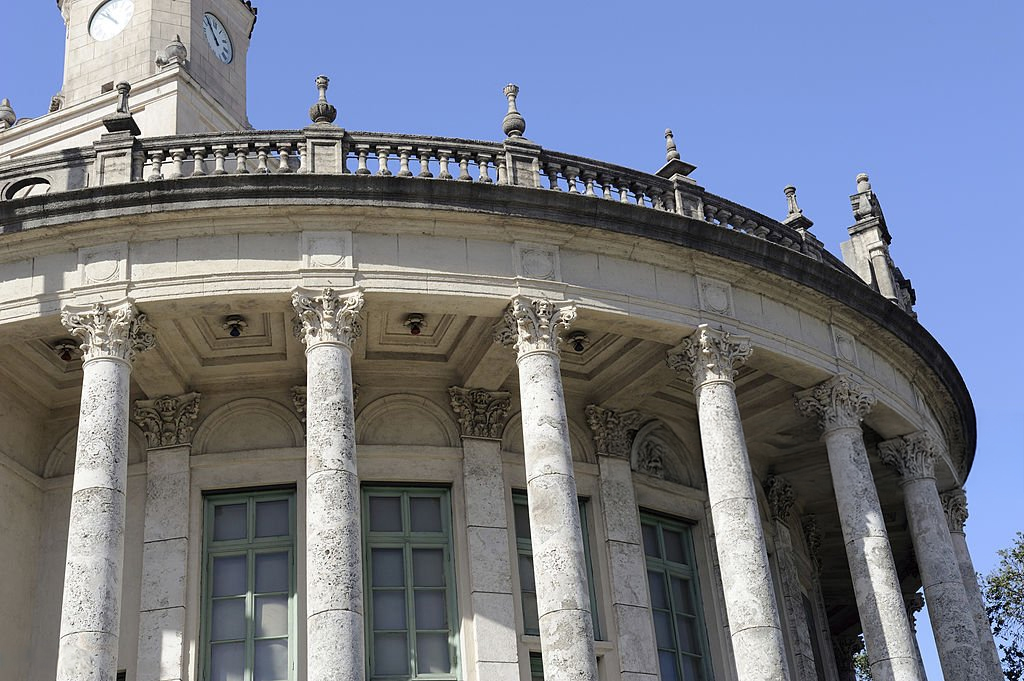
The overarching designs for the buildings in Coral Gables are drawn from a wealth of centuries-old Mediterranean examples that were not simply copied, but instead adapted and modified—recognizable, but different. The focal point for the new hotel would be its bell tower, from which the wings of the hotel project. The tower emulates the Giralda Tower of the Cathedral in Seville, Spain completed in the 12th century and originally a Moorish Mosque. The tower served as its minaret, where the faithful could be called to prayer. Silhouetted against the great canvas of clouds and sky, the tower would satisfy the poetic inclinations of Merrick and employ the richness of detail that the architects of the Biltmore Hotel could use as their organizing principle.
Partners, architects Leonard Schultze and S. Fullerton Weaver, based in New York, had previously been commissioned by Bowman to design the Atlanta-Biltmore (1925); the Los Angeles Biltmore (1923,) and in the Miami area, the Miami Daily News Tower ( now known as the Freedom Tower) [1925] and the Nautilus Hotel in Miami Beach ( 1923.) The announcement of the partnership between the Bowman-Biltmore chain and George Merrick’s development served to generate even more excitement within the region. At a dinner for some 200 business leaders, Bowman explained their masterpiece. Costing $10 million ($180 million in today’s dollars,) the resort would include a 400-room hotel, a country club, two, 18-hole golf courses, polo fields, tennis courts and a gigantic swimming pool measuring 150 x 225 feet. Today, an Olympic size pool measures approximately 164 feet in length and 82 feet in width and is rectangular in shape. The Biltmore Hotel’s pool was for some time the largest ever to be built in the United States.
Besides the local coverage, The New York Times reported:
Coral Gables is one of the largest and most beautiful high-class housing developments ever undertaken in the South…. Coral Gables is just outside Miami and consists of several thousand acres that are being developed with wide boulevards and hundreds of private residences of the Spanish type.
While the scale and scope of the project could leave one breathless, it was the schedule for its construction that would leave observers awestruck. The team announced that it would be begun and completed in just thirteen months.
In our next part, the history continues. Widely anticipated lavish opening parties, a Who’s Who of guests, a storm of a century and great change and loss.
In addition to being the first director of the Coral Gables’ Historic Preservation Department, Uguccioni is also a past president of The Villagers. She served on the Florida Historical Preservation Commission in Tallahassee for 12 years, serving as the Architectural Historian member, appointed by both the Secretary of State and the Governor. Uguccioni was one of the founders of the Coral Gables Historic Preservation Association, a lecturer at the University of Miami’s School of Architecture and a member of the Board of History Miami. She was named a Trustee Emerita by the Florida Trust for Historic Preservation and was awarded its Lifetime Achievement Award. Uguccioni is the author of numerous books, including “The Biltmore Hotel: An Enduring Legacy” and “Coral Gables: Miami Riviera: An Architectural Guide”

Author: Coral Gables Gazette News Staff
Originally established in 1996 and relaunched as a digital publication in February 2025, the Coral Gables Gazette is an independent local news organization dedicated to factual, objective and accountable community journalism. Our newsroom reports on the people, policies, institutions and events shaping Coral Gables, Florida, providing residents with timely, informative coverage of the issues affecting their community. Our reporting includes City Hall, local government, municipal elections, public spending, real estate development, business, education, arts and culture, and neighborhood affairs throughout the City Beautiful. We follow City Commission decisions, examine public records and report on the businesses, organizations and individuals contributing to Coral Gables. We believe informed residents are essential to a healthy, engaged community. Stories published under the Coral Gables Gazette News Staff byline are prepared or compiled by the publication's editorial team. We strive for accuracy, fairness, transparency and clear distinctions between news reporting, opinion and advertising. Readers are encouraged to submit news tips, corrections, editorial inquiries and story suggestions through our Contact page and learn more about our standards through our Editorial Policy.











This is a great history of our magnificent hotel, but what i do not understand is why the lower lobby that was remodeled without permits and input from the historical commission just totally disappeared and nothing has been done about it? What is the latest in bringing it back to its former self?
It’s always a pleasure to hear from Ms. Uguccioni on matters of local history and this article is no exception. We appreciate her sharing her considerable depth and breadth of knowledge of local history, adding value and appreciation for the surrounding works of our talented predecessors. We’re looking forward to additional chapters.