
By Coral Gables Gazette staff
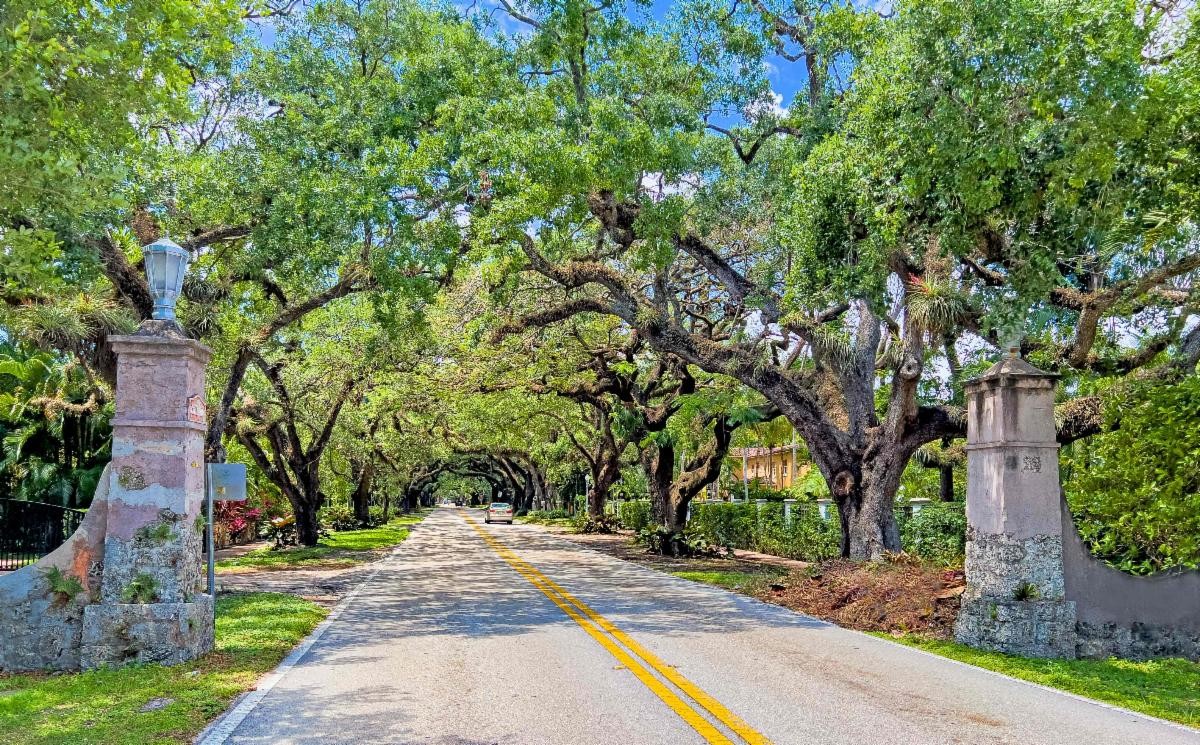
Trees cover 58 percent of Coral Gables, according to a newly completed digital inventory that puts a number on one of the city’s most recognizable features and gives officials a new baseline for managing it.
The inventory, announced by the city Aug. 19, identified nearly 39,000 trees within public rights-of-way and measured canopy coverage across the entire city, including trees on both public and private property.
The result puts Coral Gables well above Miami-Dade County’s goal of reaching 30 percent tree canopy by 2030, and nearly three times the county’s most recent measurement.
Miami-Dade’s latest Urban Forestry Plan says tree canopy within the county’s Urban Development Boundary has remained essentially flat at about 20 percent since 2016. A 2021 assessment measured it at 20.1 percent, despite years of county efforts to expand the urban forest.
The comparison is striking, although not necessarily exact. Coral Gables and Miami-Dade conducted separate assessments, and their methodologies and geographic boundaries may differ.
The city described Coral Gables as having one of the most extensive urban tree canopies in Florida, although its announcement did not provide a statewide ranking.
A new baseline for the city’s trees
Coral Gables has tracked its public trees for years. The significance of the new inventory is that it pairs information on individual trees in public rights-of-way with a citywide canopy measurement that includes private property.
The result gives city officials what the announcement describes as measurable and verifiable information to monitor the condition and distribution of trees, guide planting and maintenance decisions and plan for the long-term resilience of the urban forest.
An earlier count offers some historical context, though not a direct comparison. A 2019 profile of the city’s My Tree Keeper system reported 38,175 trees in public spaces, including streets and parks. The new inventory identifies nearly 39,000 specifically in public rights-of-way. Because the categories are different, the two figures alone cannot establish whether the city’s public tree population has increased.
The 58-percent citywide canopy figure also appears to be a broader measurement than the public-tree counts the city has traditionally highlighted because it captures trees growing on private property as well.
“Coral Gables was envisioned as a city defined by its natural beauty, shaded streets and lush landscape, and we have worked for generations to preserve that vision,” Mayor Vince Lago said in announcing the results.
Lago said the new data reflects both the city’s investment in managing its urban forest and the role residents play in preserving trees on private property.
How 58 percent compares
There is no single national percentage that defines a healthy urban tree canopy.
American Forests once recommended a 40-percent canopy goal for many communities but abandoned that universal standard in 2017, saying appropriate targets should instead account for climate, development density, land use and the amount of space realistically available for trees.
The organization has said, however, that research indicates 40 to 60 percent urban tree canopy can be attainable under ideal conditions in forested states. Coral Gables’ newly measured 58 percent sits near the upper end of even that range.
Canopy percentage alone also does not establish the health of an urban forest. American Forests points to species and age diversity, tree condition and equitable distribution among neighborhoods as other important measures.
Those are among the questions Coral Gables’ announcement does not answer.
The release does not say whether the city’s 58-percent canopy represents an increase or decline from an earlier comparable citywide measurement. Nor does it provide a neighborhood-by-neighborhood breakdown, species or age distribution, or an overall assessment of tree health.
Those measures will matter in determining whether Coral Gables’ unusually large canopy is also diverse and resilient, and whether its benefits are distributed evenly across the city.
A four-decade designation
Trees have been part of Coral Gables’ identity since the city’s founding, when George Merrick envisioned neighborhoods built around landscaped and tree-lined streets.
Coral Gables has held the Arbor Day Foundation’s Tree City USA designation since 1985. The city says it maintains its public urban forest through planting, pruning, monitoring and succession planning designed to replace aging and declining trees.
The benefits extend beyond appearance. Tree canopy shades streets and neighborhoods, reduces temperatures, manages stormwater, improves air quality and provides wildlife habitat, according to the city.
Miami-Dade has been pursuing the same benefits on a much larger scale. The county adopted a goal of expanding overall tree canopy to 30 percent, with its current climate strategy targeting 2030.
Coral Gables’ new inventory suggests the city has already moved well beyond that threshold.
More importantly, it gives the city a number against which future changes can be measured. The challenge now is not simply preserving Coral Gables’ reputation as the City Beautiful, but determining whether the 58-percent canopy measured today can be maintained as trees age, properties redevelop and the city continues to grow.
Residents can explore the inventory and canopy data through the city’s Smart City Hub.

Author: Coral Gables Gazette News Staff
Originally established in 1996 and relaunched as a digital publication in February 2025, the Coral Gables Gazette is an independent local news organization dedicated to factual, objective and accountable community journalism. Our newsroom reports on the people, policies, institutions and events shaping Coral Gables, Florida, providing residents with timely, informative coverage of the issues affecting their community. Our reporting includes City Hall, local government, municipal elections, public spending, real estate development, business, education, arts and culture, and neighborhood affairs throughout the City Beautiful. We follow City Commission decisions, examine public records and report on the businesses, organizations and individuals contributing to Coral Gables. We believe informed residents are essential to a healthy, engaged community. Stories published under the Coral Gables Gazette News Staff byline are prepared or compiled by the publication's editorial team. We strive for accuracy, fairness, transparency and clear distinctions between news reporting, opinion and advertising. Readers are encouraged to submit news tips, corrections, editorial inquiries and story suggestions through our Contact page and learn more about our standards through our Editorial Policy.










Coral Gables likes to brag about the tree canopy and it is lovely and more dense than in many other cities, although Coconut Grove can give it a run for its money. But how can the City brag about its tree canopy and then allow developers to take down 150+ year old oak trees in the Garden of the Lord at 110 Phoenetia?
At least one of the trees is a live oak determined to be 163+ years old by Aurelio Gabaldon Gutierrez, Civil Forest Engineer Geologist and ISA & FNGLA Certified Arborist. If this tree were to be moved, according to Jody Haynes, who works for Signature Palms and has 20+ years of experience moving large specimen trees, it will take more than a year, a great deal of money (six figures) and there is no guarantee the tree will survive the move.
The development known as “Crystal Academy” at 110 Phoenetia needs to be redesigned to SAVE THE OLD OAK TREES and the Garden of the Lord!
YES!!
That is not the only ancient oak to be destroyed by developers. And there are parts of Coral Gables, like Gables by the Sea, where the tree selection did not result in shade and many of the ill chosen species died. The two main east west roads in Gables by the Sea are an oven, with temperatures above the exposed pavement around 120 degrees. After 15 years of trying to get shade on those streets, we have made little progress.
Well, after the commission meeting yesterday, it looks like 110 Phoenetia Ave/Crystal Academy Project is a DONE DEAL dispite all the protest to the project. It seems that three commissioners to one (and one missing who obviously does not care) have made up their minds long before yesterday’s testimonies. It was quite obvious that no mater what anyone had to say and no matter what valid points they brought out, the 3 commissioners had already made up their minds this project was going through. What a shame the city favors development rather than saving the “Garden of the Lord” the two 150+ year old oak trees and the surrounding neighbors who live nearby want.
I am SO disappointed…