When an acclaimed choir changes artistic directors after 24 years, its first concert offers a glimpse of the direction ahead. For Seraphic Fire, that glimpse includes Shakespeare’s celebration of music, a biblical king’s grief, a 17th-century meditation on Christ’s wounded hands and a contemporary composer’s response to human displacement.
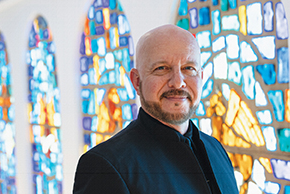
The program, Serenade to Music, comes to First United Methodist Church of Coral Gables, 536 Coral Way, at 7:30 p.m. Friday, Oct. 16. It marks the ensemble’s first Coral Gables performance under Dr. James K. Bass, who succeeded founder Patrick Dupré Quigley as artistic director in June.
Bass is hardly a newcomer to Seraphic Fire. A longtime associate conductor and performer with the Miami-based ensemble, he co-founded its Professional Choral Institute in 2011 and helped shape its educational programs.
He is also a Grammy Award-winning conductor and singer, recognized in 2020 for his work as chorusmaster and soloist on Richard Danielpour’s The Passion of Yeshua.
But Friday’s concert carries a different significance. Bass is now responsible for the artistic direction of the ensemble whose reputation Quigley built over more than two decades.
The Gazette covered Quigley’s farewell performances in April, when the founder closed his tenure with a program devoted to polychoral music, a tradition in which voices respond to one another across physical space.
Bass begins with another kind of musical dialogue, this time between composers separated by centuries.
Shakespeare’s celebration of music opens the program
Ralph Vaughan Williams composed Serenade to Music in 1938 to honor Sir Henry Wood, the conductor who helped establish London’s celebrated Proms concerts.
Wood conducted its premiere at the Royal Albert Hall on Oct. 5, 1938, at a concert marking his 50 years on the podium.
The text comes from Act V of Shakespeare’s The Merchant of Venice, in which Lorenzo reflects on music and the harmony of the heavens during a moonlit evening.
Vaughan Williams originally wrote the work for 16 individually designated vocal soloists and orchestra, giving each singer passages suited to the character of that voice. He subsequently arranged it for other combinations.
Seraphic Fire will perform a version bringing together chorus, piano and solo violin.
The music moves between individual voices and blended harmonies, turning Shakespeare’s meditation into a celebration of listening itself.
For a newly appointed artistic director, it is an appropriate beginning: a work that recognizes individual expression while finding its fullest effect in an ensemble.
Whitacre’s setting of a father’s grief
The emotional atmosphere changes considerably with Eric Whitacre’s When David Heard, composed in 1999.
The text comes from the Second Book of Samuel, when King David learns that his son Absalom has been killed.
Whitacre builds the composition around a single biblical sentence expressing David’s devastation.
The piece was commissioned for the Brigham Young Singers under conductor Ronald Staheli, who premiered it on March 26, 1999.
Scored for unaccompanied choir, it lasts approximately 15 minutes and relies on vocal color, extended harmonies and long passages of silence.
Whitacre has described silence as the principal musical idea behind the composition.
Without instrumental accompaniment, the singers must create the dramatic movement themselves. Repeated words and slowly shifting harmonies convey grief that does not resolve easily.
The contrast with Vaughan Williams is striking. One work celebrates music’s capacity to console; the other explores the limits of consolation.
A Baroque cantata receives a modern answer
The most unusual pairing of the evening brings together Dieterich Buxtehude and Caroline Shaw, composers separated by more than three centuries.
Buxtehude completed Membra Jesu Nostri in 1680, a cycle of seven cantatas meditating on different parts of the crucified Christ’s body.
The third cantata, Ad manus, addresses the hands.
Its devotional imagery includes a question about the wounds in those hands, drawing on a passage from the Book of Zechariah.
In 2016, Shaw composed To the Hands in response to Buxtehude’s work.
The Philadelphia-based choir The Crossing commissioned the piece as part of Seven Responses, a project inviting seven contemporary composers to respond to Buxtehude’s seven cantatas.
Shaw’s six-movement composition begins with a wordless reworking of Buxtehude’s music, then gradually transforms its language and meaning.
One of the most consequential changes is grammatical.
Buxtehude’s text asks about wounds in “your hands.” Shaw changes the question to wounds in “our hands.”
The shift moves the focus from contemplating another’s suffering to considering humanity’s possible responsibility for it.
The third movement, “Her beacon-hand beckons,” draws on Emma Lazarus’s The New Colossus, the sonnet associated with the Statue of Liberty. The image of wounded hands becomes one of hands extended in welcome.
Later, in “Litany of the Displaced,” the choir speaks numerical figures representing people displaced within their own countries.
The figures come from 2015 data compiled by the Internal Displacement Monitoring Centre. They are part of the historical composition, not current displacement estimates.
Shaw places those statistics within a musical setting, giving numerical evidence an unsettling emotional presence.
The concluding movement turns toward the possibility of comfort and protection.
Pairing the two works allows listeners to hear how a question first expressed through 17th-century Christian devotion can take on new meaning in an age of migration, displacement and humanitarian crisis.
Four works, one artistic statement
Seraphic Fire describes the program as an exploration of beauty, grief, devotion and the enduring power of the human voice.
The four works approach those themes from different directions.
Vaughan Williams finds beauty in musical harmony. Whitacre confronts grief without an easy resolution. Buxtehude meditates on suffering through devotion. Shaw asks what obligations arise when suffering belongs not only to the past but to the present world.
The sequence also reveals something about Bass’s artistic priorities.
Rather than opening his tenure with a program built entirely around familiar audience favorites, he has chosen music that demands close listening and invites connections across historical periods.
Seraphic Fire says the works are receiving their first performances by the ensemble.
The program will feature 16 professional singers accompanied by South Florida instrumentalists.
Quigley, now artistic director laureate, will return to conduct one of the season’s seven programs. Bass will lead the other six.
The Gazette previously covered Bass’s work as associate conductor, including an October 2025 concert featuring audience favorites from the ensemble’s repertoire.
His first season as artistic director takes a broader approach, ranging from the Baroque and Romantic traditions to jazz, contemporary music and Latin American repertoire.
November’s Blue Notes will explore songs associated with Nat King Cole, Etta James and Cole Porter, while December brings the ensemble’s seasonal program, Noel: An Old-World Christmas.
For Seraphic Fire, the transition is both a continuation and an opportunity for reinvention. The voices remain familiar. The person choosing what they sing, and how the works speak to one another, has changed.
If you go
Serenade to Music will be performed Friday, Oct. 16, at 7:30 p.m. at First United Methodist Church of Coral Gables, 536 Coral Way.
A pre-concert conversation begins at 6:30 p.m. and is included with admission.
Tickets and current availability are available through Seraphic Fire’s official season page or by calling 305-285-9060.
Season 24 continues in Coral Gables with Blue Notes on Friday, Nov. 20.

Author: Coral Gables Gazette News Staff
Originally established in 1996 and relaunched as a digital publication in February 2025, the Coral Gables Gazette is an independent local news organization dedicated to factual, objective and accountable community journalism. Our newsroom reports on the people, policies, institutions and events shaping Coral Gables, Florida, providing residents with timely, informative coverage of the issues affecting their community. Our reporting includes City Hall, local government, municipal elections, public spending, real estate development, business, education, arts and culture, and neighborhood affairs throughout the City Beautiful. We follow City Commission decisions, examine public records and report on the businesses, organizations and individuals contributing to Coral Gables. We believe informed residents are essential to a healthy, engaged community. Stories published under the Coral Gables Gazette News Staff byline are prepared or compiled by the publication's editorial team. We strive for accuracy, fairness, transparency and clear distinctions between news reporting, opinion and advertising. Readers are encouraged to submit news tips, corrections, editorial inquiries and story suggestions through our Contact page and learn more about our standards through our Editorial Policy.