The trail that helped unravel the Watergate scandal ran through Miami, where a local investigator followed bank records to a $25,000 check linking one of the burglars to President Richard Nixon’s re-election campaign.
Fifty years after Hollywood turned that investigation into one of cinema’s most celebrated political thrillers, the story returns to a Coral Gables screen.
All the President’s Men, Alan J. Pakula’s 1976 film about Washington Post reporters Bob Woodward and Carl Bernstein, will be shown Tuesday, Oct. 13, at 7:30 p.m. at Coral Gables Art Cinema, 260 Aragon Ave.
The 50th-anniversary screening brings back a film that transformed the painstaking work of journalism into a detective story, with a particularly revealing chapter set in South Florida.
A thriller built from phone calls and documents
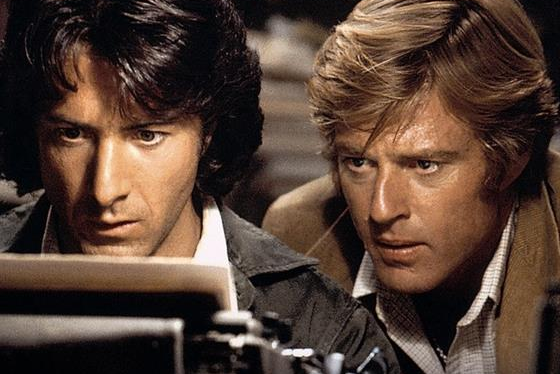
Robert Redford plays Woodward, the young Washington Post reporter assigned to what initially appears to be a routine burglary at Democratic National Committee headquarters in Washington’s Watergate complex.
Dustin Hoffman plays Bernstein, his colleague in an investigation that gradually exposes connections between the burglars and Nixon’s political organization.
The film follows the reporters through telephone calls, interviews, addresses, financial records and reluctant witnesses. The discoveries accumulate slowly, with each verified detail opening another line of inquiry.
Much of the action takes place in the newsroom, where editor Ben Bradlee, played by Jason Robards, presses the reporters to establish facts before publication.
Hal Holbrook portrays Deep Throat, the confidential source whose cryptic guidance becomes central to Woodward’s investigation.
Pakula builds suspense without relying on conventional action sequences. A name in an address book, an unexpected telephone answer or a source’s hesitation can carry as much tension as a chase.
The cinematography by Gordon Willis reinforces the atmosphere of uncertainty, moving between the brightly illuminated Washington Post newsroom and the shadowy settings where the reporters pursue leads.
The sound design is equally important. Writing in The Times of London, critic Wendy Ide praised the way the film makes typewriter strikes resemble gunfire, concluding that “words are weapons.”
The film won four Academy Awards, including adapted screenplay for William Goldman, supporting actor for Robards, art direction and sound. It received four additional nominations, including best picture and best director.
Miami provided a crucial financial link
The film’s connection to South Florida is more than incidental.
Four of the five men arrested in the June 17, 1972, Watergate break-in were based in Miami. Their local connections prompted Dade County State Attorney Richard Gerstein to begin an investigation.
His chief investigator, Martin Dardis, examined financial records involving Bernard Barker, one of the burglars.
Through subpoenaed bank records, Dardis identified a $25,000 cashier’s check deposited into an account associated with Barker’s real estate business.
The check had been issued by a Florida bank to Kenneth H. Dahlberg, a fundraiser for Nixon’s re-election campaign.
When Bernstein traveled to Miami, Dardis showed him the financial evidence.
Woodward subsequently contacted Dahlberg, who confirmed that he had delivered the check to officials of the Nixon campaign.
The finding supplied a crucial connection between the Watergate burglars and money associated with Nixon’s re-election organization.
The reporters disclosed the connection in an Aug. 1, 1972, Washington Post article.
Decades later, Woodward described the financial evidence as the connective tissue linking the burglary to the campaign.
Dardis, portrayed by Ned Beatty in the film, was not entirely satisfied with how Hollywood represented his contribution. He later complained that the book and film portrayed him unfairly, according to his 2006 obituary in the Los Angeles Times.
His resentment did not diminish the importance of the discovery. The Miami investigation helped establish one of the earliest publicly reported financial links between the burglars and Nixon’s political operation.
For Coral Gables audiences, the sequence offers a reminder that one of the defining political scandals in American history had a consequential chapter in their own metropolitan area.
Redford’s legacy, 50 years later
The anniversary has added poignancy following Redford’s death on Sept. 16, 2025, at age 89.
Redford did more than star in All the President’s Men. He served as an executive producer and helped shepherd the project from Woodward and Bernstein’s early manuscript into a feature film.
The project reflected his interest in stories about institutions, individual responsibility and the pursuit of truth.
The film also completed what critics frequently call Pakula’s paranoia trilogy, following Klute (1971) and The Parallax View (1974).
Together, the three films examined fear, surveillance, secrecy and the uneasy relationship between individuals and powerful institutions.
Unlike a conventional political biography, All the President’s Men concentrates largely on the opening months of the investigation rather than dramatizing Nixon’s entire downfall.
The later developments, including his August 1974 resignation, appear through the film’s concluding teletype headlines.
That choice keeps the story focused on the reporters’ daily work and the uncertainty they faced before the full dimensions of Watergate became known.
A classic returns to a local screen
Coral Gables Art Cinema has regularly brought historically significant films back to theatrical audiences, including its 10th-anniversary screening of the Miami-set Moonlight in June.
The return of All the President’s Men fits that tradition, but with an unusual local connection through the Miami investigators, bank accounts and political operatives who helped shape the Watergate story.
For viewers who have never seen the picture, its most striking quality may be its patience. The drama unfolds through verification, not revelation alone. A reporter learns something, checks it, encounters resistance and looks for another source.
With Coral Gables approaching a municipal election, the film’s attention to documentary evidence, accountability and the scrutiny of powerful institutions has particular resonance.
Fifty years later, the questions at the heart of the story remain familiar: What can be established? Who will confirm it? And what happens when the evidence leads somewhere powerful people would prefer it not to go?
If you go
All the President’s Men screens Tuesday, Oct. 13, at 7:30 p.m. at Coral Gables Art Cinema, 260 Aragon Ave.
The film runs 138 minutes, is rated PG and will be presented digitally.
Tickets are $8 for cinema members and up to $11.75 for nonmembers. Members avoid online service fees, according to the cinema.
Tickets and additional details are available on the film’s official screening page or by calling 786-472-2249.

Author: Coral Gables Gazette News Staff
Originally established in 1996 and relaunched as a digital publication in February 2025, the Coral Gables Gazette is an independent local news organization dedicated to factual, objective and accountable community journalism. Our newsroom reports on the people, policies, institutions and events shaping Coral Gables, Florida, providing residents with timely, informative coverage of the issues affecting their community. Our reporting includes City Hall, local government, municipal elections, public spending, real estate development, business, education, arts and culture, and neighborhood affairs throughout the City Beautiful. We follow City Commission decisions, examine public records and report on the businesses, organizations and individuals contributing to Coral Gables. We believe informed residents are essential to a healthy, engaged community. Stories published under the Coral Gables Gazette News Staff byline are prepared or compiled by the publication's editorial team. We strive for accuracy, fairness, transparency and clear distinctions between news reporting, opinion and advertising. Readers are encouraged to submit news tips, corrections, editorial inquiries and story suggestions through our Contact page and learn more about our standards through our Editorial Policy.