At the Coral Gables Museum this Sunday, the music of Cuba will share the stage with its poetry and painting in a concert conceived as an act of cultural remembrance.
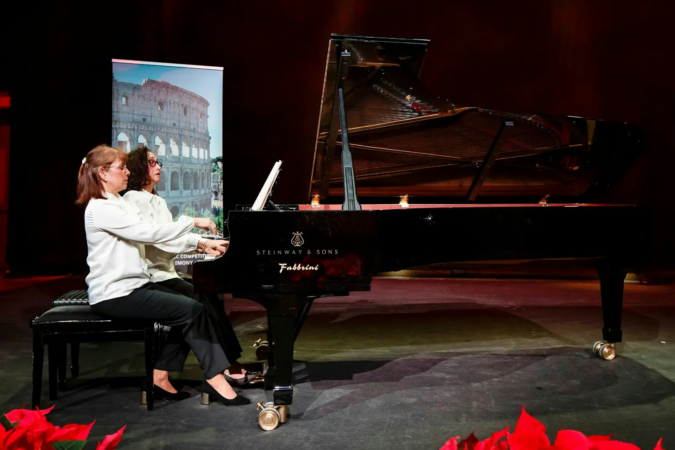
“Cuba en la Memoria: Música, Arte, y Poesía” brings together eight Cuban composers, seven literary figures and seven painters in a program spanning the 19th and 20th centuries. Performed by the N Blanco Y Negro piano duo, the Oct. 25 presentation combines live piano music, spoken verse and projected artwork to evoke a homeland whose cultural traditions have endured far beyond its shores.
The concert’s premise is that memory survives through more than one art form. A melody can recall a place; a poem can summon a voice; a painting can preserve the colors and textures of a vanished world. Together, the organizers suggest, they offer Cubans living abroad a means of reconnecting with an island that remains central to their identity.
The program assigns each discipline a role. Selected poems will be recited before the musical performances, while artworks by Cuban painters will be projected throughout. José Guillermo Muñoz is listed as the presenter.
From the contradanza to Lecuona
The musical journey begins with Manuel Saumell, the 19th-century Havana composer whose contradanzas helped shape a distinctly Cuban musical language. Three of his pieces open the program, followed by dances from Ignacio Cervantes, who combined European classical training with the rhythms and melodic character of his homeland.
Cervantes’ works include “Soledad,” “La Encantadora,” “Siempre Sí” and “Adiós a Cuba.” The last title carries particular resonance in a concert devoted to memory and displacement. His music returns at the program’s conclusion with three more dances, including “Los muñecos.”
The repertoire also features Cervantes’ daughter, pianist and composer María Cervantes, represented by “Fusión de almas.”
Moving into the 20th century, the duo will perform Carlo Borbolla’s “Rítmica Cubana,” with pieces drawing on the son and montuno traditions, and selections from Gisela Hernández’s “Cubanas,” including “Toque de clave” and “Guajira.” Hernández’s compositions reflect the interplay of classical forms and Afro-Cuban musical traditions.
Joaquín Nin-Culmell contributes two Cuban dances, “El Guante” and “El Malecón.” His family connection to another artist in the program is notable: he was the brother of writer Anaïs Nin, whose work is represented among the literary selections.
Ernesto Lecuona, perhaps the most internationally recognizable composer on the program, appears through three contrasting dances: “Ahí viene el chino,” “Danza Negra” and “Malagueña.” José White, the Matanzas-born violinist and composer, is represented by his habanera “La Bella Cubana.”
Lecuona and Cervantes have figured prominently in other Coral Gables performances exploring Cuban cultural heritage. In April, the Gazette reported on a Cuban classical ballet program celebrating their music and its continuing life in exile.
Cuban literature and painting complete the portrait
The literary selections extend the program beyond music.
The seven writers include 19th-century figures Gertrudis Gómez de Avellaneda, Plácido, Juana Borrero and José Martí, alongside Dulce María Loynaz, Lydia Cabrera and Anaïs Nin.
Their contributions encompass poetry, literary modernism and the preservation of cultural traditions. Cabrera, who died in Miami in 1991, is particularly associated with her documentation of Afro-Cuban religion and folklore. Loynaz, one of Cuba’s most distinguished poets, represents another important strand of the island’s literary inheritance.
The visual program reaches across a similarly broad period. Works by Vicente Escobar and Esteban Chartrand connect the presentation with earlier Cuban painting, while Amelia Peláez, Wifredo Lam and Carlos Enríquez bring the distinctive visual languages of 20th-century Cuban modernism. Armando Menocal and Guillermo Collazo complete the group of seven painters.
The organizers have not identified the individual paintings to be projected, but the selections are intended to accompany the music and poetry rather than function as a separate exhibition.
That interplay distinguishes “Cuba en la Memoria” from a conventional recital. The audience will encounter Cuban culture not as a sequence of isolated artistic achievements but through the relationships among the country’s music, literature and visual art.
Earlier this month, another Coral Gables performance traced Cuban musical memory from ancestral rhythms to Benny Moré. Sunday’s program approaches remembrance through a different repertoire, drawing on classical piano traditions and pairing them with words and images.
Two pianists with an international career
N Blanco Y Negro was founded in Miami in 2017 by pianists Mirta Gómez and Sahily Cánovas, both of Cuban descent.
Gómez graduated from the Juilliard School in New York, while Cánovas studied at the Kyiv and Odesa state conservatories in Ukraine. Both have performed internationally as soloists, and their partnership has taken them to stages in the United States and Europe.
According to the duo’s biography, the musicians received international competition honors in Macedonia, France and Italy in 2021. They subsequently won the Euterpe Music Awards in Berlin in 2023 and a bronze medal at Vienna’s International Schubert Competition in April 2025.
For the Coral Gables performance, the duo has assembled a program that places demanding classical piano repertoire in conversation with the cultural history of Cuba.
The choice is especially meaningful in South Florida, where generations of Cuban immigrants and their descendants have maintained ties to their homeland through music, literature, visual art and family traditions.
The concert’s organizers describe that bond in explicitly personal terms, presenting Cuban culture as something that survives geographical separation and remains alive in the memory of those who have left the island.
A historic setting for cultural remembrance
The Coral Gables Museum provides a setting with its own history of preservation.
Its home at 285 Aragon Ave. was completed in 1939 as the city’s police and fire station, a Works Progress Administration project designed by architect Phineas Paist. The restored building now houses exhibitions and programs devoted to art, architecture and civic identity.
The Gazette recently explored the building’s history in its coverage of a museum program celebrating the Dominican community in Miami-Dade County.
On Sunday, the museum becomes a meeting place for another expression of cultural heritage: an afternoon in which Cuba is remembered through the sounds of its composers, the words of its writers and the images created by its painters.
If you go…
What: “Cuba en la Memoria: Música, Arte, y Poesía,” featuring the N Blanco Y Negro piano duo, poetry readings and projected Cuban artwork.
When: Sunday, Oct. 25, 2026 at 3 pm.
Where: Coral Gables Museum, 285 Aragon Ave., Coral Gables.
Tickets: Listed at $10–$25 by a local event calendar. Tickets and additional information are available through the museum’s Eventbrite listing.

Author: Coral Gables Gazette News Staff
Originally established in 1996 and relaunched as a digital publication in February 2025, the Coral Gables Gazette is an independent local news organization dedicated to factual, objective and accountable community journalism. Our newsroom reports on the people, policies, institutions and events shaping Coral Gables, Florida, providing residents with timely, informative coverage of the issues affecting their community. Our reporting includes City Hall, local government, municipal elections, public spending, real estate development, business, education, arts and culture, and neighborhood affairs throughout the City Beautiful. We follow City Commission decisions, examine public records and report on the businesses, organizations and individuals contributing to Coral Gables. We believe informed residents are essential to a healthy, engaged community. Stories published under the Coral Gables Gazette News Staff byline are prepared or compiled by the publication's editorial team. We strive for accuracy, fairness, transparency and clear distinctions between news reporting, opinion and advertising. Readers are encouraged to submit news tips, corrections, editorial inquiries and story suggestions through our Contact page and learn more about our standards through our Editorial Policy.