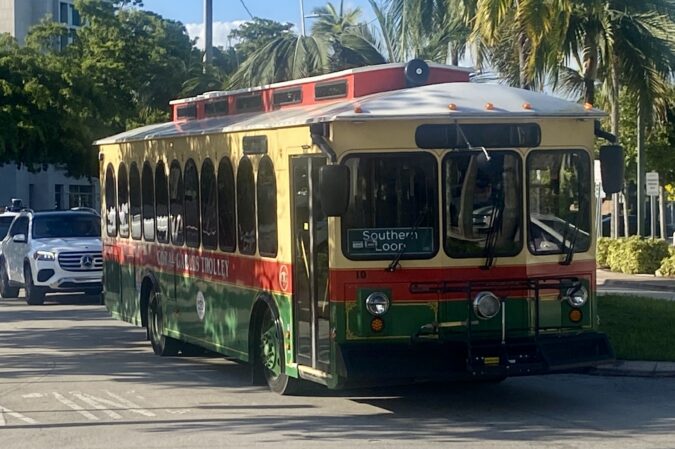
Coral Gables trolley ridership has fallen more than 14 percent over two years, with the system recording its second consecutive annual decline even after the city added a new route intended to expand transportation options.
The city recorded 891,275 passenger trips in the fiscal year that ended Sept. 30, down 7.7 percent from 965,419 the year before and 14.3 percent from 1,039,757 in fiscal 2024. The decline was steeper on the city’s established routes, which lost nearly 91,000 trips during the latest fiscal year.
Over the same two fiscal years, operating expenses in the city’s Transportation and Trolley fund increased 18.1 percent, from $2.74 million to $3.24 million, based on spending through the first nine months of each year. The fund includes transportation services beyond the trolley routes.
The ridership figures were discussed at the Oct. 20 Transportation Advisory Board meeting. In a subsequent written response to Gazette questions, the city said the decline was not unique to Coral Gables and that officials had not identified a single cause.
The written totals differ from those presented at the meeting, where the previous year’s ridership was described as exceeding one million and the annual decline was estimated at 11 percent. The revised figures establish a smaller annual decrease but confirm a sustained two-year downward trend.
Ponce route accounts for nearly all the losses
The main Ponce de Leon Boulevard route, which serves downtown and the Central Business District, recorded 836,967 boardings in fiscal 2026, down 10.1 percent from 931,160 the previous year. The route has lost 163,031 annual passenger trips, or 16.3 percent, since fiscal 2024.
It still accounts for approximately 94 percent of the trolley system’s ridership.
The Grand Avenue route, which serves Coconut Grove, moved in the opposite direction. Ridership increased 9.7 percent to 37,580 boardings, up from 34,259 in fiscal 2025 and nearly matching the 37,900 recorded two years earlier.
Combined, the two established routes lost 90,872 trips, or 9.4 percent, during fiscal 2026. The new Southern Loop added 16,728 trips, reducing the systemwide decline to 74,144.
The Ponce route alone lost more passengers than the entire system’s net decrease.
Southern Loop reaches less than half its projection
The Southern Loop began operating Nov. 3, 2025, connecting the Douglas Road Metrorail station to Red Road along Ponce de Leon Boulevard. The route serves destinations including the University of Miami, medical offices and residential neighborhoods along the U.S. 1 corridor.
During its first 11 months, the route carried 16,728 passengers, averaging approximately 1,520 monthly boardings. That is about 43 percent of the city’s original projection of 3,500 riders per month.
The Gazette reported in February that the route was gaining passengers month over month but remained well below expectations. Matt Anderson, the city’s assistant director of mobility, had also projected that monthly ridership could eventually reach 4,500.
Anderson told the Transportation Advisory Board on Oct. 20 that the city is building momentum through marketing and expects demand to increase as construction of the Underline segment from LeJeune Road to 57th Avenue is completed.
“You’re going to see a lot of demand, I think, along the Underline,” Anderson said, noting that the trolley runs adjacent to the corridor along Ponce.
Martha Pantin, the city’s director of communications, likewise said the city expects ridership to grow as the route becomes more established, although it is too early to quantify that growth or predict when the original projection might be reached.
Construction along Ponce could also be affecting access and travel patterns, the city said, but officials have not quantified its impact.
The Southern Loop was introduced as a one-year pilot, with an estimated annual operating cost of $400,000. The initial funding arrangement included approximately $196,000 from the Florida Department of Transportation and $204,000 from the city.
As the Gazette reported in March, the state funding was expected to run out, potentially leaving Coral Gables responsible for the full annual operating cost.
The city said the grant is approaching its conclusion. With the pilot’s first anniversary less than two weeks away, the material provided to the Gazette does not establish whether the route will continue under the same operating arrangements or how the city intends to finance it without state support.
The city’s official description of the pilot says ridership and community feedback will help determine whether service continues beyond the first year.
Operating expenses rise 31 percent
The city’s financial report for the nine months ended June 30 shows Transportation and Trolley fund operating expenses increasing from $2.47 million in fiscal 2025 to $3.24 million in fiscal 2026, a rise of approximately $771,000.
The largest increases were in other charges and expenses, up approximately $399,000; contractual billing and collection, up $303,000; and salaries and employee benefits, up $69,000.
The fund’s operating loss widened from approximately $654,000 to $1.69 million. Transfers from the city’s General Fund increased from $262,090 to approximately $1.4 million over the same nine-month periods.
The figures describe the broader Transportation and Trolley fund, which encompasses activities beyond the three trolley routes. They do not establish how much of the spending increase can be attributed to the Southern Loop.
In its response to the Gazette, the city described a trolley division budget of approximately $4.7 million, supported by about $3.1 million from Miami-Dade County’s half-cent transportation sales tax and $1.6 million from parking revenue. That budget covers trolley operations and related mobility services, including Freebee.
The quarterly financial report, however, lists a $6.39 million amended annual operating-expense budget for the broader Transportation and Trolley fund. The city did not explain how the two budget figures relate.
Regional transit figures offer a mixed picture
Pantin said Coral Gables was not alone in experiencing declining transit use.
According to figures the city provided, Miami’s trolley system recorded approximately 4.29 million passenger trips in fiscal 2026, down from 4.66 million the previous year—a decline of about 8 percent.
Miami-Dade County’s latest published ridership report presents a more mixed picture. Total county transit ridership declined approximately 1.4 percent during the 11 months from October 2025 through August 2026 compared with the corresponding period a year earlier.
The reporting periods are not identical, but the countywide decline was considerably smaller than Coral Gables’ 7.7 percent decrease.
Gasoline prices also rose sharply during the second half of the fiscal year. Federal Energy Information Administration data show Miami-area regular gasoline averaging approximately $2.86 per gallon in February, $4.02 in April and $4.31 in May.
Although higher fuel prices can encourage public transportation use, their effects vary by system and may take time to emerge. Neither the gasoline-price trend nor the regional comparisons establishes why Coral Gables ridership declined.
Improved stops and a new mobility study
The city reported completing accessibility improvements at 42 trolley stops along Ponce de Leon Boulevard during fiscal 2026, including shelters, benches, bicycle racks, signage and other amenities.
The improvements have involved trade-offs. In July 2025, city officials said the project would eliminate approximately 40 on-street parking spaces, drawing objections from members of the Parking Advisory Board, as the Gazette reported at the time.
Other parts of the city’s mobility network have shown growth. Freebee, the city’s on-demand transportation service, recorded 82,981 passenger trips in fiscal 2026, up 3.2 percent from 80,429 the previous year.
Meanwhile, the city is preparing to begin work on a Mobility Master Plan. According to the city’s response, the scope has been approved and a purchase order is being prepared for consultant Kimley-Horn.
City Manager Peter Iglesias directed staff in 2025 to pursue what would be the city’s first comprehensive trolley and mobility review since 2013. The Gazette previously examined the need for such a plan, arguing that expanded routes should be evaluated as part of an interconnected transportation network.
That study will begin against a markedly different ridership picture: the trolley system has added a route, its principal corridor has lost more than 16 percent of its annual passengers over two years, and operating expenses in the broader transportation fund have risen substantially.
The findings could help determine whether changes to existing routes, service hours and regional connections are needed to reverse the decline.

Author: Coral Gables Gazette News Staff
Originally established in 1996 and relaunched as a digital publication in February 2025, the Coral Gables Gazette is an independent local news organization dedicated to factual, objective and accountable community journalism. Our newsroom reports on the people, policies, institutions and events shaping Coral Gables, Florida, providing residents with timely, informative coverage of the issues affecting their community. Our reporting includes City Hall, local government, municipal elections, public spending, real estate development, business, education, arts and culture, and neighborhood affairs throughout the City Beautiful. We follow City Commission decisions, examine public records and report on the businesses, organizations and individuals contributing to Coral Gables. We believe informed residents are essential to a healthy, engaged community. Stories published under the Coral Gables Gazette News Staff byline are prepared or compiled by the publication's editorial team. We strive for accuracy, fairness, transparency and clear distinctions between news reporting, opinion and advertising. Readers are encouraged to submit news tips, corrections, editorial inquiries and story suggestions through our Contact page and learn more about our standards through our Editorial Policy.