
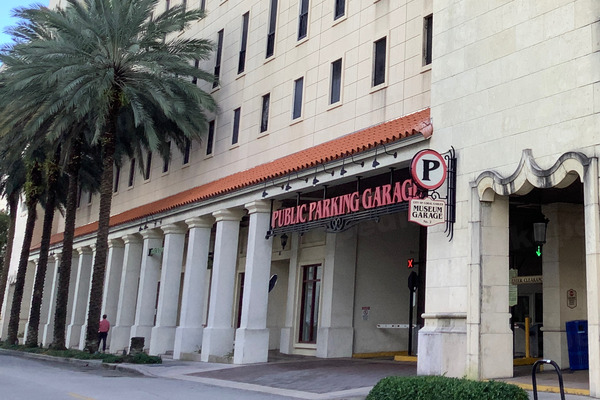
Despite years of complaints from residents and business owners about downtown parking, city data covering the first seven months of 2026 show substantial unused capacity in four Coral Gables public garages throughout the day.
Occupancy figures for Garages 1, 2, 4 and 6, measured at 10 a.m., 2 p.m., 7 p.m. and 9 p.m., show no garage exceeding 86% occupancy. Most of the readings are below 60%.
The numbers do not mean finding a convenient space is always easy. They do show that the four garages themselves have generally had room available, complicating a longstanding perception that downtown Coral Gables simply does not have enough parking.
Garages fill differently over the day
Garage 4, at 385 Andalusia Ave., is the busiest during the daytime measurements. It is 60% occupied at 10 a.m. and rises to 80% at 2 p.m., before dropping to 61% at 7 p.m. and reaching 68% at 9 p.m.
Garage 6, at 51 Aragon Ave., follows almost the opposite pattern. It is only 23% occupied at 10 a.m., the lowest figure anywhere in the data, and 37% full at 2 p.m. By 7 p.m., however, it reaches 86% — the highest occupancy recorded among the four garages — before falling to 71% at 9 p.m.
Garages 1 and 2 are steadier.
Garage 1, at 245 Andalusia Ave., ranges from 34% occupancy at 10 a.m. to 59% at 2 p.m., then registers 49% at 7 p.m. and 57% at 9 p.m. Garage 2, at 220 Aragon Ave., goes from 42% at 10 a.m. to 61% at 2 p.m., then 58% at 7 p.m. and 50% at 9 p.m.
The figures highlight a tension the Gazette has reported before. A spring 2025 business survey found 69% of respondents viewed downtown parking availability as a significant obstacle, even as the same survey showed strong overall confidence in the city’s business climate.
The occupancy numbers do not erase that concern. A space in a garage several blocks from someone’s destination may not feel like available parking to the motorist circling for a closer spot. Nor do four time-of-day measurements capture every dinner rush, weekend event or unusually busy hour.
But they do challenge the simpler proposition that downtown’s public garages are routinely full.
Garage 2 handles nearly 40% of transactions
A separate city data set shows how much traffic each garage handled from January through July.
Together, the four garages recorded 498,907 transactions during the seven-month period. Garage 2 accounted for 191,109 of them, or about 38% of the total.
Its average daily traffic ranged from 767 transactions in July to 1,041 in May. Garage 1, by comparison, ranged from 403 to 468 daily transactions. Garages 4 and 6 generally fell between the two.
Overall garage traffic peaked in May, when the four facilities recorded 81,336 transactions. By July, the total had fallen to 65,237, about 20% below the May peak.
Garage 2 was the busiest by transaction count in every month. Garage 1 was the least busy in every month, recording 92,711 transactions over the seven-month period compared with Garage 2’s 191,109.
The transaction figures measure turnover, not how full a garage is at any one moment. One parking space may generate several transactions over the course of a day. A garage can therefore handle substantial traffic without approaching capacity.
The numbers arrive as Garage 1 faces replacement
The data take on added significance because Garage 1 sits at the center of one of Coral Gables’ largest capital projects.
The city’s planned Mobility Hub would replace Garage 1 on Andalusia Avenue and consolidate parking now provided by Garages 1 and 4 into a new mixed-use facility. City officials have said the existing structures are obsolete and have presented the project as more than a response to parking demand, incorporating new mobility features, electric-vehicle infrastructure, public space and other uses.
City Manager Peter Iglesias has said the planned hub would provide roughly 626 spaces, essentially matching the combined capacity of Garages 1 and 4 rather than creating a major net increase in parking. Previous city presentations put the two existing garages at a combined 627 spaces.
That distinction is important. The Mobility Hub has often been discussed in the broader context of downtown access and parking, but the project is fundamentally a replacement and consolidation of aging public infrastructure rather than a large expansion of the city’s parking supply.
The city has continued moving the project through preconstruction. Its procurement documents describe a facility intended to accommodate cars, bicycles, scooters, rideshare services and other forms of transportation, with flexibility for future changes in how people move through downtown.
Capacity and convenience are different
The city’s data cover only four garages. Coral Gables operates other public parking facilities, as well as surface lots and on-street spaces, that are not reflected in these figures.
The numbers also cannot measure frustration.
Drivers may reject a garage because it is too far from their destination. They may circle for curbside parking before entering one. Restaurants, shops and offices can experience parking pressure on different schedules. An average across seven months can also smooth out individual days when a garage is substantially busier.
Those limits matter.
So does what the data actually show.
From January through July, the four public garages examined by the city remained below capacity at the measured times. Even the busiest reading — Garage 6 at 7 p.m. — left about 14% of its spaces unoccupied. At many other times, one-third, one-half or more of a garage’s capacity remained available.
Coral Gables may still have a parking problem in the experience of the people trying to park downtown. The city’s own numbers suggest the problem is more complicated than simply running out of spaces.

Author: Coral Gables Gazette News Staff
Originally established in 1996 and relaunched as a digital publication in February 2025, the Coral Gables Gazette is an independent local news organization dedicated to factual, objective and accountable community journalism. Our newsroom reports on the people, policies, institutions and events shaping Coral Gables, Florida, providing residents with timely, informative coverage of the issues affecting their community. Our reporting includes City Hall, local government, municipal elections, public spending, real estate development, business, education, arts and culture, and neighborhood affairs throughout the City Beautiful. We follow City Commission decisions, examine public records and report on the businesses, organizations and individuals contributing to Coral Gables. We believe informed residents are essential to a healthy, engaged community. Stories published under the Coral Gables Gazette News Staff byline are prepared or compiled by the publication's editorial team. We strive for accuracy, fairness, transparency and clear distinctions between news reporting, opinion and advertising. Readers are encouraged to submit news tips, corrections, editorial inquiries and story suggestions through our Contact page and learn more about our standards through our Editorial Policy.










I would urge residents and all visitors to use the aforementioned garages and street parking ( wherever available) and NOT the scam parking lots using the cameras that send you BS bills in the mail.
Maybe if parking rates were more reasonable, visitors to Coral Gables will use the public garages more often. Rates are, in my opinion, abusive. Now the rate is $1 for every 24 minutes, making it even difficult to figure out how many time periods you are paying for. A 2-1/2 to 3 hour stay (A minimum stay to, say go to dinner and then take a stroll after dinner) will run you $7 to $8, or more if you stay 1 second past the next 24-minute parking period. Too much when one is already paying taxes and patronizing the stores in the City Beautiful.
Half of the businesses on Miracle Mile are sitting empty. What did you expect??
Removing the angled parking on Miracle Mile was an absolutely awful decision. Angled parking was easy to get in and out of, and it provided more parking spaces, plus more convenient parking than parallel parking does.
In order to parallel park one has to pull ahead, stop, and then back-up, which completely stops the flow of traffic. And in today’s world most people don’t know how to parallel park since it’s been decades since that skill was required on the driver’s license test.
We may have plenty of space in our garages, but one aspect of convenient parking was eliminated. All to be able to beautify and expand the sidewalks with those horrendous pavers. No foresight whatsoever with that decision.
These numbers don’t account for the publicly available parking in private garages, so the actual parking capacity is being underreported.
I’ve lived here for 14 years, and parking has never been a problem for me. Not even during the busiest holiday events have I had a legitimate issue finding a place to park.
The parking is cheap. So we have an abundance of cheap parking with plenty of capacity still available, that raises a different question: Are we actually attracting enough people to the area? High parking demand is usually a sign of a thriving, busy destination. If parking is consistently available, even during major events, it may be worth looking at whether the bigger issue is attracting visitors and activity, rather than building more parking.
Well, now this is interesting.
Garage 2 handles nearly 40% of all the transactions among these four garages, yet its measured occupancy never gets past 61%.
So are we running out of parking—or are we running out of patience?
Those might be two very different problems.