
By Coral Gables Gazette staff
No single response earned majority support in a Coral Gables Gazette reader poll on the University of Miami’s proposed 30-year development agreement. “Take more time” was the largest individual choice, while approval held a narrow edge when the two approval options were combined.
The voluntary, non-scientific poll, conducted Aug. 17 through Aug. 24 using Crowdsignal, drew 153 responses to the question:
“What should the Coral Gables City Commission do with the University of Miami’s proposed 30-year development agreement?”
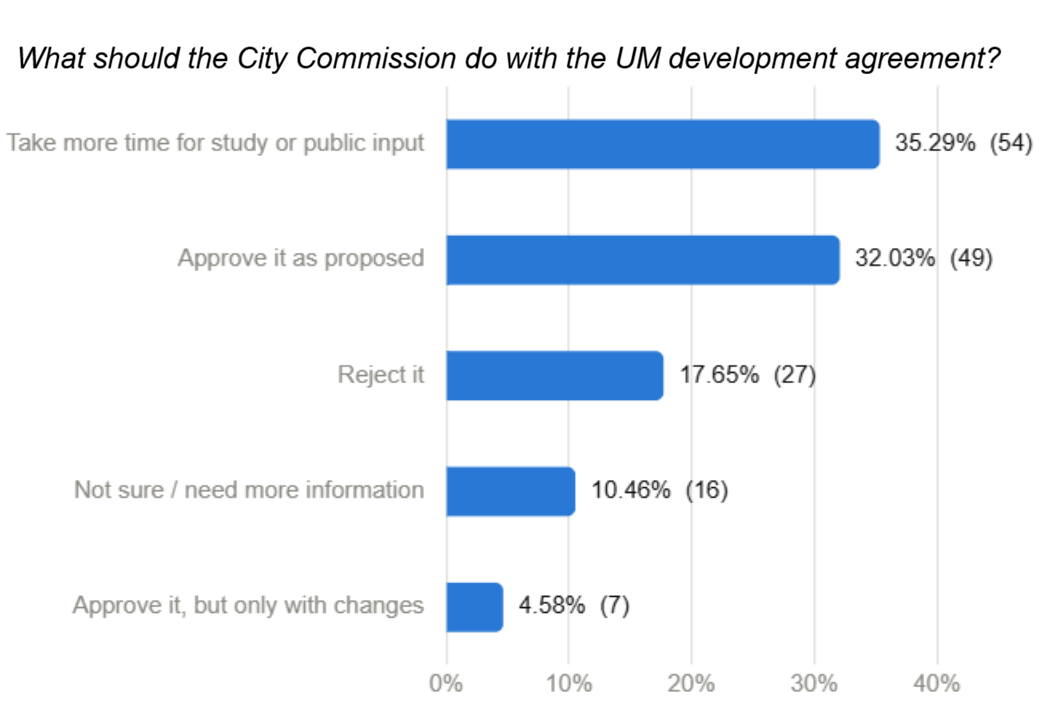
Fifty-four respondents, or 35.29 percent, chose “take more time for study or public input before deciding.” Forty-nine, or 32.03 percent, said the commission should approve the agreement as proposed.
Another 27 respondents, or 17.65 percent, said the commission should reject it. Sixteen, or 10.46 percent, said they were not sure or needed more information. Seven, or 4.58 percent, favored approval, but only with changes.
The poll closed Monday as commissioners prepared to take up the university’s proposal Tuesday, Aug. 25.
A closely divided result
Read strictly by the five choices offered, “take more time” was the largest response, ahead of “approve it as proposed” by five votes.
Combining the two approval choices changes the picture. The 49 respondents supporting approval as proposed and seven supporting approval with changes total 56 votes, or 36.60 percent, narrowly exceeding the 35.29 percent who chose more time.
Neither reading tells the whole story.
A respondent willing to approve the agreement only after changes is expressing a materially different view from someone who supports it exactly as filed. Likewise, respondents seeking more time are not necessarily opposed to eventual approval; some could support the agreement once their questions are answered.
What the results show most clearly is a participating reader sample divided over how the commission should proceed, with no majority behind any option.
Because participation was voluntary and respondents selected themselves, the poll should not be interpreted as representative of Coral Gables voters or residents generally. Duplicate voting was restricted by the polling system, but the survey did not use a randomized sample or collect demographic information.
Readers who favor approval
Among respondents who submitted comments, some argued that the university’s proposal has already undergone substantial professional review and that UM’s long-term presence in Coral Gables distinguishes it from a conventional developer.
“The City’s professional staff and the Planning and Zoning Board have more expertise and exist to more properly vet land use proposals than individual residents,” one respondent wrote. “Let’s rely on what they’ve done, and let’s rely on UM’s expertise and goodwill.”
Another reader emphasized the university’s record as a neighbor.
“I am an FSU grad, so I don’t have any alignment with UM,” the respondent wrote. “I also live a few blocks away from UM. They have only been good neighbors. I do not see anything wrong with their requests.”
Calls for more time or changes
Other respondents focused less on outright opposition than on whether the city has allowed enough time to understand the consequences of a 30-year agreement.
“The rush to vote without adequate studies is a disconcerting trend which has been happening throughout our City,” one reader wrote, calling for greater public involvement before a decision.
Several respondents raised specific concerns about the proposed hospital use, the 17,500-student enrollment mitigation threshold, parking and traffic. Some said they lacked enough information to decide, while others indicated they could support development if additional commitments were included.
One respondent said the proposal could become “a win-win for all” but called on UM to provide more on-campus parking, reduce the impact of shuttle buses and work with the city to make Ponce de Leon Boulevard safer and more attractive.
Some want the deal rejected
Nearly 18 percent of respondents favored rejecting the agreement.
Among those who submitted comments, some were unequivocal.
“Reject all of it,” one reader wrote.
Another responded simply: “Stop destroying our city.”
Comments were optional, and the number or tone of submitted comments should not be interpreted as representing everyone who selected a particular response.
What comes next
The City Commission is scheduled to take up the university’s development package Tuesday in a time-certain 2 p.m. hearing.
The proposal includes changes that would increase allowable development intensity on the campus, permit hospital use in the Multi-Use Zone, reclassify university-owned parcels along Levante Avenue and Ponce de Leon Boulevard and restate the city’s long-term development agreement with UM.
Tuesday’s ordinance votes are on first reading. If they advance, a second reading and public hearing would still be required before the measures take effect, giving residents another opportunity to weigh in before final approval.
Methodology: The Gazette poll was conducted through Crowdsignal from Aug. 17 through Aug. 24. Participation was voluntary and duplicate voting was restricted by the polling system. The poll did not collect demographic information or use a randomized sample and should be understood as a survey of participating Gazette readers, not a representative poll of Coral Gables residents.

Author: Coral Gables Gazette News Staff
Originally established in 1996 and relaunched as a digital publication in February 2025, the Coral Gables Gazette is an independent local news organization dedicated to factual, objective and accountable community journalism. Our newsroom reports on the people, policies, institutions and events shaping Coral Gables, Florida, providing residents with timely, informative coverage of the issues affecting their community. Our reporting includes City Hall, local government, municipal elections, public spending, real estate development, business, education, arts and culture, and neighborhood affairs throughout the City Beautiful. We follow City Commission decisions, examine public records and report on the businesses, organizations and individuals contributing to Coral Gables. We believe informed residents are essential to a healthy, engaged community. Stories published under the Coral Gables Gazette News Staff byline are prepared or compiled by the publication's editorial team. We strive for accuracy, fairness, transparency and clear distinctions between news reporting, opinion and advertising. Readers are encouraged to submit news tips, corrections, editorial inquiries and story suggestions through our Contact page and learn more about our standards through our Editorial Policy.










You can ask for more resident approval and discussion, but Lago and Lara have already been paid off by $25k. They are bought and sold crooks who will still vote on it. Get them out of our city sp we can have a fair honest government.
Why do you always say I’ve already posted when I haven’t.