
By Coral Gables Gazette staff
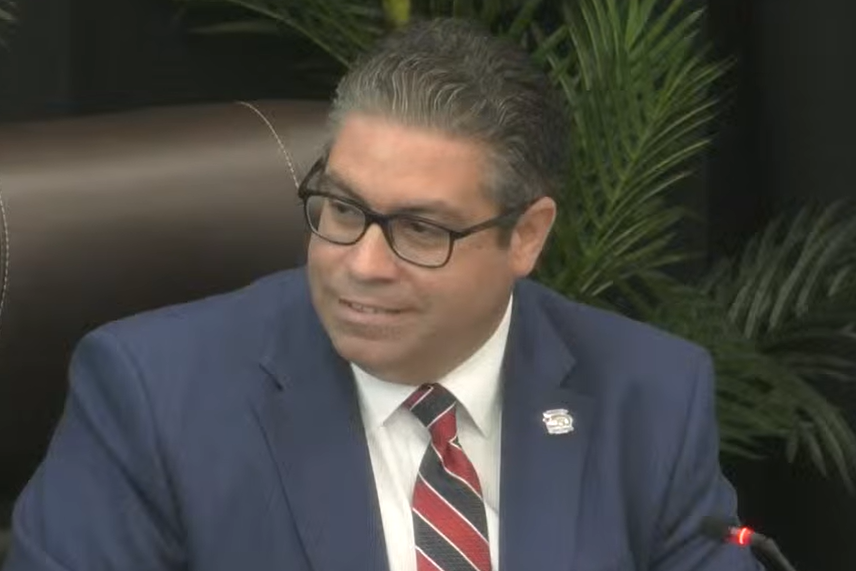
Almost 11 months after the Coral Gables Commission directed the city to investigate claims of “phishing” surveys against Commissioner Ariel Fernandez, the Miami-Dade County State Attorney’s Office officially reported the matter closed on May 19.
In a close-out memo, Tim VanderGiesen, chief of the State Attorney’s Public Corruption Unit, concluded there was “insufficient evidence of criminal activity to warrant further inquiry” and formally closed the matter.
The inquiry stemmed from allegations that Fernandez was behind anonymous political email surveys sent to Coral Gables residents in 2023 and 2024 through entities such as “People Count USA,” a group with no active website and no registration in Florida corporate or political committee records. The emails began circulating in August 2023, approximately four months after Fernandez and Commissioner Melissa Castro won election defeating Lago-backed candidates. The allegations were amplified last year in a lengthy post published by the anonymous Aesop’s Gables blog, widely viewed as sympathetic to Mayor Vince Lago, and prompted the commission to authorize a police investigation in July 2025. Commissioner Melissa Castro, who like Fernandez is frequently at odds with the Lago-Anderson-Lara bloc, declined to support the investigation, arguing it rested on the foundation of an anonymous blog.
The memo stated that while both Lago and Coral Gables Police Chief Edward Hudak Jr. forwarded complaints alleging Fernandez orchestrated anonymous polling and improperly tracked residents’ responses, investigators could not clearly determine who was actually responsible for the surveys.
VanderGiesen also rejected the central legal theories underlying the complaints. “There is no anti-phishing criminal offense in Florida,” he wrote, adding that state statutes involving deceptive electronic communications did not apply to the type of survey emails involved in the case.
The prosecutor further determined there was no evidence Fernandez used city resources or acted in his official capacity if he was involved in the polling at all. The memo noted that elected officials are permitted to engage in political activity and polling as private citizens and that such records would not automatically qualify as public records.
“Finally, if the person(s) conducting the polling did track the respondents’ answers, that is not a crime,” VanderGiesen wrote. “There is no allegation that the captured data was used in a criminal manner.”
Fernandez claims vindication
According to Fernandez, the decision represents complete vindication after what he repeatedly characterized as a politically motivated investigation. “The memorandum issued by the State Attorney’s office is unambiguous: the allegations against me were baseless,” Fernandez said in a statement. “There was no wrongdoing. None. This is not a matter of interpretation, it is a matter of fact.”
The commissioner went on to say the findings shine a light on many of the destructive actions of the mayor, Vice Mayor Rhonda Anderson and Commissioner Richard Lara over the past year. “It is deeply troubling that the very tactics employed by authoritarian regimes; the suppression of dissent, the weaponization of political machinery, and the systematic destruction of reputations; have found their way into the halls of Coral Gables government under Vince Lago, Rhonda Anderson, and Richard Lara.
“Over the past year, residents have witnessed their First Amendment rights violated, political propaganda disseminated through City-sponsored media, and personal vendettas cynically placed on City Commission agendas as though they were legitimate matters of governance. They are not,” he continued.
In his statement, Fernandez said the State Attorney’s office report also served as a rebuke of the blog used to initiate the inquiry. “This outcome must also serve as a permanent indictment of the anonymous blog Aesop Gables, its operatives and collaborators. It is a platform that exists for one purpose and one purpose only: to defame, intimidate, and destroy the reputations of anyone who does not align with the political agenda of Lago, Anderson, and Lara. No allegation from that outlet, or from those involved in it, should ever again be treated as credible. Their record speaks for itself.”
Mayor remains defiant
Despite the findings, Lago remained adamant that Fernandez was connected to the surveys. “The State Attorney declined to pursue criminal charges. That is not the same as a finding that nothing happened, and Commissioner Fernandez knows it,” Lago told the Miami Herald. “He has spent over a year refusing to deny that he was behind these surveys, because he cannot.”
The Gazette specifically asked Fernandez if he had anything to do with the surveys. As of the publication of this article, the commissioner had not responded to that question.
Lago’s position mirrored comments he made when the investigation was first launched last summer. “The facts are there, it’s very clear what happened, we were targeted by push polls,” Lago said during the July 1, 2025 commission meeting. “I saw the evidence, damning and the extent some are willing to go to ruin others.”
Vice Mayor Rhonda Anderson and Commissioner Richard Lara, who strongly backed the investigation last year, struck a noticeably more restrained tone after the State Attorney’s decision. Anderson told the Herald it was “good news for Coral Gables that the State Attorney’s Office has closed out this matter” and added that residents should still be cautious about clicking links in emails. “In this case, the link just led to a poll, but others may lead to a computer virus,” Anderson said.
Lara said he “fully” supports the decision by prosecutors, noting that the standard for criminal charges “is appropriately high.”
Fernandez quiet about Lago’s alleged Sunshine violations
Fernandez raised a separate allegation at the May 19 commission meeting, accusing Lago of violating Florida’s Sunshine Law by calling fellow commissioners during private gatherings to discuss pending legislation. When the Gazette followed up by text and email, the commissioner did not respond.
“We were in your house … and you would call your colleagues to make sure they were supporting your legislation,” Fernandez alleged at the May 19 meeting. “You would put them on speaker phone and put the phone on the table and tell us don’t talk so they don’t know you’re on the phone.”
The Gazette asked specifically why he waited so long to reveal the allegations, what other former commissioners were involved and what issues the calls dealt with, but as of the publication of this article, Fernandez has not responded.

Author: Coral Gables Gazette News Staff
Originally established in 1996 and relaunched as a digital publication in February 2025, the Coral Gables Gazette is an independent local news organization dedicated to factual, objective and accountable community journalism. Our newsroom reports on the people, policies, institutions and events shaping Coral Gables, Florida, providing residents with timely, informative coverage of the issues affecting their community. Our reporting includes City Hall, local government, municipal elections, public spending, real estate development, business, education, arts and culture, and neighborhood affairs throughout the City Beautiful. We follow City Commission decisions, examine public records and report on the businesses, organizations and individuals contributing to Coral Gables. We believe informed residents are essential to a healthy, engaged community. Stories published under the Coral Gables Gazette News Staff byline are prepared or compiled by the publication's editorial team. We strive for accuracy, fairness, transparency and clear distinctions between news reporting, opinion and advertising. Readers are encouraged to submit news tips, corrections, editorial inquiries and story suggestions through our Contact page and learn more about our standards through our Editorial Policy.









After nearly a year of speculation, it’s interesting to see the State Attorney’s Office conclude there wasn’t enough evidence to pursue the matter further. Cases like this show how quickly anonymous political activity and online accusations can shape public perception, even before any official findings are made public.
Really enjoyed this post. For anyone interested, I use file-convert-factory regularly and it does the job.
Fantastic article! Anyone looking for a reliable file converter should try HEIC to JPG. Really solid!
Great insights. I found this HDR photo tool useful and free.
It may have not been illegal, but it was unethical. The investigation absolved Fernandez from criminal behavior. By the way he is celebrating the legality of the actions, indicates that he actually did them. There may have been no crime, but can we trust him ?
Speaking of TRUST, how can we trust à Mayor who uses anonymous blogs as sources of his information? À Mayor who says one thing one day and then changes it whenever is convenient for him? Did he or did he not own a business?
Good for Ariel! This was a ridiculous investigation. An anonymous blog accusing someone of using an anonymous poll to get information that people gave willingly. Another example of Little King Julius Lago and his revenge tour.
Sunshine law (Section 286.011) provides that any meeting at which City action is taken is a “public meeting open to the public at all times” and the records of such meeting “shall be open to public inspection.” Mayor Lago has a voting bloc (Anderson and Lara) who agree to anything Lago wants, including illegal acts like amending our Charter without any elector vote (CG Ordinance # 2025-08), this bogus complaint and the frivolous threats against Coral Gables War Memorial Youth Center Association, Inc. (another Aesop’s Gables topic). It appears that Lago is secretly making and then communicating City decisions using his anonymous blog. That is illegal per Attorney General Opinion 2008-07. Assuming Lago is no longer directly speaking with commissioners about City business (as he did with other elected officials per the disclosure made at the last Commission meeting), Lago knowingly posting his comments on a blog for Lara and/or Anderson to later repeat at a public meeting violates Sunshine Law punishable as a second degree misdemeanor. The blog is not Lago’s position – it is his direction as to how Lara and Anderson must vote and speak at the next Commission meeting. The communication between Lago and other blog participants is also subject to Sunshine Law and must be disclosed. This should be the first investigation by our new Inspector General to return to a transparent and open government like we had prior to Lago becoming mayor. We need elected officials who do not break the law by secretly conducting City business.
Thank you for all your dedication.
This does look like another Sunshine Law violation, or at a minimum, some questionable behavior regarding full and fair disclosure. It seems we have had other Sunshine Law compliance incidents under Mayor Lago’s leadership. Neither the “Aesops Gables” blog, nor any actual or potential violations of the Sunshine Law, serve to build trust in the current administration. Coral Gables deserves better representation.
Alberto, we can trust him about as much as we trust Lago. Actually a bit more, since he hasn’t gone off the deep end
This entire investigation, based on the hateful and anonymous Aesop, is absurd. How can any anonymous blog be taken seriously? And a mayor using an anonymous blog as a mouthpiece is a joke.
If you read carefully the findings the issue was not deemed prosecutable simply because there aren’t specific-language in any current statutes that clearly defines this phissing, click-bait ruse as being a criminal act. Thus, they were hampered even if it was a clearly unehical method of data subterfuge so innocence is not even mentioned nor applicable
Gazette, your coverage in this instance is better balanced
The distinction the state attorney drew between suspicious correspondence and criminally actionable phishing activity is an important one — intent and actual fraudulent solicitation thresholds are higher than many assume. Useful local reporting that clarifies what the inquiry actually covered rather than just repeating the initial allegations.
The decision to close the phishing inquiry without charges raises interesting questions about the threshold for prosecuting elected officials in cyber-related cases. It’s worth watching how this precedent plays out if similar situations arise in other jurisdictions. Good coverage on what’s clearly a nuanced legal process.
Good to see a thorough investigation with a clear outcome — transparency in local law enforcement decisions is crucial for community trust. Local news like this often slips under the radar, which is why I use Qwen3 TTS to listen to regional publications and stay connected to community stories.
It’s notable how cybersecurity-related legal investigations at the local government level have become more common — the phishing vector in public sector communications is still dramatically underreported. Local news organizations have been experimenting with AI video summaries of legal proceedings; I tested generating a 60-second video brief from this kind of written report using Kling 3.5 and the structured output was clean.
Local accountability journalism like this is genuinely important — the detailed breakdown of how the inquiry was opened, investigated, and ultimately closed without criminal finding gives readers the full picture rather than just the headline. The transparency about the process is commendable. I produce local news explainer content and have been using HappyHorse AI to create short video summaries of public interest reporting.
Thorough reporting on the state attorney’s closure of this phishing inquiry — local governance accountability journalism like this is exactly what community papers should be doing. Editorial photo work for local news often needs quick enhancement, and Nano Banana 3 has been part of my content production toolkit.
Local legal reporting like this is genuinely valuable — cases that don’t reach federal news cycles still matter enormously to community members directly affected. The factual breakdown of why the inquiry was closed helps readers understand the prosecutorial threshold without needing a law background.
The procedural detail on how the state attorney’s office distinguished phishing from authorized data collection is the crux of this story — that line is going to get litigated repeatedly as more institutions move their authentication processes online. Important local accountability journalism.
Loved this post on State attorney closes ‘phishing’ inquiry against Fernandez, . The details you included really set it apart from similar articles. Very helpful content.
The distinction between finding no criminal offense and clearing someone of all misconduct is important — the public tends to conflate the two when reading headlines. I produced audio summaries of similar local government proceedings using GPT Realtime 2 for a civic journalism outlet; narrated news recaps have strong engagement for mobile news audiences. Good contextual reporting.
The closure of the phishing inquiry without charges is a significant development for the ongoing accountability conversation in local governance — the ‘no criminal intent’ finding will inevitably be read through different lenses depending on where people stand politically on the underlying situation. Investigative journalism that tracks these kinds of institutional inquiries through to resolution is genuinely valuable for community transparency. For local news organizations creating educational content about how cybercrime investigations work, AI animation tools like ToonComposer can help produce visual explainers that make the procedural details more accessible to general readers.
Solid overview of the current landscape in this area. The practical advice for getting started is especially valuable for those transitioning into the field or looking to upskill in a rapidly evolving domain.
Appreciate the detailed coverage of this case — the nuances between phishing as a criminal act and the civil liability dimension are often glossed over in general reporting. Keeping public officials accountable through local journalism like this is genuinely important.
Good to see this resolved after almost 11 months of uncertainty for Commissioner Fernandez. Investigations like this can hang over a public figure’s reputation even when no wrongdoing is ultimately found. Appreciate the Gazette following up on the State Attorney’s final report.
Good that the article lays out exactly why no criminal offense was found rather than just reporting the headline outcome — that distinction matters a lot in cases like this. Solid local reporting.
This was a clear read on state attorney closes ‘phishing’ inquiry against fernandez, finding no criminal offense. I appreciated the emails began circulating in august 2023, approximately four months after fernandez and commissioner melissa castro won election defeating lago-backed candidates, because it gives readers something concrete to think about.
Well-researched local journalism on the phishing inquiry closure — the legal process explanation helps readers understand what ‘no criminal activity found’ actually means procedurally. For local news visual content, Muse AI has been useful for generating clean illustrative images alongside investigative pieces.
Thoughtful piece on the transition to AI-first operations — the framing around restructuring workflows rather than just adding AI tools on top of existing processes is exactly right. One practical example: AI voice tools like Omni Voice are helping businesses convert written content into audio at scale, reducing production bottlenecks.
Important local journalism covering the closure of the phishing inquiry — understanding the reasoning behind the state attorney’s findings helps the community make sense of a complex situation. Clear, factual coverage like this is exactly what local news should provide. When recording community meeting audio or local government proceedings, Audio Convert transcribes them accurately for public records.
Great overview of the current state of AI technology. The practical applications you mention are spot-on and are becoming essential in everyday work.
Important local accountability journalism here — tracking how phishing investigations are handled at the state attorney level is exactly the kind of reporting communities need. The closure details matter for public trust in digital security enforcement. Good to see this being covered. Speaking of digital tools, we’ve been using Minimax H3 to produce short video briefings from press-release stills for our newsroom.
This article highlights just how easily political narratives can distort the truth—and how important it is to focus on verified facts over speculation. For anyone following the Coral Gables commission drama, the takeaway is clear: not everything that gets amplified online holds up under scrutiny. That same principle applies to wellness trends, where exaggerated claims often overshadow what actually works. If you’re someone over 40 dealing with daily joint stiffness or seeking better circulation, you don’t need hype—you need honest, functional support. That’s why we offer solid copper bracelets embedded with neodymium magnets, designed for comfort and everyday wear. No miracle promises, just a practical accessory backed by traditional use and quality materials. Whether you’re treating yourself or looking for a thoughtful gift for a loved one, check out our collection at MagnetPure to see what fits your lifestyle.
[object Object]
Good investigative follow-up on the phishing inquiry — local journalism that holds public officials accountable for how these kinds of cases are handled provides a real civic service. The timeline framing helps readers track what actually happened versus what was initially reported.
Great read and very well written article! Thanks for sharing this valuable information. (4858)
Great content on this topic — the detail and clarity here really stand out. I’ve been experimenting with AI voice tools for content creation and the quality of natural-sounding speech generation has improved remarkably. Worth checking out for anyone producing audio content alongside their written posts.
Local accountability journalism like this is so important for community trust. The closure of this inquiry deserves careful scrutiny given the broader context. Our newsroom has been experimenting with Eleven AI to create audio versions of long-form investigative pieces — the natural voice output keeps listeners engaged throughout.
Good content! Quick share: Cat Calculator is a free tool that calculates cat age in human years. My cat-loving friends enjoy it.
Glad to see the inquiry properly closed — the phishing allegation seemed tenuous from the start. Local journalism like this plays a critical role in accountability. Narrated audio versions of investigative pieces can dramatically expand readership, especially for audiences who commute. Voice Art‘s natural prosody makes long reads sound genuinely engaging.
Glad to see the inquiry properly closed — the phishing allegation seemed tenuous from the start. Local journalism like this plays a critical role in accountability. Narrated audio versions of investigative pieces can dramatically expand readership, especially for audiences who commute. Voice Art‘s natural prosody makes long reads sound genuinely engaging.