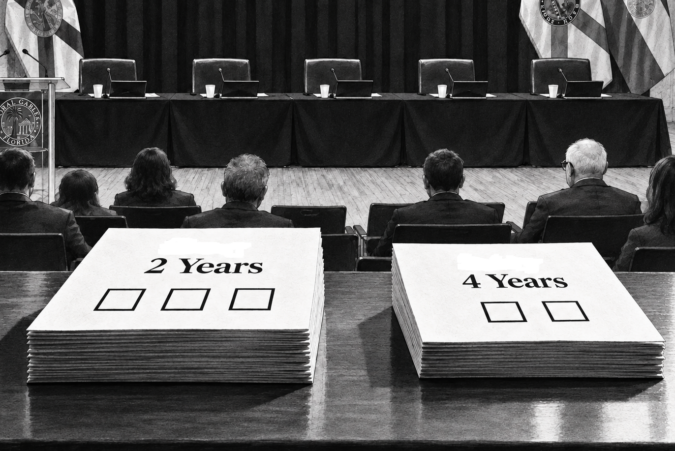
Coral Gables voters should reject the charter amendment that would stretch the mayor’s term from two years to four. It looks like a small change to the calendar. Its real effect is to take voters’ ability to replace three of the five commission seats off the ballot in every other city election. Voters have had that check at every regular city election except 2009, and they should keep it.
The mechanics are simple. The commission has five members. Commissioners serve staggered four-year terms, so two of their seats come up every two years. The mayor, elected every two years, makes three. Three of five is a majority. Every regular city election puts enough seats before voters to keep the commission’s direction or change it. That is the most direct check voters hold over their city government, and it works because the mayor is on every ballot.
The amendment would break it. Starting in 2028, the mayor would be elected in presidential years alongside two commissioners and then drop off the next ballot. In 2030, and every four years after, voters would choose just two of five members. They could replace everyone on that ballot, and three of the five members would still keep their seats. Residents unhappy with the direction of City Hall would be told, in effect, to wait.
Coral Gables knows what that looks like because it has lived it. Voters approved a four-year term in 2005, by 190 votes. The April 2009 election — the only regular election during that four-year mayoral cycle without a mayoral race — put just two commission seats before residents. At that same election, voters restored the two-year mayoral term. That margin was narrow too, 73 votes, and neither vote was a landslide. But the city tried a less accountable mayor’s office once and chose to undo it.
Supporters say a mayor elected every two years is always campaigning, that projects like the City Hall restoration and the Mobility Hub outlast a two-year term, and that the mayor’s term should match the commissioners’. Those arguments carry more weight in a strong-mayor government, where the mayor runs the city, than they do in Coral Gables. The commission sets policy, a city manager runs the government day to day, and the mayor chairs the meetings and casts one vote of five. The city manager and administration, not the mayor alone, are responsible for carrying out commission policy and managing those projects. What an election decides is who holds that vote, and that is exactly the decision voters should keep making.
The amendment would not change how long a mayor can serve. A mayor could still hold office for eight straight years. What changes is how many times that mayor has to earn it. Under the current charter, a mayor who serves the maximum wins four elections. Under the proposal, two. Residents would get half as many chances to judge the job.
Frequent campaigns are the main complaint, and the burden is real. That burden comes with the accountability the current system creates. A two-year term keeps the city’s most visible elected official close to the people who elected him or her. It creates a recurring opportunity for a citywide debate about development, spending and the conduct of commission business every time the mayor’s seat comes up. Under a four-year term, every other city election would consist of two commission races on a long November ballot shared with state and federal contests. Those local races would risk receiving less attention at the moment residents are choosing who sits on the commission.
Mayor Vince Lago supports the change. It would begin in 2028 and does not alter the eight-year limit, so it would not extend his eligibility; if reelected in November, he reaches that limit in 2028. This question is bigger than any one mayor. It is about whether future residents keep the ability to change the direction of their government at every election, or give up half of those chances.
One major thing has changed since 2009: Coral Gables elections now coincide with November state and federal elections. If anything, that change makes the mayor’s race more important as the local anchor of each ballot. What has not changed is the five-member commission, the commission-manager form of government or the math of putting three seats before voters every two years. Nothing in that record justifies giving those chances up.
Vote no on the four-year mayoral term.