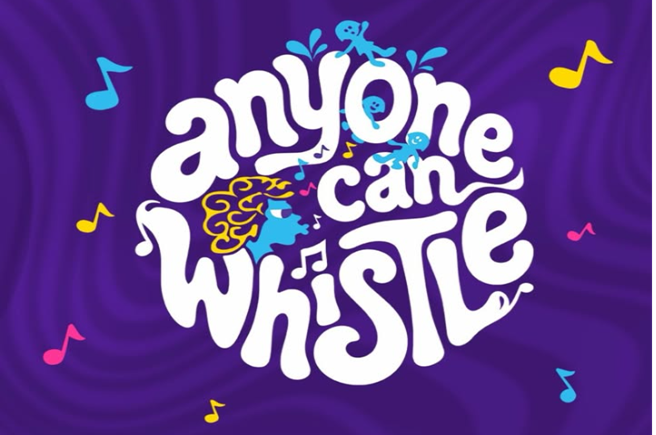
Stephen Sondheim’s Anyone Can Whistle lasted just nine performances on Broadway in 1964. Its contemporary, Jerry Herman’s Hello, Dolly!, ran 2,844. This week, the University of Miami stages Sondheim’s musical in the theater bearing Herman’s name.
The UM Department of Theatre Arts presents Anyone Can Whistle at the Jerry Herman Ring Theatre, 1312 Miller Drive, on the Coral Gables campus. The production opens Thursday, Nov. 12, at 8 p.m. and continues through Nov. 19, with six scheduled performances.
The show is a political and social satire about a corrupt mayor who invents a miracle to rescue her bankrupt town. The scheme draws tourists, sparks confusion over who is sane and who is not, and sets an unlikely romance in motion. Beneath its farce lies a question about conformity and the courage to challenge accepted rules.
Nine performances and a Broadway disappointment
Anyone Can Whistle arrived on Broadway with formidable credentials. Arthur Laurents, who had written the books for West Side Story and Gypsy, supplied the book and directed. Sondheim, then 34, wrote both music and lyrics.
The cast featured Angela Lansbury as the scheming mayor, Cora Hoover Hooper; Lee Remick as Fay Apple, a nurse determined to expose the fraud; and Harry Guardino as J. Bowden Hapgood, a mysterious newcomer who complicates the mayor’s plans.
It was the Broadway musical debut for Lansbury and Remick. Choreographer Herbert Ross, who would later direct major Hollywood films, contributed the show’s dances.
After an out-of-town engagement in Philadelphia and 12 Broadway previews, the musical opened at the Majestic Theatre on April 4, 1964. It closed April 11.
According to the Internet Broadway Database, the original production managed only nine regular performances. Ross received its sole Tony Award nomination, for choreography.
The show had trouble finding an audience despite its celebrated creators and performers. Its unconventional structure, shifting tone and pointed satire stood apart from the more traditional Broadway entertainments that dominated the period.
A corrupt mayor and a manufactured miracle
The story takes place in an economically distressed town ruled by Cora Hoover Hooper, whose administration is desperate for revenue.
Her solution is to manufacture a miracle. Water begins flowing from a rock, attracting pilgrims and tourists willing to spend money in the struggling community.
But the scheme becomes harder to control when patients from a nearby institution, known as the Cookie Jar, mingle with the visitors. Their presence makes it increasingly difficult to distinguish the supposedly sane from those labeled mentally ill.
Fay Apple, a nurse responsible for the patients, challenges the deception. Her efforts bring her into contact with Hapgood, whose arrival further unsettles the town’s already fragile understanding of order.
The confusion gives Laurents and Sondheim room to mock political opportunism, commercial greed, organized religion, psychiatric authority and the pressure to conform.
As Music Theatre International’s synopsis makes clear, the musical’s central conflict concerns the boundaries society draws between acceptable behavior and individuality.
The premise also gives the title its meaning. Fay can manage difficult responsibilities but struggles with something apparently simple: letting go and whistling.
A score that survived the failure
Although the original production disappeared almost immediately, Sondheim’s music found a lasting audience.
The original cast recording, made after the Broadway closing, helped preserve a score that would otherwise have been heard by relatively few theatergoers. Songs including Anyone Can Whistle, Everybody Says Don’t and With So Little to Be Sure Of subsequently became favorites among performers and admirers of Sondheim’s work.
Another number, There Won’t Be Trumpets, was cut from the original Broadway production but later gained a following through recordings and concert performances.
The Stephen Sondheim Society’s production history traces the show’s gradual return to the stage.
A 1995 benefit concert at Carnegie Hall featured Bernadette Peters, Madeline Kahn, Scott Bakula and Angela Lansbury, who returned as narrator. New York City Center’s Encores! series presented the musical in 2010 with Sutton Foster, Donna Murphy and Raúl Esparza.
London productions followed, including a 2022 staging at Southwark Playhouse.
Those revivals helped sustain the musical’s reputation as an ambitious work whose score proved more durable than its original production.
A demanding assignment for UM performers
The musical presents substantial challenges for a university cast.
Its songs range from intimate ballads to rapid-fire comic numbers and elaborate ensemble sequences. Performers must move between broad satire and emotional vulnerability while keeping the story’s intricate plot intelligible.
That range gives UM theater students an opportunity to explore Sondheim’s work before the later achievements of Company, Follies, A Little Night Music and Sweeney Todd.
It also offers audiences a chance to experience the musical as a complete theatrical work, rather than through the individual songs that have kept its reputation alive.
The university describes the production as a satire that combines memorable music and humor with questions about conformity and personal courage.
An unlikely connection to Jerry Herman
The production’s setting adds another layer of Broadway history.
Jerry Herman, who graduated from the University of Miami in 1953, went on to compose some of American musical theater’s most popular works, including Hello, Dolly!, Mame and La Cage aux Folles.
The Ring Theatre, long a home for the university’s drama program, was renovated in the 1990s and reopened under Herman’s name.
The contrast between Herman’s best-known musical and Anyone Can Whistle is particularly striking.
Hello, Dolly! opened Jan. 16, 1964, nearly three months before Sondheim’s musical. Its original Broadway production continued through December 1970, becoming one of the era’s defining commercial successes.
The two works represent markedly different approaches to the American musical. Herman’s show celebrated romance, optimism and theatrical spectacle. Sondheim and Laurents offered a more skeptical view of society, authority and the pressure to behave as others expect.
More than six decades later, both remain part of musical theater’s history, though for very different reasons.
If you go…
Anyone Can Whistle opens Thursday, Nov. 12, at 8 p.m. at the Jerry Herman Ring Theatre, 1312 Miller Drive, Coral Gables.
Additional performances are scheduled for Saturday, Nov. 14, at 2 and 8 p.m.; and Tuesday, Nov. 17, Wednesday, Nov. 18, and Thursday, Nov. 19, at 8 p.m.
Tickets are available through the University of Miami’s official ticketing website. University students, faculty and staff may receive up to two complimentary tickets, subject to availability, with a valid Cane ID. Tickets may also be reserved by emailing theatre@miami.edu.
The university’s event calendar provides performance information and ticketing details.
The Broadway original lasted barely a week. At UM, a new generation of performers has an opportunity to discover why its music and ideas have endured long after the production that introduced them disappeared.

Author: Coral Gables Gazette News Staff
Originally established in 1996 and relaunched as a digital publication in February 2025, the Coral Gables Gazette is an independent local news organization dedicated to factual, objective and accountable community journalism. Our newsroom reports on the people, policies, institutions and events shaping Coral Gables, Florida, providing residents with timely, informative coverage of the issues affecting their community. Our reporting includes City Hall, local government, municipal elections, public spending, real estate development, business, education, arts and culture, and neighborhood affairs throughout the City Beautiful. We follow City Commission decisions, examine public records and report on the businesses, organizations and individuals contributing to Coral Gables. We believe informed residents are essential to a healthy, engaged community. Stories published under the Coral Gables Gazette News Staff byline are prepared or compiled by the publication's editorial team. We strive for accuracy, fairness, transparency and clear distinctions between news reporting, opinion and advertising. Readers are encouraged to submit news tips, corrections, editorial inquiries and story suggestions through our Contact page and learn more about our standards through our Editorial Policy.