Coral Gables voters rejected proposals to extend the mayor’s term from two years to four and sharply increase the threshold for formal public-works solicitations Tuesday, while approving stronger protections for city-owned parks and tighter residency requirements for candidates seeking municipal office.
The four charter amendments, all sponsored by Mayor Vince Lago, split evenly: two passed and two failed. Lago won reelection the same night, but voters declined to adopt his proposal for longer mayoral terms.
All four questions were placed on the ballot by the City Commission in July. Commissioners voted 5-0 to submit each proposal to voters, although several made clear that allowing a referendum did not necessarily mean supporting the underlying amendment.
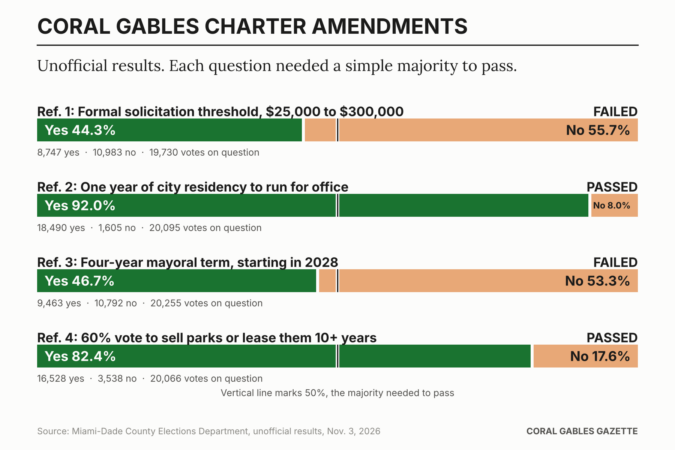
Each question required a simple majority to pass. The results remain unofficial, with all 16 participating precincts reporting, pending certification by the Miami-Dade County canvassing board.
Voters reject four-year mayoral terms
The proposal to extend the mayor’s term drew 9,463 yes votes, or 46.7 percent, while 10,792 voters, or 53.3 percent, opposed it.
The amendment would have aligned the mayor’s term with the four-year terms served by city commissioners, beginning with the November 2028 election. It would not have changed the city’s existing limit of eight consecutive years of mayoral service.
The mayor will continue to stand for election every two years.
The change would not have extended Lago’s tenure. He won his fourth consecutive two-year mayoral term Tuesday and will be ineligible to seek another consecutive term in 2028 under the existing charter.
The rejection distinguishes voters’ decision to return Lago to office from their decision on the structure of the mayoralty. The results alone do not establish why individual voters supported one and opposed the other.
Parkland protections win broad support
Voters overwhelmingly approved an amendment requiring 60 percent approval in a citywide special election before the city can sell, exchange or convey certain public properties, or lease them for 10 years or longer.
The measure received 16,528 yes votes, or 82.4 percent, compared with 3,538 no votes, or 17.6 percent.
The amendment applies to city-owned land used as parks, recreational facilities, golf courses or open park space as of Nov. 3, 2026, as well as property acquired later for those uses.
The 60 percent requirement applies to future transactions involving the covered properties. The charter amendment itself needed only a simple majority to pass.
One property potentially within its future scope is the 5.5-acre Lee Lincoln parcel, which the University of Miami agreed to convey to the city for Centennial Park under the 30-year development agreement approved in September.
That property already carries separate protections under the university agreement. Its deed restrictions require perpetual public-park use and prohibit the city from selling or leasing the land. The new citywide charter provision would be an additional layer of protection where applicable, not the property’s first restriction.
Public-works threshold stays at $25,000
Voters rejected a proposal to raise the threshold for formal solicitation of public-works projects from $25,000 to $300,000, with subsequent adjustments tied to Section 255.20 of Florida law.
The measure received 8,747 yes votes, or 44.3 percent. Another 10,983 voters, or 55.7 percent, opposed it.
The defeat leaves the charter’s existing $25,000 threshold in place. Had the amendment passed, the city would have had greater latitude to undertake public-works projects below the proposed higher threshold without the formal solicitation required by the charter, subject to other applicable procurement laws and rules.
The proposal was among the four measures the commission unanimously sent to voters July 7. As the Gazette reported at the time, commissioners’ agreement to hold the referendums did not amount to unanimous support for their substance.
Candidate residency requirement passes overwhelmingly
The most one-sided result came on the proposed residency requirement for candidates seeking mayoral or commission seats.
The amendment received 18,490 yes votes, or 92 percent, against 1,605 no votes, or 8.0 percent.
Under the existing charter, candidates had to reside in Coral Gables for at least one year before the election. The amendment tightens that requirement by mandating continuous city residency for at least one year immediately preceding the end of the candidate qualifying period.
That distinction matters because the qualifying deadline precedes Election Day. The new language moves the relevant residency test earlier and explicitly requires continuity.
Charter questions draw substantial participation
Between 19,730 and 20,255 valid votes were recorded on each of the four city amendments, compared with 19,799 votes recorded in the mayoral race in the same reporting period.
The four questions appeared on the final face of a lengthy general-election ballot, following statewide constitutional amendments, county referendums and a school tax question.
Despite that placement, each referendum attracted a number of valid votes broadly comparable to participation in the mayoral contest. The four-year mayoral-term question drew 456 more valid votes than the mayoral race.
Those figures do not establish the city’s overall undervote rate, which requires the total number of Coral Gables ballots cast and any overvotes. But they show that the referendum questions did not uniformly draw fewer responses than the municipal candidate contests.
Tuesday marked the first regular Coral Gables municipal general election held in November rather than April, following a calendar change approved by voters earlier this year.
Statewide property-tax amendment passes
In a separate statewide vote with potentially substantial financial consequences for Coral Gables, Florida voters approved Amendment 3, a constitutional change expanding the homestead exemption and limiting assessment increases on non-homestead property.
The measure had approximately 62 percent support when the statewide result was called Tuesday night, exceeding the 60 percent required for Florida constitutional amendments.
The amendment increases the homestead exemption for non-school property taxes to $150,000 in 2027 and $250,000 in 2028, with inflation adjustments thereafter. School property taxes are excluded from that expansion.
It also lowers the annual cap on assessment increases for non-homestead properties, including rental and commercial properties, from 10 percent to 5 percent. Certain new Florida residents face a waiting period before qualifying for the expanded homestead benefit.
Supporters promoted the amendment as property-tax relief for homeowners. Opponents warned that reduced collections could put pressure on municipal and county services.
The financial consequences have been a subject of debate in Coral Gables for months.
As the Gazette reported in July, city budget projections estimated that the homestead expansion could reduce Coral Gables property-tax revenue by approximately $5.7 million in fiscal 2028 and $11.4 million annually beginning in fiscal 2029. Those were projections prepared before voters approved the amendment, not final calculations of its fiscal impact.
The state result now places those revenue concerns before city officials as they plan future budgets. Lago supported the amendment as tax relief for homeowners.

Author: Coral Gables Gazette News Staff
Originally established in 1996 and relaunched as a digital publication in February 2025, the Coral Gables Gazette is an independent local news organization dedicated to factual, objective and accountable community journalism. Our newsroom reports on the people, policies, institutions and events shaping Coral Gables, Florida, providing residents with timely, informative coverage of the issues affecting their community. Our reporting includes City Hall, local government, municipal elections, public spending, real estate development, business, education, arts and culture, and neighborhood affairs throughout the City Beautiful. We follow City Commission decisions, examine public records and report on the businesses, organizations and individuals contributing to Coral Gables. We believe informed residents are essential to a healthy, engaged community. Stories published under the Coral Gables Gazette News Staff byline are prepared or compiled by the publication's editorial team. We strive for accuracy, fairness, transparency and clear distinctions between news reporting, opinion and advertising. Readers are encouraged to submit news tips, corrections, editorial inquiries and story suggestions through our Contact page and learn more about our standards through our Editorial Policy.