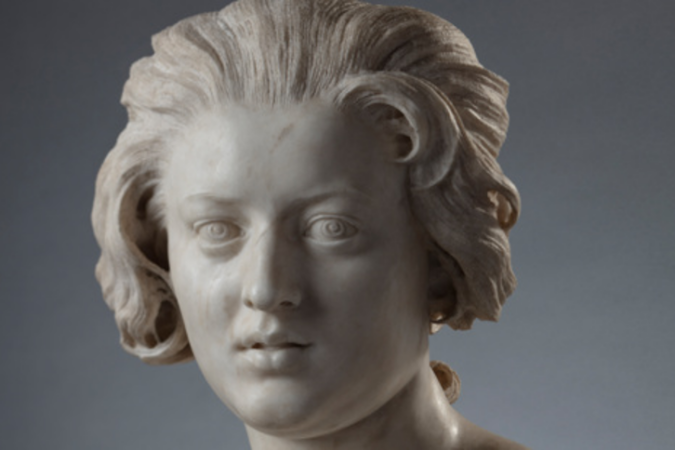
Gian Lorenzo Bernini immortalized Costanza Piccolomini in one of the most celebrated marble portraits of the 17th century. He also ordered a servant to slash her face with a razor in an act of jealous revenge. For centuries, the violence and scandal surrounding their relationship overshadowed the life of the woman herself.
A lecture Thursday, Nov. 5, at the Lowe Art Museum in Coral Gables will examine the life that history largely overlooked: that of an accomplished art collector, dealer and businesswoman who navigated the social constraints of Baroque Rome.
Sarah McPhee, the Samuel Candler Dobbs Professor of Art History at Emory University, will present her research at 6:30 p.m. as part of the museum’s Old Masters in Context series. The program runs until 8:30 p.m. at the Lowe, 1301 Stanford Drive on the University of Miami campus. Admission is $15.
A portrait and a violent betrayal
Bernini, among the most influential sculptors and architects of the Italian Baroque, carved his portrait of Costanza around 1636–37, when she was married to Matteo Bonarelli, a sculptor who worked with him in Rome.
Unlike the grand commissions Bernini produced for popes, cardinals and aristocrats, the portrait was a private undertaking. Its expressive realism — Costanza’s parted lips, animated gaze and loosely arranged hair — gave the marble an intimacy unusual for its time.
The relationship ended violently in 1638 after Bernini discovered that Costanza was also involved with his younger brother, Luigi.
According to McPhee’s account, Bernini attacked his brother with an iron rod and arranged for a servant to disfigure Costanza. The servant arrived at her home carrying two flasks of wine and slashed her face with a razor as she accepted them.
Costanza was subsequently confined for four months in a Roman institution for women considered to be in troubled marriages. She petitioned the governor of Rome for release and eventually returned to her husband.
Bernini continued his prestigious career under papal patronage. His victim’s name, meanwhile, became inseparable from the scandal.
The archives reveal a different woman
McPhee’s research challenges the longstanding depiction of Costanza primarily as Bernini’s mistress and the subject of his jealous rage.
In a 2016 interview with the Getty’s Art + Ideas podcast, McPhee described spending approximately eight years tracing Costanza through Roman archives.
“I turned up some 2,000 new documents on Costanza, because no one had ever bothered to look,” she said.
Those records revealed a woman of considerable intelligence, determination and commercial ability.
Born around 1614 in Viterbo, north of Rome, Costanza came from modest circumstances despite bearing the Piccolomini name, associated with an influential Sienese family. She received assistance from religious institutions that provided marriage dowries for young women with limited means.
She married Matteo Bonarelli in 1632, entering a household connected to Rome’s flourishing artistic community.
Following the attack and her eventual reconciliation with Matteo, Costanza continued participating in the family’s artistic and commercial affairs. When her husband died in 1654, he left his estate to her.
She subsequently managed the sculpture workshop and developed her activities as an art dealer and collector.
The inventory assembled after her death in 1662 recorded 111 paintings and 70 sculptures, most of the latter ancient. The collection included works by Nicolas Poussin and other significant artists of the period and eventually passed into the holdings of the papal Chigi family.
Costanza was buried in Rome’s Basilica of Santa Maria Maggiore, an indication of the social standing she had achieved.
Her career complicates the familiar narrative of a woman defined by her relationship with a celebrated man. McPhee’s research instead places her within the artistic, commercial and social networks that shaped 17th-century Rome.
A different way of looking at the sculpture
McPhee’s findings also change how viewers might understand Bernini’s famous portrait.
The bust is commonly identified as Costanza Bonarelli, using a form of her married name. McPhee’s 2012 book, Bernini’s Beloved: A Portrait of Costanza Piccolomini, instead emphasizes the family name Costanza used in her own will.
In the Getty interview, McPhee explained that earlier scholars tended to reproduce the sculpture from the front, interpreting the woman’s loose hair and informal clothing as indications of her social position.
Examining the portrait from other angles revealed details previously overlooked, including an elaborate hairstyle at the back of her head that suggested a more privileged identity.
The distinction illustrates how assumptions about a woman’s character can influence the interpretation of an artwork, even one studied for centuries.
The original marble bust, approximately 29 inches tall, is housed at the Museo Nazionale del Bargello in Florence. It will not be on display at the Lowe.
A scholar of Bernini and Baroque Rome
McPhee’s scholarship focuses on the artistic and architectural culture of 17th- and 18th-century Europe, particularly Rome.
Her earlier book, Bernini and the Bell Towers: Architecture and Politics at the Vatican, published by Yale University Press in 2002, examined the political and architectural controversies surrounding the sculptor’s work at St. Peter’s Basilica.
She followed it a decade later with Bernini’s Beloved, which combined archival research, biography and art history to reconstruct Costanza’s life.
McPhee’s faculty biography at Emory University also lists research on Baroque sculpture, urban history, artistic biography and print culture.
A lecture connecting art and history
The Lowe’s Old Masters in Context series examines European artworks through the historical, cultural and social circumstances in which they were created.
Last November, the series explored a 14th-century altarpiece from the museum’s Samuel H. Kress Collection, accompanied by a curatorial presentation and live music, as the Gazette reported.
Thursday’s program shifts the focus from an artwork’s formal qualities to the life of the person it depicts, examining how historical research can challenge interpretations that have endured for generations.
Old Masters in Context: Lecture with Dr. Sarah McPhee takes place Thursday, Nov. 5, from 6:30 to 8:30 p.m. at the Lowe Art Museum, 1301 Stanford Drive, Coral Gables.
Tickets are $15 and available through the Lowe’s online ticketing page or the University of Miami event listing.
The lecture offers an opportunity to look beyond a masterpiece and reconsider the woman whose likeness has endured in marble, but whose own accomplishments remained largely unrecognized for centuries.

Author: Coral Gables Gazette News Staff
Originally established in 1996 and relaunched as a digital publication in February 2025, the Coral Gables Gazette is an independent local news organization dedicated to factual, objective and accountable community journalism. Our newsroom reports on the people, policies, institutions and events shaping Coral Gables, Florida, providing residents with timely, informative coverage of the issues affecting their community. Our reporting includes City Hall, local government, municipal elections, public spending, real estate development, business, education, arts and culture, and neighborhood affairs throughout the City Beautiful. We follow City Commission decisions, examine public records and report on the businesses, organizations and individuals contributing to Coral Gables. We believe informed residents are essential to a healthy, engaged community. Stories published under the Coral Gables Gazette News Staff byline are prepared or compiled by the publication's editorial team. We strive for accuracy, fairness, transparency and clear distinctions between news reporting, opinion and advertising. Readers are encouraged to submit news tips, corrections, editorial inquiries and story suggestions through our Contact page and learn more about our standards through our Editorial Policy.