Vice Mayor Rhonda Anderson read the article over lunch.
It had been published shortly after noon on an anonymous blog and raised questions about Commissioner Melissa Castro’s travel expenses for a trip to Tallahassee. Then Anderson brought the matter before the City Commission and urged Castro to reimburse the city. Mayor Vince Lago followed with questions about receipts, travel dates, hotel charges and Uber expenses.
Castro said she had not seen the article.
“This is the first time that I’m hearing about it,” she told her colleagues. She disputed parts of Lago’s account, said she had personally paid some expenses and asked that the matter return as a scheduled agenda item so she could review the records.
“I don’t have the facts in front of me,” she said.
The commission took no action.
This board takes no position on whether Castro’s expenses were appropriate. Commissioners who suspect improper spending by a colleague have every right to raise it, and perhaps a duty.
Our objection is to the method.
The matter arrived as a pocket item, without notice on the commission’s published agenda. It was at least the second time in five weeks that a substantive matter reached the commission this way.
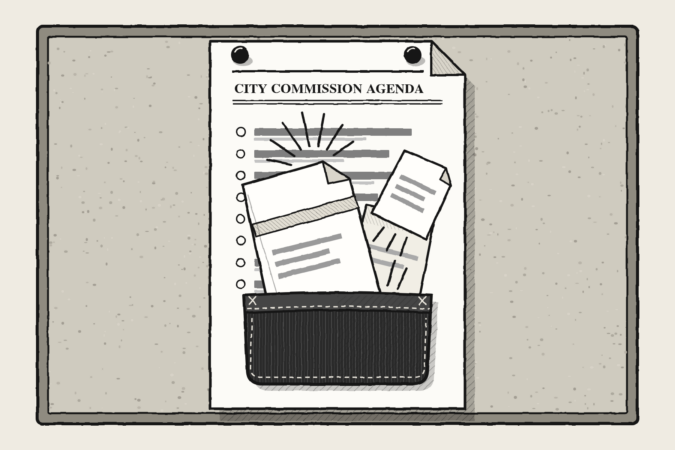
A pocket item is, in practice, a matter a commissioner raises without placing it on the posted agenda. It can give colleagues no time to study the issue, staff no time to assemble records and residents no reason to know they should attend the meeting.
Every commissioner has a better route. City code gives each member authority to sponsor and place items on the agenda, and the published agendas identify those items by sponsor. Giving notice costs a commissioner a few days of patience.
There is a legitimate place for the pocket item. A hurricane does not wait for an agenda deadline. Neither does an immediate public-safety threat or a legal deadline that expires before the next regular meeting.
A park name can wait.
Five weeks earlier, on Aug. 25, Lago introduced what he called “another pocket item” and proposed naming a future park associated with the Publix redevelopment at 2551 Le Jeune Road for City Manager Peter Iglesias.
As the Gazette wrote at the time, the commission violated no rule. The city’s park-naming policy allows the commission to waive its procedures.
That does not make bypassing those procedures good practice.
The city has a Parks and Recreation Advisory Board for a reason. Staff review and advisory-board consideration allow a proposal to be examined before commissioners vote. That process was used for parks honoring former Mayor Dorothy Thomson and James and Sallye Jude.
No emergency required immediate action on the Iglesias proposal. The park does not yet exist. The advisory board could have considered the name first.
The same principle applies with greater force when the subject is the conduct of another elected official.
Allegations about a colleague’s conduct deserve a higher standard. Except in a genuine emergency, they should appear on a posted agenda, with supporting records available in advance and a fair opportunity for the person involved to respond.
Once an allegation is aired from the dais, the lack of notice cannot be undone. A commissioner who learns of it there, with an anonymous blog post as the source, cannot answer with documents. She can ask for more time, as Castro did. The public exchange has already occurred.
Advance notice also protects the other commissioners. They should not be expected to assess accusations, financial records or policy questions for the first time while cameras are running and a meeting is underway.
And it protects residents.
A published agenda tells the public what its government intends to discuss and possibly decide. It allows residents to read the documents, contact commissioners, attend the meeting and speak before a decision is made.
Watching the video afterward is not participation.
The commission can solve the problem with a simple rule.
Any matter that can reasonably wait should wait for the next agenda. Short of an emergency, an unnoticed item may be raised for discussion, but substantive action should occur at the next properly noticed meeting. Allegations about a colleague’s conduct should wait for a posted agenda altogether.
The emergency exception should be narrow. If a commissioner believes immediate action is necessary, the sponsor should explain on the record why delay would materially harm the city, and four of the five commissioners should agree before the commission proceeds. Coral Gables already uses a four-fifths standard in other circumstances when commissioners are asked to waive normal requirements.
The city should also define an emergency in writing: an immediate threat to health, safety or property, or a legal deadline that falls before the next regular meeting.
Honorary names for parks and public facilities should go through the Parks and Recreation Advisory Board before reaching the dais. Allegations concerning a commissioner’s conduct should come through a posted agenda with the relevant records and, when warranted, be referred to the appropriate legal or ethics authority.
The clerk should also keep a public list of the pocket items raised at each meeting. Residents should be able to see how often this extraordinary procedure is used and for what purposes.
A commission needs some flexibility for genuinely unforeseen circumstances, and a stated reason with a supermajority vote provides it. The rule would bind all five members, including those who object to the practice today. A rule written for whoever holds the gavel will someday protect them, too.
Procedural protections are easiest to value when the other side needs them. Their real test comes when commissioners are frustrated, enthusiastic, offended or certain that they are right.
Agenda rules are restraints a government places upon itself. Without them, “pocket item” can become little more than a label for whatever five elected officials happen to want to discuss that day.
That is not how deliberative government should work.
The allegations concerning Castro’s travel expenses deserve an answer. The city’s next agenda now includes a discussion of travel expenses, sponsored by Castro herself.
That is how the matter should proceed: on a published agenda, with the relevant records available, Castro given a fair opportunity to respond, commissioners able to ask their questions and residents able to judge the evidence for themselves.
The process may take a little longer.
Good government sometimes should.
An agenda is a promise. When the commission posts one, it tells residents what to expect.
If a matter is important enough for the commission to debate or act upon, it is important enough for elected officials and residents to know about in advance, except in a genuine emergency.
Residents should expect that of their government.