
By Coral Gables Gazette staff
The Coral Gables Planning and Zoning Board moved quickly Wednesday through six proposed amendments that would substantially expand the University of Miami’s development capacity, increase its enrollment limit and open the door to a future 100-bed hospital, approving each item by a 6-1 vote with relatively little discussion or critical questioning.
The votes represent the first formal recommendations on a new 30-year development agreement between the city and UM, replacing an agreement adopted in 2010. The package still must go before the City Commission for two public hearings before it can take effect.
A much larger development envelope
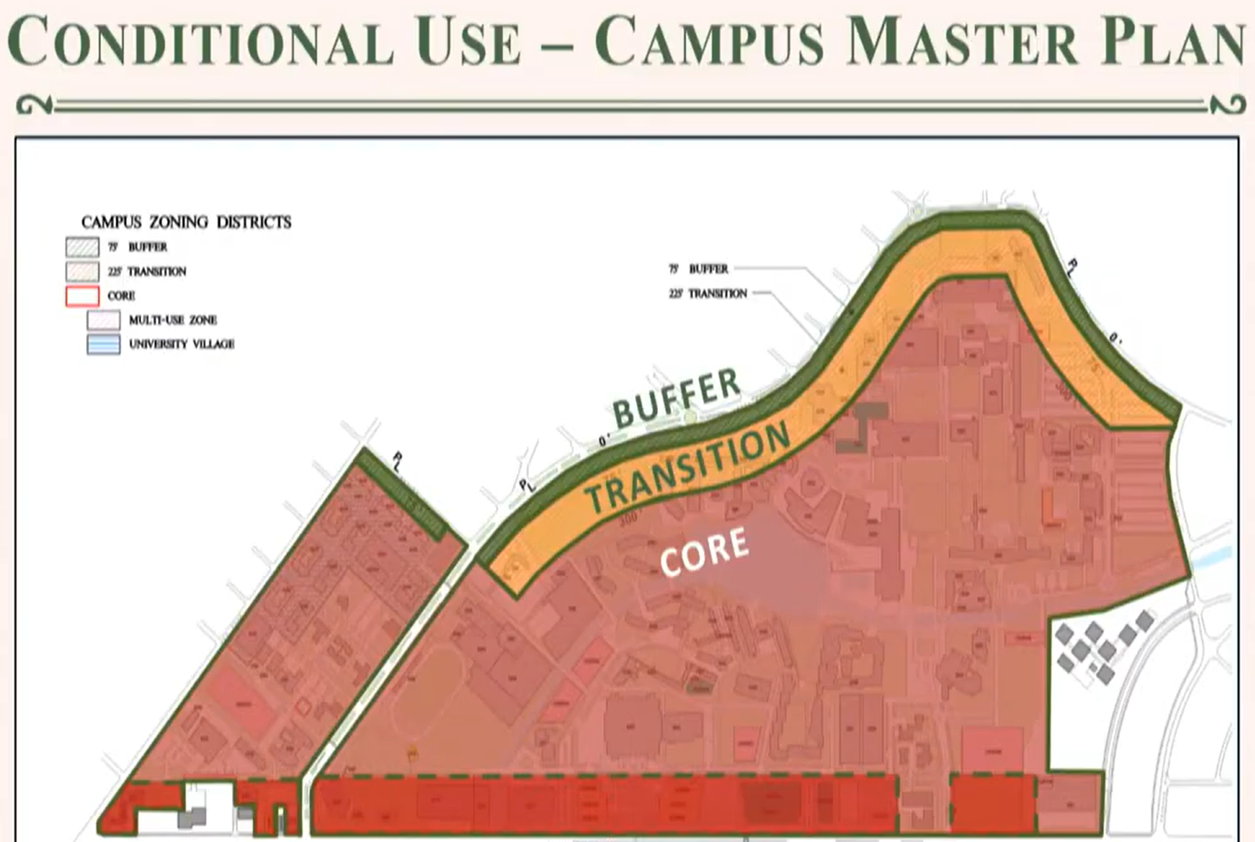
The proposed changes include replacing UM’s existing 6.8 million-square-foot development cap with a floor-area ratio, or FAR, of 1.0, which city staff estimates would allow about 10.5 million square feet of development. The agreement also would increase the university’s maximum enrollment from 13,000 to 17,500 students, allow a hospital of up to 100 beds within the campus’s expanded Multi-Use Area without a separate conditional-use review, and increase permitted retail from 15% to 20%.
The Multi-Use Area also would expand along Ponce de Leon Boulevard, with three university-owned properties incorporated into the university’s land-use and zoning framework. The agreement would require UM to convey the 5.52-acre Lee Lincoln parcel to the city for use as a public park, provide an additional buffer between the university and nearby residential neighborhoods, and provide for a 4% annual increase in UM’s payment to the city.
UM says the capacity is for the long term
UM attorney Jeff Bass told the board that the new agreement’s longer term is now possible because state law allows development agreements to extend for 30 years, rather than the 20 years previously permitted. He also emphasized that the agreement is intended to establish a framework for the university’s future rather than authorize specific projects now.
When asked, Bass said UM has no immediate plans to build to the proposed 1.0 FAR, increase enrollment to 17,500 or construct a hospital. The university also has no current plans for the new Multi-Use areas to develop student-oriented projects, although Bass clarified that those potential uses would be for the university rather than public projects. The 30-year agreement, he said, gives UM the ability to plan appropriately for its needs over the life of the agreement.
Five board members appeared largely supportive of the proposal, raising only limited questions before voting in favor.
Questions about the hospital and park
Board member Gonzalo Sanabria asked whether the 100-bed hospital provision was a hard cap or whether a hospital exceeding that number could still be built through a conditional-use process. Bass explained that up to 100 beds would be a permitted use, while a larger hospital would require the additional public review associated with a conditional use.
Sanabria also questioned whether the city would have enough flexibility in determining how the 5.52-acre park could be used. Most board members and UM, however, favored keeping the property as a passive park, with Bass saying the university’s goal is for it to remain green space without bathrooms, lighting or other physical improvements. Board members said they wanted assurances that the property would remain passive and continue serving as a buffer between UM and residents.
The deed restriction and easement that would govern the park were not final Wednesday. Bass said he was open to working with city officials on the language, while noting that the final terms ultimately would require UM’s agreement.
One board member pushes back
Board member Felix Pardo was the lone dissenter on all six votes. He questioned the speed of the process, saying a proposal of this size and complexity deserved more than two meetings before the board voted. His biggest concern was traffic.
Pardo pointed to a letter from the city’s Public Works Department stating that a traffic impact study was not warranted based on UM’s traffic statement and existing zoning standards.
“The traffic statement from Public Works is very disturbing, (it) goes out of the way to say we don’t need a traffic study. I would like one, we do need a traffic study, if you drive around Coral Gables you know this,” Pardo said, questioning why the city would not require a more thorough traffic analysis.
UM, however, argued that the campus already operates under an extensive transportation-monitoring system. Bass said the university conducts annual traffic counts on surrounding roads and a broader regional traffic study every five years under a methodology developed with the city. He also pointed to restrictions on freshman cars, assigned parking, the Hurricane Shuttle and Freebee service as measures the university has used to reduce and manage campus-related vehicle trips.
Pardo’s objection extended beyond traffic. He argued that approving the long-term framework now matters because many future projects that comply with it could proceed administratively rather than returning to the board for the same level of public review. He said that made it especially important to resolve questions about impacts before granting the broader development authority.
Pardo also questioned whether the board had been given enough information about surrounding residents’ views. He noted that the packet referenced a Feb. 4 neighborhood meeting but, in the materials he reviewed, did not provide attendance figures, signatures or a detailed account of the comments made. Bass later estimated that 15 to 25 people attended and that about three spoke. City staff said notices for the neighborhood meeting and the Planning and Zoning hearing were mailed to property owners within 1,500 feet of the campus and that the city had received no emails, letters, phone calls or electronic comments on the applications.
“This is another application that’s coming before us where, regardless of what our concerns are, it feels like it’s going to go through. I could vote for it if I could get reasonable answers to the concerns I have. But right now, I don’t feel comfortable approving something that I have a lot of doubts about. I hope they can defer this and come back to us,” Pardo said.
Resident Maria Cruz, who said she has lived in Coral Gables since 1976, also expressed concern about the pace of the process and the importance of allowing residents enough opportunity to understand what was being approved.
Other board members embrace UM’s growth
Board members Robert Behar and Ignacio Alvarez, by contrast, voiced strong support for allowing UM to grow. Behar called the proposed enrollment increase modest over a 30-year period and said he saw little problem with the FAR increase.
“I’m proud that we have a world-class university in our city. The transformation of the campus has been incredible,” Behar said. “My wife and I walk through the campus two nights a week, and we see it firsthand. As for the increase in students, 17,500 over 30 years is insignificant compared with other universities. That’s nothing.
“And the hospital… I don’t think that’s going to affect the neighborhood. It’s on Ponce, facing Ponce, and it’s not something that’s going to impact the neighborhood,” Behar added.
Alvarez, who lives near the university, said he had no negative concerns and viewed the hospital and park components favorably.
Next stop: City Commission
The board’s recommendations now move to the commission, where the agreement will face two public hearings and ultimately a final decision on the city’s long-term framework for development at one of Coral Gables’ largest and most influential institutions.












This is a done deal, long before it goes to public comment. Don’t bother to waste your time with the public meetings, Vinnie and his crew already “got this”. We are in the mining business with Vinnie, only he gets the gold and we get the shaft.
It was disturbing to see how anxious the majority of the P&Z board members were to vote to approve without discussions or questions. No impact? No traffic concerns? We are talking about a hospital, not a little neighborhood coffee shop which has opening and closing hours.
Mrs. Maria Cruz made very valid points. Ignored by most of the board, and not addressed by the staff.
Yep, I agree with Mr. Bobiack, it was a done deal.
Here we have one more instance of the City rushing ahead without sufficient consideration, except by Mr. Pardo, to make the traffic worse and the City more dense.