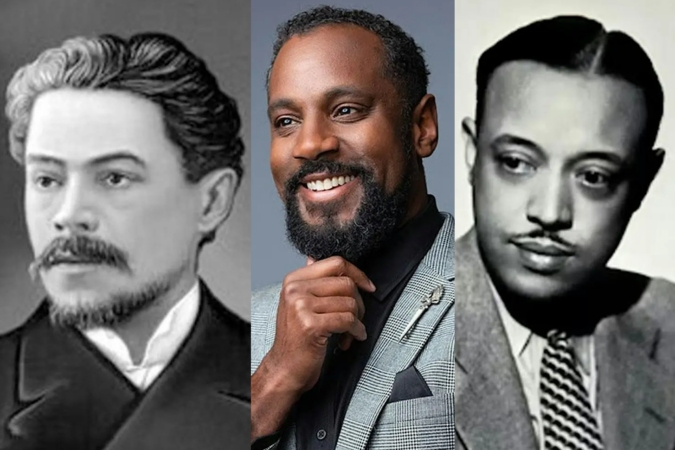
A Russian composer mourning a friend. A Black American pioneer imagining the soul’s journey after death. A living composer finding inspiration in Oprah Winfrey’s reflections on the presence of God. Their music comes together Sunday at the Coral Gables Museum in a program that spans more than a century and explores what lies beyond ordinary experience.
The South Beach Chamber Ensemble presents “The Piano Trio in Contrast” at 2 p.m. Sunday, Nov. 15, at the Coral Gables Museum, 285 Aragon Ave. Doors open at 1:30 p.m., and a champagne toast follows the approximately 90-minute concert.
The program pairs Russian Romantic composer Anton Arensky with two Black American composers, Carlos Simon and William Grant Still. Their works approach reflection, loss and spirituality from distinctly different musical traditions, using the same intimate combination of violin, cello and piano.
A Romantic farewell
The program’s anchor is Arensky’s Piano Trio No. 1 in D minor, Op. 32, composed in 1894 in memory of Karl Davydov, a celebrated Russian cellist.
Arensky studied with Nikolai Rimsky-Korsakov at the St. Petersburg Conservatory and later taught at the Moscow Conservatory, where his students included Sergei Rachmaninoff and Alexander Scriabin. He was also close to Pyotr Ilyich Tchaikovsky, whose influence can be heard in the trio’s sweeping melodies and emotional directness.
The four-movement work gives the cello a particularly expressive role, fitting for a tribute to a musician who had devoted his life to the instrument. Its third movement, marked Elegia, is a slow lament, with a mournful melody that offers a moment of stillness before the energetic finale.
The trio is among Arensky’s best-known compositions. Its lyrical passages and shifting moods offer an accessible introduction to Russian Romantic chamber music, even for listeners unfamiliar with the composer.
A contemporary meditation
The program moves forward 121 years with Carlos Simon’s be still and know, a seven-minute piano trio written in 2015.
Simon, born in Atlanta in 1986, draws on jazz, gospel and Romantic traditions. He serves as composer-in-residence at the John F. Kennedy Center for the Performing Arts and holds the inaugural composer chair at the Boston Symphony Orchestra. His album Requiem for the Enslaved earned a Grammy nomination in 2023.
According to Simon’s notes on the composition, the work grew from a May 25, 2011, interview in which Oprah Winfrey reflected on sensing a divine presence throughout her life.
“Be still and know it,” Winfrey said.
The words echo Psalm 46, which calls for stillness and recognition of God’s presence. Simon took that thought as the starting point for music intended to evoke contemplation.
Written for violin, cello and piano, the work offers a contrast to Arensky’s expansive Romantic language. Where the Russian trio memorializes a particular person, Simon’s composition turns inward, toward awareness and spiritual reflection.
A vision from the Harlem Renaissance
William Grant Still’s Three Visions, first performed in 1936, completes the program.
Still, born in Mississippi in 1895 and raised in Little Rock, Arkansas, was a pioneering figure in American classical music and an important participant in the Harlem Renaissance. He studied at Oberlin and with composers George Whitefield Chadwick and Edgard Varèse, eventually producing nearly 200 works, including five symphonies and nine operas.
His Afro-American Symphony made history in 1931 when it became the first symphony by a Black American composer performed by a major American orchestra. The Rochester Philharmonic gave its premiere under Howard Hanson. Still subsequently broke other barriers in conducting and opera, earning the description “dean of African American composers.”
Three Visions was originally written for solo piano. Its movements, “Dark Horsemen,” “Summerland” and “Radiant Pinnacle,” depict stages in the soul’s passage after death.
Still’s daughter, Judith Anne Still, explained that the movements “tell the story of the human soul after death.” In her account, the soul faces judgment before entering a peaceful realm and possibly returning to earthly life.
The middle movement, “Summerland,” became one of Still’s most familiar piano compositions. Its gentle character contrasts with the darker opening movement and the concluding vision of spiritual ascent.
Sunday’s concert presents the suite in an arrangement for piano trio by the ensemble’s pianist, Michael Linville. Adding violin and cello gives listeners a different perspective on music originally conceived for a single instrument.
The arrangement also places Still’s work alongside the compositions by Arensky and Simon on equal instrumental footing, allowing the three pieces to be heard as contrasting expressions of the same chamber-music form.
Chamber music in an intimate setting
The South Beach Chamber Ensemble was founded in 1997 by Michael Andrews. It began with a free concert of piano trios by Haydn and Dvořák at the Bass Museum of Art in Miami Beach, and has since performed at museums, churches, gardens and other cultural spaces throughout South Florida.
Its Music in Beautiful Spaces series has received support from the Miami Beach Cultural Arts Council since 1999. The ensemble’s stated mission is to make chamber music accessible to new audiences while giving local musicians opportunities to perform.
The Coral Gables Museum offers an especially fitting venue. The building, constructed in 1939 as the city’s police and fire station, was transformed into a museum after an extensive renovation and expansion. Its coral rock exterior preserves a distinctive piece of the city’s architectural history.
Chamber music was traditionally performed in intimate rooms rather than large concert halls. A museum setting brings audiences close to the musicians, allowing listeners to follow the interplay among the three instruments.
For Sunday’s program, that intimacy may be particularly valuable. Arensky’s tribute to a friend, Simon’s meditation on faith and Still’s vision of the afterlife ask listeners to consider different experiences of loss, hope and transcendence.
The composers lived in different countries and eras. Their music offers three approaches to questions that have occupied artists for centuries.
If you go…
“The Piano Trio in Contrast” begins at 2 p.m. Sunday, Nov. 15, at the Coral Gables Museum, 285 Aragon Ave. Doors open at 1:30 p.m., and the concert is scheduled to end at 3:30 p.m. A champagne toast follows.
Tickets range from free admission for eligible students and museum members with identification to approximately $45 for paid admission. Eventbrite lists a no-refunds policy. Paid parking is available nearby.
Tickets and additional information are available through the South Beach Chamber Ensemble and Eventbrite.
The ensemble also presents the program at 2 p.m. Saturday, Nov. 14, at All Souls Episcopal Church, 4025 Pine Tree Drive, Miami Beach.

Author: Coral Gables Gazette News Staff
Originally established in 1996 and relaunched as a digital publication in February 2025, the Coral Gables Gazette is an independent local news organization dedicated to factual, objective and accountable community journalism. Our newsroom reports on the people, policies, institutions and events shaping Coral Gables, Florida, providing residents with timely, informative coverage of the issues affecting their community. Our reporting includes City Hall, local government, municipal elections, public spending, real estate development, business, education, arts and culture, and neighborhood affairs throughout the City Beautiful. We follow City Commission decisions, examine public records and report on the businesses, organizations and individuals contributing to Coral Gables. We believe informed residents are essential to a healthy, engaged community. Stories published under the Coral Gables Gazette News Staff byline are prepared or compiled by the publication's editorial team. We strive for accuracy, fairness, transparency and clear distinctions between news reporting, opinion and advertising. Readers are encouraged to submit news tips, corrections, editorial inquiries and story suggestions through our Contact page and learn more about our standards through our Editorial Policy.