The county zoning option that Coral Gables officials said left them little choice but to approve a 393-unit development across from the University of Miami is on the verge of disappearing. Miami-Dade commissioners are scheduled to vote Tuesday on removing The Mark’s property from the county’s Rapid Transit Zone, five months after its developer requested withdrawal of two county development applications.

The proposed ordinance is sponsored by County Commissioner Raquel Regalado, whose district includes Coral Gables. Regalado also sponsored the September 2025 ordinance that created the Coral Gables/University Station subzone and placed The Mark’s property within it.
If approved, the change would leave the subzone with no designated properties. The revised county map identifies the parcels remaining in the subzone with a single word: “None.”
The move would close the county development route that dominated Coral Gables’ debate over The Mark in April, when city officials argued that rejecting a negotiated, 105-foot project could send the developer back to the county for approval of a building as tall as 150 feet.
What the county is considering
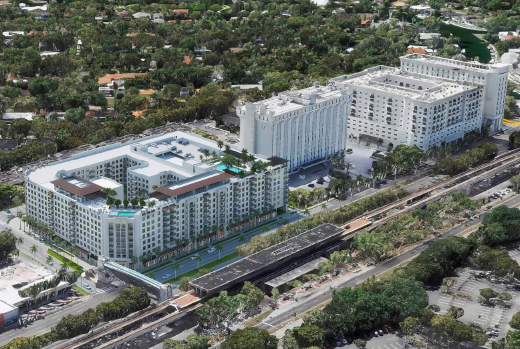
The ordinance would remove the property at 1250 Harriet Tubman Highway, identified locally as 1250 South Dixie Highway, from the county’s Rapid Transit Zone. The property lies across U.S. 1 from the University of Miami and near the University Metrorail station.
County commissioners approved the legislation on first reading Oct. 20 by a 9-0 vote and scheduled it for a Transportation Committee public hearing Nov. 10. No committee disposition appeared in the county’s online legislative record as of Wednesday.
The full commission is scheduled to hold a public hearing and consider final adoption at its 9:30 a.m. meeting Tuesday, Nov. 17. The proposal is Agenda Item 5C.
The ordinance discloses that the property owner requested withdrawal of county special-exception applications on June 5.
It also clarifies an important distinction about county authority. Under the Rapid Transit Zone rules, a property does not automatically become subject to the county’s development standards simply because it is added to a subzone. The owner must first obtain a special exception following a public hearing.
No such approval was granted for The Mark. The proposed ordinance therefore states that Coral Gables zoning standards govern the property now and will continue to do so if the county removes it from the subzone.
If adopted, the removal would take effect 10 days later unless vetoed by the county mayor.
How the property got here
The Rapid Transit Zone gives Miami-Dade County a mechanism to regulate development near transit facilities, including certain properties within municipalities.
The University Station subzone became a flashpoint last year after the developer turned to the county following resistance to an earlier version of The Mark in Coral Gables.
In September 2025, county commissioners adopted Ordinance 25-90, creating the subzone and including the property. The original exhibit identified a single parcel as the area added to the zone.
City planning officials subsequently warned that the county route could accommodate a building up to 150 feet tall, extending to the property lines, without parking or setback requirements and without city control over certain uses.
Coral Gables also stood to lose millions of dollars in impact fees if the developer obtained county approval, as the Gazette reported in October 2025.
The city responded by creating its own University Station Rapid Transit District Overlay. Adopted through votes in October 2025 and January, the overlay established local standards intended to offer developers an alternative to county review.
Those standards generally provide for heights up to 120 feet, with provisions allowing greater height on certain properties in exchange for additional open space. They also impose setback and design requirements absent from the county alternative described by city officials.
The city’s approval
The City Commission approved The Mark’s site plan April 14 by a 4-1 vote, with Commissioner Melissa Castro dissenting.
The development, proposed by LCD Acquisitions LLC, calls for an eight-story, 105-foot mixed-use building with 393 apartments, approximately 17,000 square feet of retail space and 670 parking spaces. The agreement also includes pedestrian, sidewalk and traffic improvements around the property.
The possibility of county approval dominated the commission’s deliberations.
“A vote against the city RTZ is a vote in favor of the county RTZ,” Mayor Vince Lago said. “We have no other choice.”
City Manager Peter Iglesias estimated that following the county route could cost Coral Gables $6 million to $7 million in impact fees, money otherwise available for municipal infrastructure and services.
The commission majority characterized the negotiated project as a way to retain local oversight and avoid a taller, less restricted development. Castro argued that the city should have resisted the county’s intervention more forcefully, including considering litigation.
The negotiations also involved a 45-foot-wide public alley running through the development site. The city’s approval process required the developer to withdraw its pending county application before the alley vacation could take effect. The developer also faced a requirement to begin construction within two years of approval.
The June 5 withdrawal requests, now disclosed in the county ordinance, are consistent with that requirement, although the county document does not establish whether both applications were formally closed.
The Gazette detailed the debate, its conditions and the commission’s competing positions in its April 16 report.
What changes and what doesn’t
Removing The Mark from the county’s Rapid Transit Zone would eliminate the property’s current inclusion in that alternative development process. It would not reverse the approvals Coral Gables granted in April.
The city-approved 393-unit project remains the plan of record. Nor would the county’s withdrawal restore the lower development limits that applied before the negotiations.
The distinction matters because the county’s designation helped shape the city’s decision even though the developer never received final approval to build under county rules.
The broader zoning framework would also remain in place. County commissioners could add properties to the University Station subzone through future legislation.
That possibility is particularly relevant along the Gables Waterway.
In April, Coral Gables expanded its own University Station overlay to include properties near 6100 Caballero Boulevard, where a developer has proposed two residential towers.
During those deliberations, city planning officials disclosed that the property owner had been communicating with the county about possible inclusion in its Rapid Transit Zone. The county maps accompanying the 2025 and 2026 ordinances do not identify the Caballero Boulevard property as part of the University Station subzone.
Its future zoning options remain a separate question from the proposed removal of The Mark.
Questions remain before the vote
The county proposal establishes the developer’s withdrawal requests and the proposed change in jurisdictional boundaries. It does not explain whether county and city officials discussed removing The Mark from the subzone before the city approved the development in April.
Nor does it establish whether the two county applications were formally closed, whether the related alley-vacation conditions have been satisfied or when construction on The Mark will begin.
Those questions bear on the outcome of a dispute that shaped one of Coral Gables’ largest recent development approvals.
For now, the sequence is clear: Miami-Dade created a county zoning alternative in September 2025; Coral Gables approved a negotiated development seven months later; the developer requested withdrawal of its county applications in June; and Miami-Dade is now considering removing the property from the county zone entirely.
The county route that helped shape The Mark’s approval may soon disappear. The larger city-approved development would remain.

Author: Coral Gables Gazette News Staff
Originally established in 1996 and relaunched as a digital publication in February 2025, the Coral Gables Gazette is an independent local news organization dedicated to factual, objective and accountable community journalism. Our newsroom reports on the people, policies, institutions and events shaping Coral Gables, Florida, providing residents with timely, informative coverage of the issues affecting their community. Our reporting includes City Hall, local government, municipal elections, public spending, real estate development, business, education, arts and culture, and neighborhood affairs throughout the City Beautiful. We follow City Commission decisions, examine public records and report on the businesses, organizations and individuals contributing to Coral Gables. We believe informed residents are essential to a healthy, engaged community. Stories published under the Coral Gables Gazette News Staff byline are prepared or compiled by the publication's editorial team. We strive for accuracy, fairness, transparency and clear distinctions between news reporting, opinion and advertising. Readers are encouraged to submit news tips, corrections, editorial inquiries and story suggestions through our Contact page and learn more about our standards through our Editorial Policy.