
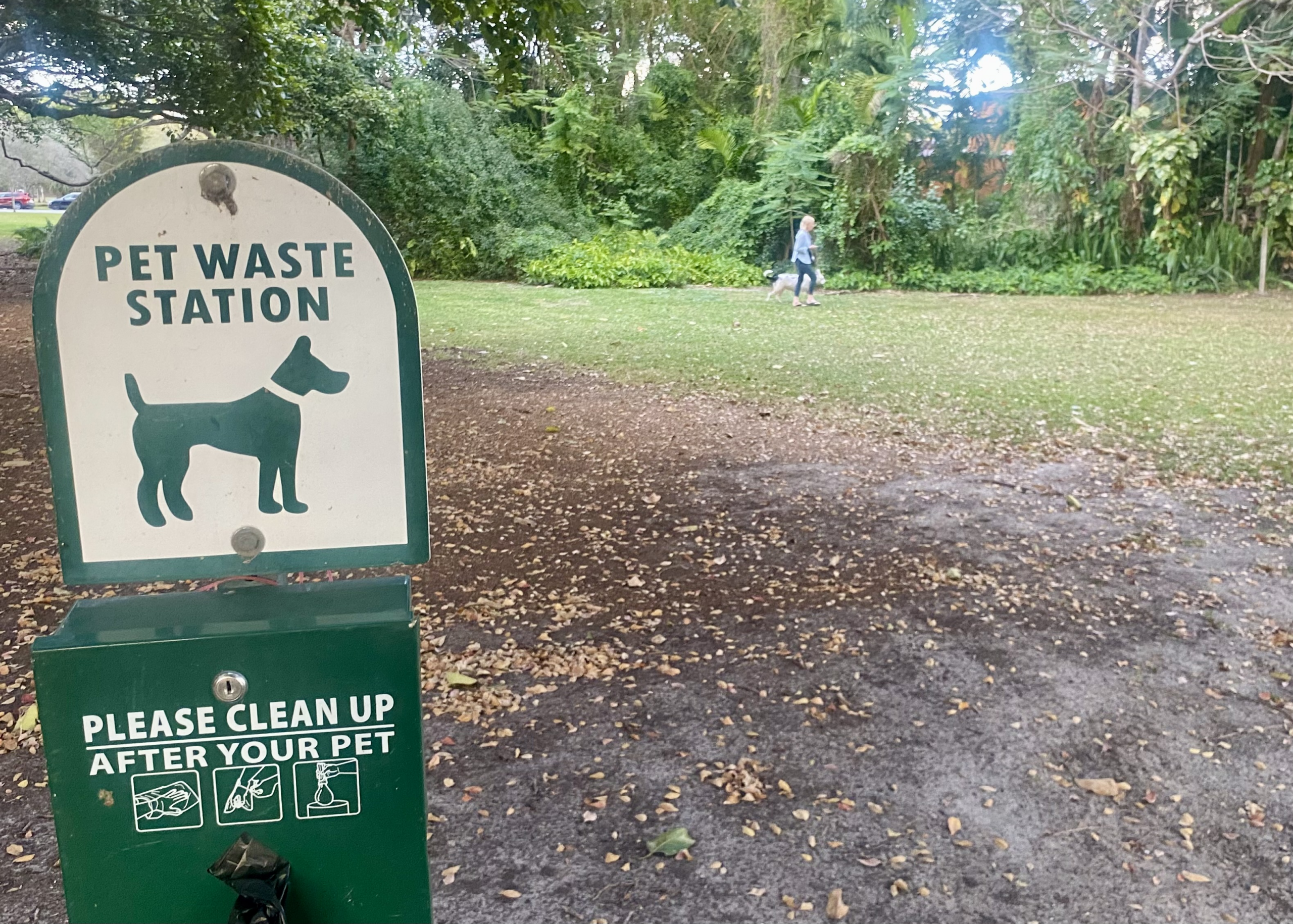
By Coral Gables Gazette staff
The legal fight over a proposed dog park at 520 University Drive has expanded into a second court challenge, this time targeting the zoning change the City Commission adopted last month to broaden how the property may be used.
On Aug. 6, the University Green Neighbors Association and resident Jose Val Cohen filed a Petition for Writ of Certiorari asking Miami-Dade Circuit Court to quash Ordinance 2026-25. The ordinance, approved July 7, removed two conditions dating to 1972: one limiting 520 University to overflow parking for the Coral Gables Library and War Memorial Youth Center, and another requiring the property to revert to single-family zoning if that parking use ended.
The ordinance does not itself approve a dog park. Instead, it expands the allowable use of 520 University to include a public park while retaining overflow parking as a permitted use. A separate resolution adopted last November directed city staff to move forward with development of an off-leash dog park on the site.
The Gazette sent City Attorney Cristina Suárez and Vice Mayor Rhonda Anderson detailed questions about the ordinance and the allegations in the petition, including questions addressed directly to Anderson about claims that she should have recused herself from the zoning votes.
The city responded through Martha Pantin, director of communications and public affairs.
“The City followed all required processes in adopting Ordinance No. 2026-25 and will file an appropriate response to the petition for writ of certiorari if required to do so,” Pantin said.
Neither Suárez nor Anderson responded separately, and the city’s statement did not address the specific allegations concerning Anderson.
A second court challenge in a months-long dispute
The controversy dates to Nov. 18, 2025, when the City Commission approved Resolution 2025-452 directing staff to move forward with development of a dog park at 520 University.
University Green Neighbors Association and Val Cohen later sued the city, seeking to stop the project. Among their arguments are that the city should have acted by ordinance rather than resolution, that the existing zoning conditions did not permit the proposed use and that the city violated Florida’s Government in the Sunshine Law in the events leading to the November vote.
The Aug. 6 petition attacks a different action.
Rather than seeking to invalidate the November resolution, it asks the court to overturn Ordinance 2026-25 — the zoning amendment the commission adopted while the first case was pending. The petition says the city failed to provide due process, departed from legal requirements and lacked competent substantial evidence for the zoning decision.
What the ordinance actually changed
Ordinance 1952, adopted in 1972, governed properties at 430, 440, 450 and 520 University Drive after they were rezoned from single-family residential to Special Use.
Among its conditions, the properties were to remain unpaved and park-like, with trees and foliage preserved as much as feasible; their use was limited to overflow parking for the library and Youth Center; and they were to revert to single-family zoning if that parking was no longer needed.
Ordinance 2026-25 changes those rules only for 520 University.
The property must still remain unpaved and park-like, and its trees and foliage are to be preserved as much as feasible. But the city changed language saying it should be used “only” for overflow parking to allow the parcel to serve as overflow parking and function as a public park. It also removed language requiring a means of closing the property when parking was unnecessary and deleted the automatic reverter to single-family zoning.
The restrictions at 430, 440 and 450 University remain unchanged.
The Planning and Zoning Board recommended approval May 20 by a 5-2 vote, while also asking the commission to review parking and traffic studies and calling for a buffer between any future park and adjoining homes. The adopted ordinance itself acknowledges those recommendations.
What the city did on traffic and parking
What happened after that recommendation has become part of the legal dispute.
On May 28, Assistant Public Works Director Melissa De Zayas issued a one-page memorandum titled “520 University Drive – Traffic Impact Study.” The memo said staff from Public Works, Parking, Community Recreation and the City Clerk’s Office had reevaluated parking needs associated with election voting at the library, high activity at the Youth Center and potential impacts from nearby Christ Journey Church. Staff concluded that 520 University was not needed for overflow parking.
The memo also concluded that a full Traffic Impact Study was not required. It said such a study is required for development expected to generate 50 or more additional peak-hour trips; because the proposed project would add no parking, staff concluded it would generate no new vehicle trips. The memo also said no intersection or roadway changes were planned and no changes in traffic patterns were anticipated.
The petitioners argue that this review did not satisfy what the Planning and Zoning Board requested. Their filing says the city conducted no actual traffic or parking studies and lacked competent substantial evidence for removing the longstanding restrictions.
That disagreement is central to the new challenge: not whether the city considered parking and traffic at all, but whether what it considered was sufficient to support the zoning change.
Five grounds for challenging the ordinance
The petition advances five principal arguments for overturning Ordinance 2026-25.
First, the petitioners argue that the commission lacked competent substantial evidence to support the changes, particularly regarding parking and traffic. They point to testimony, photographs and parking observations submitted by opponents and contend the city failed to rebut that material with an adequate study.
Second, they allege illegal spot zoning. Their argument is that the city singled out 520 University for different treatment while leaving the other properties governed by Ordinance 1952 unchanged, even though the petition describes the properties as serving the same historical purpose as overflow parking and a buffer between civic uses and nearby homes.
Third, they argue the change conflicts with the city’s Comprehensive Plan and Zoning Code. The Future Land Use Map designates 520 University as “Public Buildings and Grounds,” and the petition contends that a standalone off-leash dog park does not fit that classification. It also alleges that the city failed to conduct a required Planning and Zoning Board conceptual review before the formal hearing.
Fourth, the petition alleges procedural and notice defects. It argues that an application-specific public information meeting should have occurred before the May 20 P&Z hearing and that the notices and property postings did not consistently make clear whether the proposed amendment involved all four University Drive properties or only 520 University.
Finally, it argues that Anderson should have recused herself or abstained from participating in the quasi-judicial proceedings because of her prior involvement with efforts to establish a dog park at the site.
City staff reached the opposite conclusion
The city’s May 20 Planning and Zoning staff report provides the clearest substantive counterpoint to those arguments.
Staff concluded that allowing 520 University to function as public park space was consistent with the property’s existing “Public Buildings and Grounds” designation. It also found that the amendment would not permit densities or intensities beyond those allowed under the existing Future Land Use classification.
Staff further determined that the changes were consistent with the Comprehensive Plan and said putting park space near residential areas could encourage walking and cycling while increasing access to recreation.
The staff report also viewed removal of the reverter clause very differently from the petitioners.
Rather than treating the automatic return to single-family zoning as a neighborhood safeguard, staff argued that eliminating it would increase public participation because any future zoning change would then require notice and a public hearing rather than occurring automatically. Staff also wrote that public parks generally provide a more compatible transition to nearby single-family neighborhoods than surface parking.
The petitioners contend the opposite: that the reverter was itself a protection neighboring homeowners had relied upon for more than 50 years and that removing it eliminates a safeguard against incompatible future uses.
Castro raised a similar process concern
The process concern now at the center of the petition was also raised from the commission dais before Ordinance 2026-25 was adopted.
At the June 2 first reading, Commissioner Melissa Castro, who ultimately voted against the ordinance, said the question went beyond whether Coral Gables should have another dog park.
“This is not a dog park argument. This is a process argument,” Castro said.
She questioned why the city should change zoning conditions on the property while the legality of its original action was already being challenged in court. If the city believed the November resolution was lawful, she argued, it should allow the court to evaluate that action under the rules that existed when the decision was made.
Castro moved to defer the zoning amendment until the litigation was resolved. Commissioner Ariel Fernandez seconded the motion.
The commission ultimately moved forward with the amendment.
The recusal claim
The petition’s most pointed allegation concerns Anderson’s role in the zoning votes.
It alleges that Anderson contacted owners of two properties bordering or near 520 University in November 2024 to discuss a possible dog park. According to the filing, one owner was told the city would not move forward without neighborhood support, and both expressed opposition to the proposal. Those assertions are allegations contained in the petition and related filings; the city did not address them in its response to the Gazette.
Opponents asked Anderson to recuse herself before the June 2 first-reading vote.
The meeting transcript shows Anderson asked Suárez about the request. Suárez told her that the question of bias was one for Anderson to evaluate based on whether she believed she could fairly and impartially consider the application and the competent substantial evidence.
Anderson declined to step aside.
She said the November action had been intended to start a design and public-input process rather than constitute final approval of a dog park. She also cited survey results indicating 71 percent of Coral Gables respondents favored the dog park and said she had an obligation to listen to that response.
“I’m listening to what the majority wants,” Anderson said, adding that she believed she could remain fair and impartial.
The petition argues that the legal test is different. It contends that due process turns on whether the circumstances would create in a reasonable person a well-founded concern that a decision-maker had prejudged the matter, not simply whether the official personally believes she can remain impartial.
The association renewed its recusal request before the July 7 second reading. Anderson participated in the vote, and the commission adopted Ordinance 2026-25 by a 3-2 margin.
What happens next
The petition asks the circuit court to quash Ordinance 2026-25.
The city has not addressed the petition’s individual allegations in its response to the Gazette. Its stated position is that Coral Gables followed all required procedures in adopting the ordinance and will file an appropriate response if required.
The new challenge remains distinct from the earlier case attacking Resolution 2025-452.
One case challenges the action that set the dog park process in motion. The other asks a court to overturn the zoning amendment the commission adopted months later — an amendment that changed what the city may do with 520 University regardless of whether a dog park is ultimately built there.













Government for the Peple by the People. Someone forgot who these elected officials work for. Please note that I am in favor of an off-leash Dog Park, but it should be based on approval by the neigborhood is going to be next to. It seems that the commision want to always RAM something down the residents throats, instead of having a friendly debate.
I am for a park, but not the way this is being handled.
Please don’t fall for the clever smoke-and-mirrors sleight of hand tricks our City is attempting on a property they said was already a park. Clearly it was not. Also know that once it is zoned a park or open space the City can change it to whatever type of recreation use it wants without neighborhood input. That applies not only to 520 University Drive but everywhere in the City like Young Park, Country Club Prado, Alcazar Park, Lisbon Park, Marlin Park and many other passive places that add beauty and tranquility to our neighborhoods.
The first page of the May 20 Planning & Zoning Staff Report stated the City’s interest was to create a dog park at the site, and the June 2 and July 7 City Commission verbatim transcripts reinforced that interest. The Staff Report also suggested a park would be beneficial for the neighborhood and would not negatively impact property values yet this property has been public greenspace since the City was founded over 100 years ago. It is dishonest to imply a 40,000 sq ft off leash dog park immediately next to single family homes would not impact property values without any documentation or proof.
The 3-paragraph traffic report was also reckless and incomplete, failing to mention that special circumstances can also warrant a traffic study in the development review process – like the combined annual visitor count of 850,000 people at the Library and Youth Center. In addition, University Drive functions as an east west commuter corridor from LeJeune Road to Granade while also serving as the direct access for Fire Rescue to Doctors Hospital Emergency Room. The collision of those circumstances warrants a legitimate review which is why the Planning & Zoning Board asked for it BEFORE it went to City Commission for consideration. That review did not happen.
A quasi-judicial process in the State of Florida has strict requirements that must be adhered to. The City has not followed them, which is why our neighborhood has challenged the zoning action.
I don’t have a dog in this fight, but, given the adamant opposition by the neighbors and the legal issues that have arisen, does the City really believe that spending $$$ in legal fees to potentially create a controversial park is the best use of taxpayers’ monies?
Vice-Mayor Anderson along with Lago and his pocket vote, Lara, continue their crusade to waste our money building and maintaining low-use dog parks. Salvadore Dog Run and Chewy Bark Park are empty, and the City has 26 other pet-friendly parks. There is no need or demand for another dog park. We have more dog parks than Boise, Idaho which is ranked first with 9.1 dog parks per 100,000 residents. The proposed buffer for this new dog park is only 25 feet! The minimum buffer for dog parks should be at least 200 feet from residential property lines with 500+ feet being ideal for noise mitigation per the Municipal Dog Park Planning Guide.
. https://gooutdooramenities.com/blog/municipal-dog-park-planning
. Lago and his pocket votes do not care because it will not affect their political donors. As to money for another low-use dog park, Salvadore Dog Run costs $150,000 annually to maintain. The City is in an economic crisis due to (A) $11.4M discretionary dollar decrease with the homestead tax exemption change, (B) $1M unplanned cost to maintain the Underline property, (C) $70M debt to build the Mobility Hub – Lago’s personal monument, (D) $9.2M to build Ponce Circle Park beside the new development by Allen Morris (another Lago major contributor), and (E) $1M art that is being placed on a parking garage! The desire for Lago, Anderson and Lara to spend money on a new low-use dog park means the City either spends less on existing services (so we have less services) or we pay more for existing services which is a tax increase. Residents should not be forced to spend money suing the City in order to be heard.
Anderson “cited survey results indicating 71 percent of Coral Gables respondents favored the dog park and said she had an obligation to listen to that response.”
That must be either the original petition which didn’t indicate the location of her intended dog park, and included signatures of persons who don’t live in Coral Gables, persons who don’t have dogs, and intentionally avoided seeking signatures of the neighbors in the immediate vicinity, especially the homeowners whose homes are adjacent to or across from 520 University. Or maybe it’s citing a survey which again excluded the residents living on Cadima, Harlano and Riviera…again those most impacted by this boondoggle of a pet project of Anderson’s.
She was crowing about the perfect location for a dog park when Chewy Bark Park was approved, because it wouldn’t impact any residences. Wow, that is certainly a reversal of opinion! And as to Anderson listening to the residents, it’s hard to do that when your mind is already made up.
Again, its the residents that live near this supposed “Bark Park” who should have the last say in whether this gets approved or not. I don’t know the exact figure but i hear over 100 nearby residents oppose this plan. Obviously no commissioner or city staff live near the area, so they can smile and approve anything they want. We have too many dog parks already, let’s focus on improving safety, roads, crime, power outages, sidewalks, etc. and “STOP” wasting tax payers money on unnecessary things. Lets make Coral Gables beautiful again, don’t you think !!!!
Legalities aside, do we want to encourage or discourage education – and voting. The library NEEDS additional parking.
The Mayor and 2 commissioners who sit as leaders of Coral Gables are absolutely deplorable. Look at how the residents are fighting this, but you autocratic horrible people will not back down. How can a city fight its own people like this? How can you not hear us as you work for us? I have had it with your lack of leadership and your arrogance. You have made yourselves look like self serving bullies who will do what they want to do, not what the residents want. I pray you 3 are removed from our city and the door hits you when you leave. Add the Garden drama too. You are paid off crooks.
As per previous comments, if the dog park is only 25 feet from a home and it should be 200 feet, then this is a closed issue. To place a dog park with barking dogs so close to a home that uses its back yard is just plain wrong. This has gotten out of hand. Grow up you 3 clowns and say you respect the residents and will cancel the dog park plans. Otherwise the way you are treating us will follow you out the door. I just can not believe how you are fighting this and spending money on a dog park when the others are virtually under used. STOP YOUR DICTATING to residents who pay your salaries.