A Shuar teenager confronting mining in the Ecuadorian Amazon, Navajo runners retracing a 330-mile forced march, First Nations activists crossing Canada by train and a Miccosukee leader seeking recognition for his people are among the stories coming to the University of Miami this weekend.
The inaugural Miccosukee Indigenous Film Festival brings 22 films by or about Indigenous people to the Bill Cosford Cinema from Friday, Oct. 9, through Monday, Oct. 12. A special closing-night screening adds a 23rd film to the program.
The lineup spans the United States, Canada, Australia and other countries, with documentaries, narrative films, shorts and features. Question-and-answer sessions with visiting filmmakers are planned after screening blocks.
All screenings take place at the Cosford Cinema, 5030 Brunson Drive, inside UM’s Memorial Building. Tickets are available by individual screening block, day pass or full-festival pass.
A new festival in Iron Arrow’s centennial year
The festival arrives as the University of Miami marks its centennial and the Iron Arrow Honor Society approaches 100 years on campus.
Founded in 1926 by UM’s first president, Bowman Foster Ashe, Iron Arrow is regarded by the university as its highest honor. The film festival was organized as a separate nonprofit led by festival director Juan Lama, who also serves on Iron Arrow’s Council of Elders.
“We hope that with innovative partnerships, like this film festival, we are creating a platform for dialogue and engagement,” Lama said in announcing the event.
Miccosukee Chairman Talbert Cypress described the festival in the context of the tribe’s relationship with South Florida.
“We have been here and we always will be here,” Cypress said.
That partnership comes against a complicated history.
Iron Arrow has long incorporated Miccosukee clothing and traditions into its ceremonies, practices that have drawn criticism from some Indigenous students and alumni as cultural appropriation. In 2022, the UM Student Senate voted 28-5, with seven abstentions, for a resolution calling on the university to disaffiliate from the society.
Miccosukee tribal leaders have taken a different position. A 2018 memorandum among the tribe, Iron Arrow and the university reaffirmed their relationship, and tribal leadership has repeatedly supported the society’s ties to the Miccosukee.
For the film festival, organizers set an Indigenous connection as a condition of entry. Films must be written, directed or produced by members of Indigenous communities, feature Indigenous lead actors, or directly portray Indigenous cultures.
From the Amazon to Tierra del Fuego
The festival opens at 6 p.m. Friday with “Nunkui,” directed by Verenice Benítez.
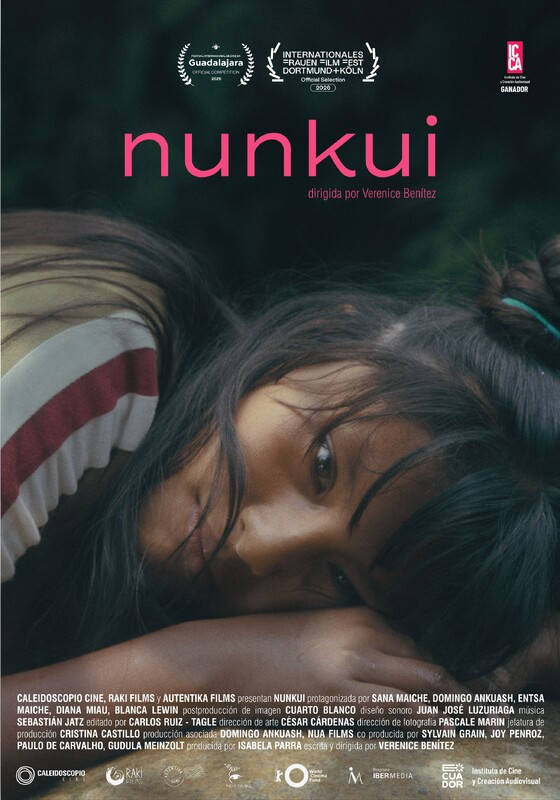
The Ecuador-Chile-Germany coproduction follows a 13-year-old Shuar girl in the Ecuadorian Amazon who dreams of Nunkui, the female spirit of the orchard. Her coming of age unfolds as mining companies move into the region and her community faces eviction.
Benítez cofounded Cámara Shuar, a community film laboratory, with Shuar leader Domingo Ankuash, who plays the girl’s grandfather in the film.
Saturday begins outside the theater. Festivalgoers can join a morning visit to the Miccosukee Indian Village, departing the cinema parking lot at 8 a.m. The visit includes tours, demonstrations and an alligator show from 9 a.m. to noon, with optional airboat rides available at additional cost. The group is scheduled to return to campus by 1 p.m.
Films follow at 3, 5:30 and 8 p.m.
Among them, “The Long Walk: A Dance With Humanities” follows six runners covering 330 miles in four days to honor survivors of the Navajo Long Walk. “Kokum Dorothy’s Story” recounts the experience of a First Nations elder taken to a residential school at age 5.
A South Florida dispute also reaches the screen. “Alligator Alcatraz” follows the Miccosukee Tribe’s opposition to the migrant detention center established in the Everglades and its participation in litigation challenging the facility.
Saturday ends with “When Fire Turns to Ash,” an essay-style documentary examining the history, Indigenous cultures and landscape of Tierra del Fuego.
Stories of survival, resistance and sovereignty
Sunday’s three screening blocks continue the festival’s geographic sweep.
“Reservation Redemption” tells the story of Chief Marchand Rice, whom the festival describes as having gone from a life sentence for murder to becoming a voice for healing and change.
“South to Freedom” examines Spanish Florida as a destination for people escaping slavery, while “Seeds We Bury” connects the experiences of the Ati people of the Philippines and the Shinnecock Nation.
The evening closes with “Breakpoint: The Untold Story of the Constitution Express,” about the 1980 movement in which First Nations activists traveled thousands of miles by train to Ottawa as Canada prepared to rewrite its constitution without protections for Indigenous rights.
The festival returns to the Miccosukee story for its final night.
“Becoming Buffalo,” written and directed by Montana Cypress, screens at 7 p.m. Monday, which falls on Indigenous Peoples Day. The special non-competition film traces the Miccosukee Tribe’s pursuit of sovereignty through the life of Buffalo Tiger.
Born in the Everglades in 1920, Tiger emerged as a leader during the tribe’s struggle for recognition. After years of frustration with the U.S. government, he led a Miccosukee delegation to Cuba in 1959, where the government recognized the tribe. Federal recognition from the United States followed in 1962.
Cypress, who grew up hearing elders tell stories about Tiger, plays him in the film.
The closing-night screening brings the festival’s journey back to South Florida after four days of stories stretching from the Amazon to Canada, the Philippines and Tierra del Fuego.
An awards ceremony follows the film.