By the Coral Gables Gazette editorial board
The City Commission voted 4-0 Tuesday to advance the University of Miami’s proposed 30-year development agreement, with Commissioner Ariel Fernandez absent.
The vote was only a first reading. A second reading, and the public hearing that comes with it, still lie ahead.
That hearing should not be a formality.
Coral Gables may ultimately conclude that the land, payments and other benefits it receives make this a fair exchange for the development rights it is granting UM. But on the evidence presented publicly so far, the city has not demonstrated that conclusion.
Before commissioners commit Coral Gables to a 30-year bargain, they should show residents how they determined what each side of that bargain is worth.
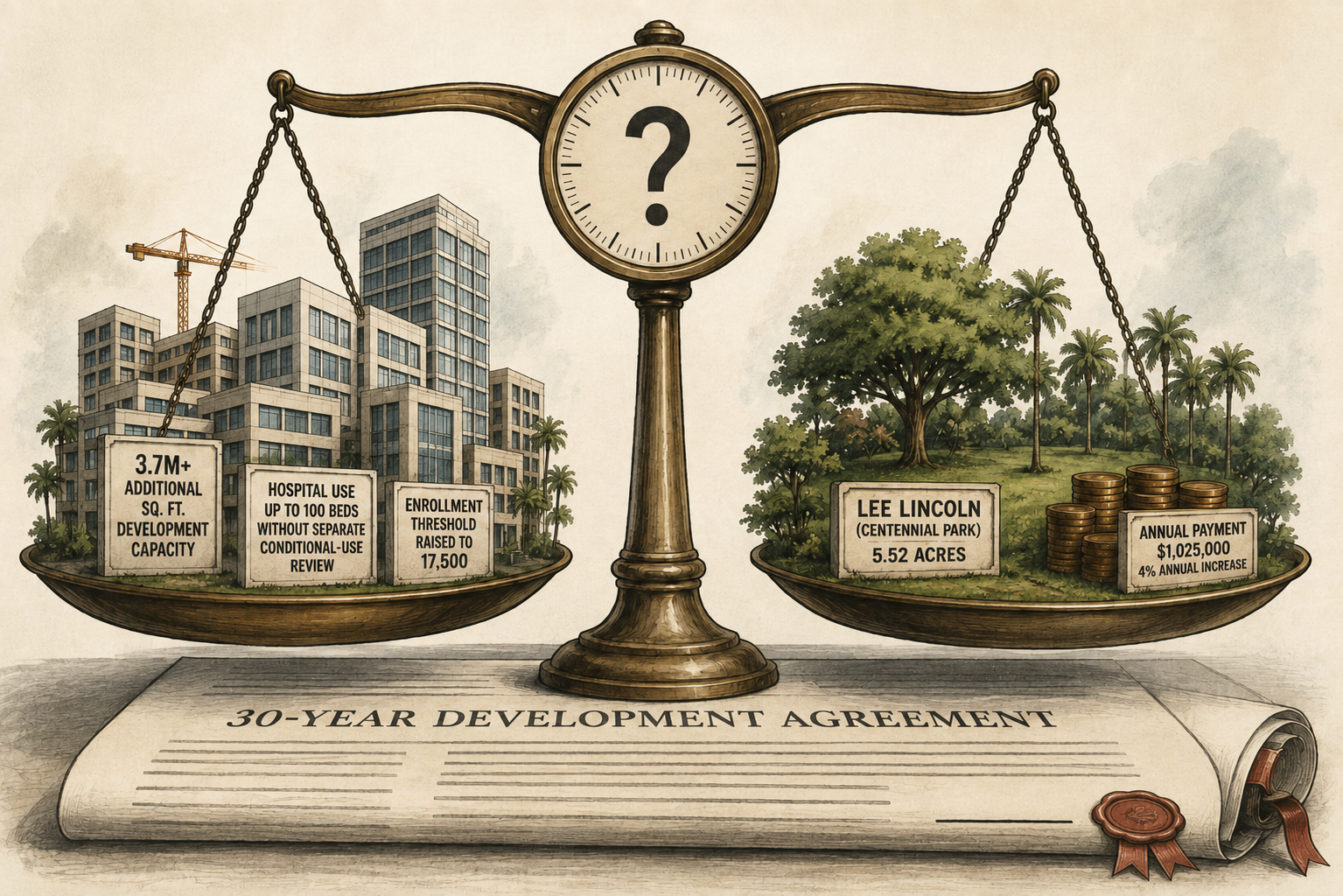
The agreement sets UM’s annual payment to the city at $1,025,000, rising 4 percent each year for the first time under the agreement. Compounded over 30 years, that produces roughly $57.5 million in nominal payments.
That is real money. It also tells residents little, by itself, about whether the overall exchange is fair.
The relevant question is not whether $1.025 million sounds large or small compared with UM’s finances or the city’s budget. It is whether the entire package Coral Gables receives, including the land, payments and community benefits, is commensurate with the entire package it grants.
No independent appraisal of Lee Lincoln, fiscal-impact analysis or valuation of the additional development rights was presented publicly Tuesday, and none appears in the public materials reviewed by the Gazette.
No such valuation was presented publicly before commissioners cast their first-reading votes.
That leaves residents with numbers for individual pieces of the deal but no accounting that puts both sides on the same scale.
We are not claiming that $57.5 million in nominal payments, Centennial Park and the agreement’s other community benefits are insufficient. We are saying the city has not shown that they are sufficient.
Those are different assertions.
The centerpiece of the agreement, by nearly every account given Tuesday, is the transfer of the 5.52-acre Lee Lincoln property to Coral Gables, where it would become Centennial Park.
Receiving title to 5.52 protected acres has real value.
But UM’s own attorney, Jeff Bass, described what the city is receiving in terms worth examining closely. Centennial Park, he told commissioners, would be a “green and beautiful passive place, much like it is now.” He also said the property already serves as a buffer between the university and nearby single-family homes.
The formal transfer would create permanent public ownership, which is meaningful. But it is not the same as creating new open space where none existed. UM’s own presentation acknowledges that the property already functions as passive green space and already provides a buffer between the campus and surrounding neighborhoods.
There is another consideration.
The city would receive title subject to UM’s perpetual recreational easement over portions of the property.
That does not make the conveyance worthless. Far from it. But it does mean any serious valuation should account for the rights UM retains rather than treating the transaction simply as the unrestricted transfer of 5.52 acres.
How much is Centennial Park worth under those conditions?
That is precisely the kind of question an independent valuation could help answer.
Mayor Vince Lago offered the fullest defense of the agreement’s economics of anyone who spoke Tuesday, and his argument deserves to be engaged with directly.
Lago said UM had been willing to pay the city more in cash annually but that Coral Gables chose the land instead, reasoning that permanent ownership of Lee Lincoln was worth more than a larger annual check.
He also noted that the new 4 percent annual escalator improves on the flat payment structure in the 2010 agreement. And he predicted that Lee Lincoln could double or triple in value over the next 10 to 20 years.
“That’s why you don’t see a much higher annual payment like maybe you see in other universities,” Lago said.
Those are legitimate arguments. They are not substitutes for a valuation.
The assertion that UM offered more cash is Lago’s account of a private negotiation; no one else who spoke Tuesday quantified such an offer. His comparison with what other universities pay named no institution and provided no figure residents could examine.
More fundamentally, the city has quantified the future value of only one side of the exchange rhetorically.
The agreement would give UM roughly 3.7 million additional square feet of development capacity by replacing the existing 6.8 million-square-foot cap with a floor area ratio allowing approximately 10.5 million square feet. It would expand the campus Multi-Use Area. It would raise the enrollment figure that triggers additional mitigation obligations from 13,000 to 17,500 students, though that figure is a threshold rather than a hard cap. And it would make hospital use of up to 100 beds a permitted use in the Multi-Use Area without a separate conditional-use review for the hospital use itself.
Those entitlements carry economic value too.
Yet no analysis presented publicly Tuesday quantified the value of that additional development capacity, the expanded Multi-Use Area, the revised enrollment framework or the new hospital use and weighed those benefits against what Coral Gables receives.
If future value is central to the city’s argument that Lee Lincoln makes this a fair bargain, future value should be examined on both sides of the bargain.
Florida law already requires development agreements to undergo regular review to determine whether a developer is complying in good faith with their terms.
That is not what Commissioner Melissa Castro asked for Tuesday.
Castro, who ultimately voted yes, asked whether UM’s financial commitment itself could be revisited periodically, suggesting something closer to a five-year cycle given the agreement’s 30-year duration.
Lago rejected the idea directly.
“This is a 30-year agreement,” he said. “There’s no renegotiating.”
Florida law does allow a development agreement to be amended or canceled later by mutual consent. So the agreement is changeable.
But that is different from building a scheduled financial reopener into the agreement itself.
As proposed, the economic terms would be set at adoption without a mechanism requiring the parties to reconsider periodically whether those terms still reflect the scale of development occurring under the agreement.
Perhaps there is a compelling reason not to include such a provision.
If so, commissioners should explain it before final adoption.
None of this is an argument against a strong relationship between Coral Gables and its university, nor does it require treating UM as an adversary.
UM is one of Coral Gables’ defining institutions. Its success benefits the city in obvious ways. A university planning decades into its future also has a legitimate interest in regulatory certainty.
But Coral Gables has an equally legitimate obligation to demonstrate to its residents that the certainty it is granting for 30 years is being exchanged for fair value.
Before second reading, the city should produce an independent valuation, or equivalent financial analysis, of what Coral Gables is granting and what it is receiving. If such an analysis already exists, it should be made public.
The city should explain the Lee Lincoln easement in plain language and account for its effect, if any, on the value of the property being conveyed.
And commissioners should explain why the agreement needs no scheduled financial reopener, particularly after one of their colleagues asked for exactly that protection.
The answer may ultimately favor the agreement exactly as written.
If an independent analysis shows that the escalating payments, Centennial Park and other benefits reasonably compensate Coral Gables for the development rights it is granting, residents should know that. The city would have a much stronger case for final approval.
But that conclusion should follow from evidence, not precede it.
Coral Gables does not need to reject this agreement. It needs to show its work before adopting a 30-year bargain.