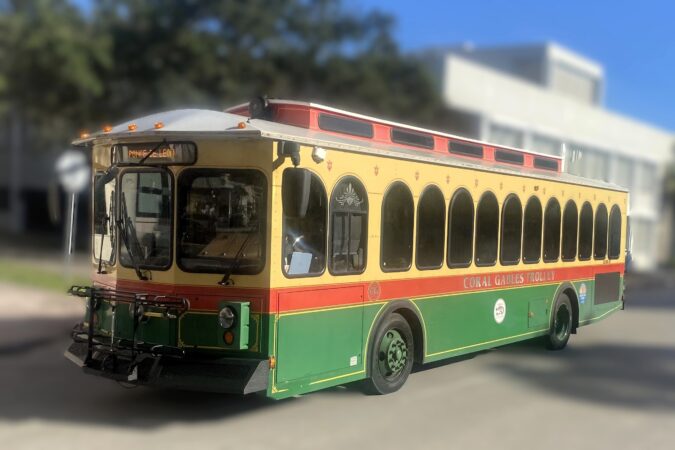
Coral Gables spent the past year trying to win back trolley riders, and the riders have not returned. The system recorded 891,275 passenger trips in the fiscal year that ended Sept. 30, down 7.7 percent from a year earlier and more than 14 percent from two years ago. A new route the city hoped would help reverse the decline reached just 43 percent of its initial ridership projection. The Southern Loop’s one-year pilot reaches its first anniversary Nov. 3, and the city has not publicly explained whether it will continue or how continued operations will be funded.
The city should answer those questions in public. It should also use the occasion to establish meaningful performance standards for the entire trolley system, because the Southern Loop is only a small part of the problem.
Fairness to the city comes first. Construction along Ponce de Leon Boulevard may be affecting access, officials say, and transit ridership has declined elsewhere in Miami-Dade County. Countywide passenger trips fell approximately 1.4 percent during the 11 months through August compared with the corresponding period a year earlier. Coral Gables’ decline was substantially steeper, although the reporting periods differ.
The city has identified no single cause. The Southern Loop’s shortfall may also say as much about the forecast as about the route. Officials said the original projection of 3,500 monthly boardings was based on peak demand for the one-trolley Grand Avenue route, a benchmark that now looks generous. The new route has averaged about 1,520 boardings a month.
In March, this editorial board argued that the Southern Loop was working, as monthly ridership climbed past 1,500. Eleven months into the pilot, however, its monthly average is barely higher. Our early optimism may have been premature. Officials expect demand to grow as construction of the Underline progresses, and they may be right.
Hope falls short of a plan, though, and the larger loss is elsewhere.
The Ponce de Leon Boulevard route carries approximately 94 percent of all trolley passengers. It lost 94,193 annual boardings in fiscal 2026 and 163,031 over two years, a decline of more than 16 percent. The Southern Loop’s 16,728 rides offset less than one-fifth of the established routes’ losses this year. Grand Avenue ridership rose almost 10 percent, and the city’s on-demand Freebee trips increased 3 percent, demonstrating that demand for some municipal transportation services remains. That makes the Ponce decline all the more important to understand.
Spending has moved in the opposite direction. Operating expenses in the city’s Transportation and Trolley fund were approximately 18 percent higher during the first nine months of fiscal 2026 than during the corresponding months two years earlier, and 31 percent higher than last year, when spending had declined. Expenses reached $3.24 million. The fund’s operating loss increased to $1.69 million from $654,000 a year earlier, while General Fund transfers rose from $262,000 to $1.4 million.
The fund covers more than trolley operations, and the figures do not establish that the Southern Loop caused the increase. They do establish that the city’s General Fund is contributing substantially more to its broader transportation system while trolley ridership declines.
Some of the city’s own numbers also need reconciling. Officials have described a trolley division budget of $4.7 million, while the city’s quarterly financial report lists a $6.39 million amended operating-expense budget for the broader fund. The Gazette has received no explanation of how the two figures relate. At the Oct. 20 Transportation Advisory Board meeting, officials described an annual ridership decline of approximately 11 percent; the city’s subsequent written figures put the decline at 7.7 percent.
Residents should not have to reconcile their own trolley statistics.
Is Coral Gables spending more to deliver better mobility—or simply spending more to carry fewer passengers? The city’s figures document the spending and the decline. They do not establish what residents are receiving in return.
The forthcoming Mobility Master Plan should help answer that question, but it cannot become another reason to postpone decisions. Last year City Manager Peter Iglesias directed staff to undertake the first comprehensive review of the system since 2013. Its scope of work has been approved, but the consultant is still awaiting a purchase order. Meanwhile, the city says it completed accessibility improvements at 42 stops along Ponce, work that officials said would remove approximately 40 on-street parking spaces.
A study intended to help explain changing travel patterns has not begun while the system continues to lose passengers.
Cost per rider cannot be the only test. A trolley that allows an older resident to reach a medical appointment or a student to connect with Metrorail serves a public purpose that a passenger count alone understates. Some routes may merit support because of the access they provide, others because of the volume of passengers they carry. Each should be evaluated against standards that reflect its purpose, established in advance and reported publicly.
The City Commission can take five concrete steps.
First, before committing to another year of the Southern Loop, the city should publicly explain what continued service will cost and where the funding will come from, as well as what changes it expects to improve performance. Any extension should have clearly defined evaluation criteria, including ridership, cost, reliability, accessibility and connectivity. If the route misses those targets, the commission should reconsider it publicly, explaining what will change or why continued service remains justified. The same scrutiny belongs on Ponce de Leon Boulevard, where nearly all trolley passengers ride and the greatest losses have occurred.
Second, the city should publish a quarterly performance scorecard showing monthly ridership by route, operating cost per boarding, boardings per service hour, reliability and accessibility. It should explain how shared expenses are allocated and identify the public purpose each service is intended to fulfill. Residents should not have to wait for a consultant’s report to learn how their transportation system is performing.
Third, the Mobility Master Plan needs a timetable. Although the city has approved the study’s scope, it has yet to issue the purchase order authorizing consultant Kimley-Horn to proceed. That should happen promptly, with preliminary findings available before the next budget cycle. The study should also survey current and former trolley riders, with particular attention to why ridership along Ponce de Leon Boulevard has declined more than 16 percent in two years.
Fourth, officials should reconcile the $4.7 million and $6.39 million budget figures and explain why the ridership numbers presented at the Transportation Advisory Board meeting differed from those subsequently supplied in writing. Consistent, comprehensible reporting is a prerequisite for meaningful public oversight.
Fifth, the Transportation Advisory Board should review the performance scorecard quarterly and report its findings to the commission. Advisory boards should also be consulted before major decisions are effectively settled. As the Gazette argued in July 2025, civic progress requires civic process. Members of the Parking Advisory Board said they learned of the parking losses along Ponce too late to influence the decision. The city should not repeat that mistake as it evaluates the future of its transportation network.
Coral Gables has legitimate reasons to invest in public transportation. A free trolley system can expand access, connect neighborhoods and reduce dependence on private automobiles. Those are worthwhile objectives. But commitment to public transportation should not mean preserving every route, schedule or spending decision regardless of results.
Expansion is not necessarily improvement. And spending more is not the same as delivering more.
A trolley is a promise the city makes to residents: a way around town that does not depend on a car and can reduce traffic congestion and parking demand. Keeping that promise means knowing, with numbers the public can see, whether people are using the service, whether it meets their needs and whether the investment is justified.
The Southern Loop’s first anniversary is days away. It offers an immediate opportunity to begin applying that standard—not merely to one route, but to the entire system.
The measure of success is not how much Coral Gables spends moving people. It is how well it moves them.