Coral Gables commissioners moved toward requiring four of five votes to refer a matter to the inspector general voters approved in April, a proposed safeguard against politically motivated investigations that would also allow two commissioners to block a referral.
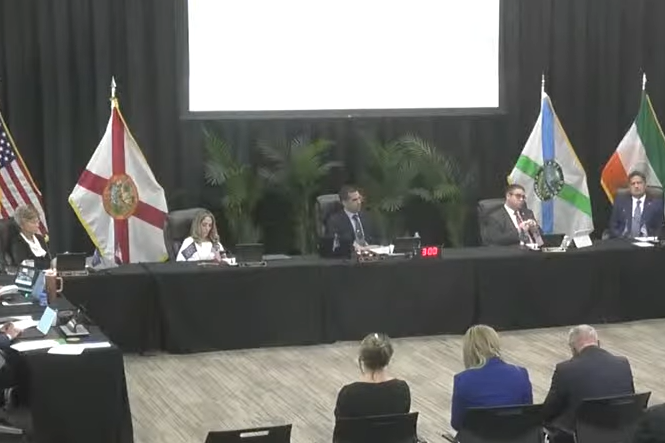
The idea emerged Oct. 13 during a public workshop at Police and Fire Headquarters. No vote was taken and no rule was adopted. City attorneys will use the discussion to prepare an ordinance defining how an inspector general would be selected, how long the appointment would last and what authority the investigator would have.
The central question is who will control access to an investigator authorized by voters to examine fraud, waste, mismanagement and abuse of power in city government.
Four votes to refer a matter
Mayor Vince Lago proposed requiring a four-fifths commission vote to refer a matter to an inspector general. He also favored reviewing referrals case by case and publishing an annual report on the inspector general’s work.
Lago called the supermajority “important and sets a standard.”
Commissioner Richard Lara argued that a four-vote threshold would help prevent the office from being used for unintended purposes.
“It would be tough to get across four out of five of us something to get submitted to the IG for an investigation if there was some other purpose behind it other than what it’s intended to be,” Lara said.
He added that “the likelihood of us sending things to the inspector general will be incredibly limited, which is a good thing.”
Vice Mayor Rhonda Anderson also supported the safeguard. “Last thing we want to do is politicize” an investigation, she said.
No commissioner voiced opposition to the four-fifths proposal during the discussion.
The commission consists of the mayor and four commissioners. Requiring four affirmative votes would mean that two members could stop a referral supported by the other three.
The workshop did not establish whether a commissioner named in a proposed investigation would participate in the referral vote, or how recusals and vacancies would affect the required number of votes.
Nor did it settle whether the inspector general could investigate commissioners directly. Lara suggested that a member who made a referral for improper reasons could also become the subject of an inspector general investigation.
A different approach from Miami
Lago cited the City of Miami’s four-fifths requirement as a model. But the distinction between the two approaches is significant.
Miami’s supermajority provision concerns removal of its inspector general, rather than commission approval to begin an investigation. Miami’s permanent inspector general office also has authority to initiate matters independently.
Under the approach discussed in Coral Gables, four votes would be needed to send a matter to an investigator. The commission has not yet determined whether any other route to an investigation would exist.
Coral Gables also plans a different organizational structure. Rather than establish a permanent office, voters authorized the city to contract for inspector general services as needed, either through Miami-Dade County or a private entity.
Deputy City Attorney Stephanie Throckmorton emphasized the importance of independence, calling it “a hallmark” of inspectors general. She noted that other jurisdictions use supermajority votes or public hearings as safeguards against removing an investigator.
Who can file a complaint?
An FIU student attending the workshop asked how corruption would be identified.
Lago said residents, businesses and commissioners could bring concerns forward. He then described a process in which the commission would decide whether a matter should be referred.
“If there’s an issue that’s identified, it will be presented to the commission and then the commission will refer it over to the inspector general,” Lago said.
That description suggests the public could submit complaints, but commissioners would control whether those complaints reached an inspector general.
The workshop left two important questions unanswered: Could a complaint reach an inspector general without commission approval? And if an investigator uncovered evidence of additional misconduct while examining an authorized matter, could the investigation expand without another commission vote?
Those questions will help determine how independently the oversight system can operate.
How investigators would be selected
Commissioners also discussed how to choose an investigator for each assignment.
One approach would create a roster, or “wheel,” of prequalified investigators who could be selected as matters arise. The roster might be renewed annually and could include the Miami-Dade County Office of the Inspector General.
Another approach would establish a screening committee of retired judges and other professionals to review qualifications, potentially following a public request for qualifications.
Lara suggested allowing each commission member, the city attorney and the city manager to appoint a representative to the screening panel. He also proposed requiring four votes to select an investigator, matching the proposed threshold for referring a matter.
Throckmorton said the county inspector general’s office had expressed willingness to work with Coral Gables, although its capacity to accept assignments remained uncertain. Any arrangement would require an executed agreement and approval by the Miami-Dade Board of County Commissioners.
Commissioner Ariel Fernandez raised concerns about the county office’s workload and suggested obtaining advance authorization for a working arrangement, rather than seeking separate county approval each time a matter arose.
No selection method was finalized.
Spending limits, but no budget
Commissioners expressed interest in setting a spending ceiling for each investigation through a commission vote.
Fernandez suggested limiting private investigators’ hourly rates to what the county inspector general would charge, using hypothetical hourly rates to illustrate the idea. Throckmorton said she would need to determine how the county actually bills for its services.
The workshop produced no budget or cost estimate for the proposed oversight system.
The commission also did not establish how spending limits would affect an investigation that proved more complicated or time-consuming than initially anticipated.
Defining the inspector general’s jurisdiction
Throckmorton noted that Coral Gables already has internal and external auditors, a police internal affairs unit and procedures for bringing complaints to state and county ethics authorities.
Campaign and election matters generally fall within the jurisdiction of other agencies, she said, although commissioners could decide whether to include certain matters within the inspector general’s authority.
Anderson raised the distinction between civil oversight and criminal investigations. She urged the city to define when an inspector general would be required to refer a matter to law enforcement.
Those boundaries, along with the investigator’s powers, remain to be addressed in the ordinance.
Oversight debate follows failed referral
The workshop followed a contentious September debate over the proposed inspector general’s role.
Commissioner Melissa Castro sponsored a resolution seeking to refer matters to an inspector general, although the city has not yet established the process for engaging one. On Sept. 29, her resolution calling for an independent review of Lago’s ties to a construction firm died for lack of a second.
The new four-vote proposal would establish a substantially higher threshold for commission referrals than a simple majority.
According to the workshop discussion, the ordinance is expected to return not at the next regular commission meeting but at the following one, after the Nov. 3 municipal election. Commissioners could make changes when the ordinance comes before them for first reading.
The clerk invited public comment during the workshop. No one spoke on the proposals.
For now, the commission has expressed support for a safeguard against politically motivated investigations without resolving the other side of the question: how to ensure that a legitimate complaint can be investigated when commissioners disagree about whether it should proceed.

Author: Coral Gables Gazette News Staff
Originally established in 1996 and relaunched as a digital publication in February 2025, the Coral Gables Gazette is an independent local news organization dedicated to factual, objective and accountable community journalism. Our newsroom reports on the people, policies, institutions and events shaping Coral Gables, Florida, providing residents with timely, informative coverage of the issues affecting their community. Our reporting includes City Hall, local government, municipal elections, public spending, real estate development, business, education, arts and culture, and neighborhood affairs throughout the City Beautiful. We follow City Commission decisions, examine public records and report on the businesses, organizations and individuals contributing to Coral Gables. We believe informed residents are essential to a healthy, engaged community. Stories published under the Coral Gables Gazette News Staff byline are prepared or compiled by the publication's editorial team. We strive for accuracy, fairness, transparency and clear distinctions between news reporting, opinion and advertising. Readers are encouraged to submit news tips, corrections, editorial inquiries and story suggestions through our Contact page and learn more about our standards through our Editorial Policy.