
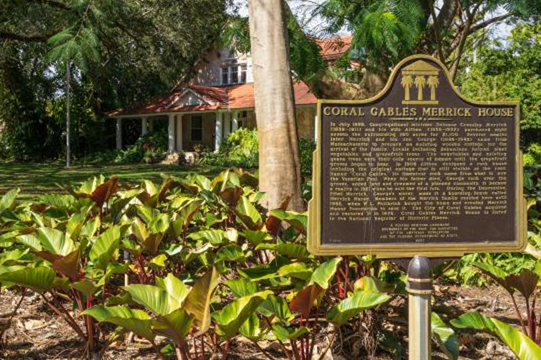
By Coral Gables Gazette staff
The family home that gave Coral Gables its name will reopen to visitors this weekend after a two-month closure, restoring public access to 14 rooms furnished to evoke the period when George Merrick was building the city around it.
Docent-led tours of the Coral Gables Merrick House will resume Saturday, Aug. 1, at 907 Coral Way. Tours begin at 1, 2 and 3 p.m. Saturdays and Sundays, with no reservation required. Admission ranges from free for children younger than 6 to $5 for adults. The house had been closed from June 1 through July 31.
The reopening offers more than a look inside the childhood home of the city’s founder. The house preserves the transition of the property from a South Florida agricultural homestead into the starting point for one of the country’s best-known planned communities.
Before the city, a family plantation
The Merrick family arrived before there was a Coral Gables.
Congregational minister Solomon Merrick and his wife, Althea, bought 160 acres in 1899 and initially lived with their children in a small frame house on the property. With the assistance of Bahamian workers, the family cleared pine and palmetto and planted grapefruit, avocado and vegetable crops. George Merrick helped work the land and carried produce by mule and cart to sell in Miami.
As the plantation became profitable, the family enlarged the house. An addition completed in 1910 used locally quarried native rock and incorporated features Althea Merrick adapted from the New England homes familiar to the family. The Merricks named the completed residence “Coral Gables” and the surrounding agricultural property the Coral Gables Plantation.
The name later followed George Merrick’s planned city.
The house is significant not only because of the family that occupied it but because its materials and design anticipated features that would recur throughout Coral Gables. The city describes it as an example of early regional architecture that adapted northeastern forms to South Florida’s climate and incorporated native rock into the building’s identity.
Fourteen rooms restored to an earlier Coral Gables
The house museum is presented largely as it appeared in 1925, the year Coral Gables was incorporated and Merrick’s development campaign was transforming former plantation land into boulevards, plazas, neighborhoods and commercial districts.
Visitors move through 14 rooms containing Merrick family furniture, paintings, photographs and personal objects. The collection places the larger civic story inside a domestic setting: bedrooms, living spaces and family possessions rather than the monumental hotels, entrances and public buildings more commonly associated with Merrick’s vision.
The City of Coral Gables acquired the property in 1976 and restored it to its 1925 appearance. The house had been added to the National Register of Historic Places in 1973 under the name Coral Gables House.
The weekend tours are led by volunteer docents rather than offered as self-guided visits. The city is also seeking people interested in future docent training, with inquiries directed to the Merrick House program.
Beyond the front door
The visit extends onto 1.3 acres of grounds surrounding the residence.
The property includes a historic grotto, a lily pond, the Heritage Garden and an expansive wraparound porch framed by tropical vegetation. The city says the grotto contains 10 species of fish. Visitors may explore the outdoor areas in addition to touring the house.
Those grounds help explain the house’s original setting. Long before Coral Way became a major city thoroughfare, the residence stood within an agricultural property whose groves supported the Merrick family and supplied the economic base from which George Merrick began acquiring and developing land.
The property also offers a contrast with the city that grew around it. Its scale remains residential and comparatively modest, even as the name conceived there came to represent Mediterranean-style civic architecture, landscaped avenues and an ambitious 1920s development program.
Tours return Aug. 1
Tours resume immediately after the scheduled closure ends, with the first three offered Saturday afternoon and another three Sunday.
No explanation for the June and July closure is provided on the city’s visitor page. Guests are advised to call before visiting for current information.
Admission is cash only. Adult tickets cost $5. Admission is $3 for seniors, military personnel and students older than 12; $1 for students younger than 12; and free for children younger than 6. Free parking is available behind the house.
Pets, food, open drinks and strollers are not permitted inside. Group tours require at least two weeks’ notice.
If you go…
Coral Gables Merrick House weekend tours
Saturdays and Sundays at 1, 2 and 3 p.m.
Tours resume Saturday, Aug. 1
907 Coral Way, Coral Gables
Adults: $5
Seniors, military and students older than 12: $3
Students younger than 12: $1
Children younger than 6: Free
Cash only; no reservation required
Free parking behind the house
Information: 305-774-0155













GEORGE MERRICK LOST EVERYTHING EXCEPT THE MERRICK HOUSE
The Merrick House or “Coral Gables House” with its wide gables of oolitic limestone [or coral rock] is the foundation of the Merrick family’s original homestead. After the South Florida real estate bust in 1926, George Merrick lost everything except the Merrick House. The property eventually found it’s way into the protective hands of the City of Coral Gables in 1976. During the Great Depression, Althea Merrick (matriarch )and her daughter, Ethel, turned their home into a boarding house to make ends meet. Althea died iin her residence at age 77. The residence is a landmark on the National Register of Historic Places.