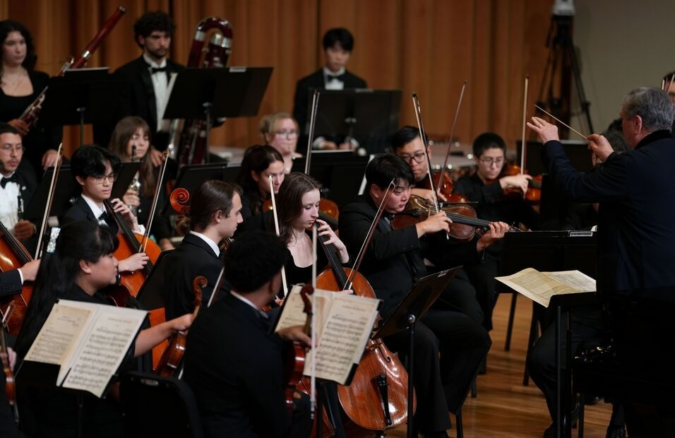
Mozart racing one commission and falling short on another meets Tchaikovsky’s final symphony Saturday night, when the Frost Symphony Orchestra brings three works with different creation stories to Gusman Concert Hall.
Gerard Schwarz conducts a program that begins with Mozart’s “Haffner” Symphony, moves to a flute concerto assembled in part from music he had already written, and closes with Tchaikovsky’s Symphony No. 6, “Pathétique,” premiered just nine days before the composer’s death. Frost doctoral student Chi Ting is the flute soloist. The concert begins at 7:30 p.m. on the University of Miami’s Coral Gables campus.
A symphony written against the clock
Mozart’s Symphony No. 35 in D major, K. 385, known as the “Haffner,” began not as a symphony but as festive music for the Haffner family of Salzburg.
In the summer of 1782, Mozart’s father relayed a commission for music celebrating the ennoblement of Sigmund Haffner the younger. The timing was inconvenient. Mozart was newly married and busy in Vienna, where The Abduction from the Seraglio had just premiered and he was arranging some of its music for wind ensemble.
His letters to his father reveal the pressure. Mozart promised to work “as fast as possible” and sent portions of the music to Salzburg as he completed them. By Aug. 7, the work was finished.
Months later, preparing a Vienna concert of his own, Mozart asked his father to send the Haffner music back. He reshaped the festive piece into the four-movement symphony heard today and expanded its orchestration with flutes and clarinets.
The result became one of the works from Mozart’s Vienna years that survived its original occasion.
A concerto salvaged from an earlier commission
The story behind Mozart’s Flute Concerto in D major, K. 314/285d, involves a deadline he did not meet.
During Mozart’s stay in Mannheim in the winter of 1777-78, Dutch physician and amateur flutist Ferdinand De Jean offered him 200 florins for three concertos and several flute quartets. Mozart famously complained to his father about writing for an instrument he disliked — although scholars have long noted that the remark came while he was explaining why he had fallen behind.
Rather than compose an entirely new second concerto, Mozart returned to an oboe concerto he had written earlier, transposed it from C major to D major and reworked the solo part for flute. The music became K. 314, now a staple of the flute repertoire.
Mozart did not complete the full commission. De Jean ultimately paid him 96 florins rather than the promised 200.
Saturday’s soloist, Chi Ting, is a doctoral student and teaching assistant in the Frost School’s flute studio, where she studies with Jennifer Grim. A native of Taipei, she previously earned a master’s degree at Rice University’s Shepherd School of Music and a bachelor’s degree at the Colburn Conservatory. Ting has performed as a substitute flutist with the Taiwan Philharmonic and as a concerto soloist with the Brevard Music Center Orchestra, and has placed in competitions including the San Diego Flute Guild Young Artist Competition and Pasadena Showcase Instrumental Competition.
A final premiere nine days before death
The concert closes with the work that supplies its title: Tchaikovsky’s Symphony No. 6 in B minor, Op. 74, “Pathétique.”
Tchaikovsky began sketching the symphony in February 1893 and completed the full score at the end of August. He regarded it with unusual affection, telling his nephew Vladimir Davydov that he considered it “the best, and in particular, the most sincere” of his works.
Tchaikovsky conducted the premiere in St. Petersburg on Oct. 28, 1893. The audience response was uncertain enough that he later remarked that the symphony seemed to have caused “some bewilderment,” though he remained more proud of it than any of his other works.
Nine days later, Tchaikovsky was dead at 53. His official cause of death was cholera; later theories that he was forced to take his own life have remained controversial, and documentary scholars have found no conclusive evidence overturning the cholera account.
The Sixth was the last work Tchaikovsky premiered during his lifetime.
The title itself has acquired almost as much lore as the symphony. Tchaikovsky’s brother Modest later claimed to have suggested “Pathétique,” although surviving correspondence has led scholars to question parts of that account.
Schwarz on the podium
Schwarz has led the Frost Symphony Orchestra since joining the Frost School in 2019. He is also conductor laureate of the Seattle Symphony, conductor emeritus of the Mostly Mozart Festival and music director of the Palm Beach Symphony, among other posts.
His recording career spans more than 350 albums, and he has received 14 Grammy nominations along with multiple Emmy Awards.
At Frost, he succeeded longtime orchestral director Thomas Sleeper and leads the school’s student symphony in repertoire ranging from the standard orchestral canon to contemporary works.
If you go…
The Frost Symphony Orchestra performs “Pathétique” at 7:30 p.m. Saturday, Sept. 19, at Gusman Concert Hall on the University of Miami campus. Tickets are $15 to $30.