A year ago, Mayor Vince Lago used his State of the City address to talk about how City Hall was governed.
He spoke about commissioner salaries, city elections, reserves, the millage rate, an inspector general, transparency and civility. “Focus” or “focused” appeared 11 times, making focus the speech’s refrain. Lago closed that portion of the address by promising to “lead with civility and transparency” and protect residents’ money and their voice at City Hall.
On Sept. 17, Lago returned to the Biltmore Hotel and the Coral Gables Chamber of Commerce with a different vocabulary. The recurring subjects were downtown, parks, infrastructure, investment and development. “Focus” disappeared. In its place was the “starting line,” Lago’s repeated metaphor for treating accomplishments as beginnings rather than endpoints. The setting was largely constant: both speeches were delivered at the Biltmore to the Chamber. The emphasis was not.
Placed side by side, the addresses show the center of Lago’s public narrative moving noticeably in a year: from government reform and fiscal guardrails toward physical growth, downtown investment and projects still ahead.
From ‘focus’ to ‘starting line’
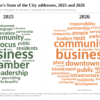
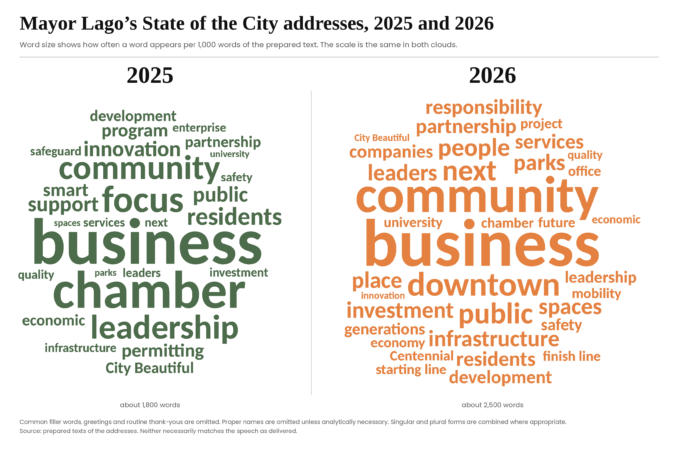
The Gazette analyzed the prepared texts of Lago’s 2025 and 2026 addresses using the same method and combining singular and plural forms where appropriate.
The 2026 speech was roughly 40 percent longer, so raw totals alone can exaggerate changes.
Business is a good example.
“Business” or “businesses” appeared 20 times in 2025 and 29 times this year. Adjusted for the greater length of the 2026 address, business occupied almost exactly the same share of each speech.
Other shifts were much larger.
“Downtown,” counting one possessive use, went from one mention to 14.
“Park” or “parks” went from two to nine.
“Infrastructure” rose from three to nine. “Investment” or “investments” did the same.
“Community” or “communities” rose from 10 mentions to 22.
And the defining language of the 2025 address disappeared. “Focus” or “focused,” used 11 times last year, did not appear at all.
In its place, Lago used “starting line” five times and “finish line” five times, repeatedly turning accomplishments into arguments about what should happen next.
The counts do not explain the speeches by themselves. They show where to look.
A more physical vision of Coral Gables
Where the 2025 speech frequently discussed rules and reforms, the 2026 version was filled with places.
City National Bank’s new headquarters. Firehouse 4. The Mobility Hub. Ponce Circle Park. Sidewalks. Landscaping. Public art. Centennial Park.
Even Lago’s discussion of development was more explicit than a year earlier.
“My record has been consistent,” he said, before arguing that downtown growth should bring residents and economic activity while producing benefits for the public.
“Where appropriate, additional height can be exchanged for meaningful public benefits: parks, open space, wider sidewalks and better gathering places,” Lago said.
Then came a sentence that ties much of the address together:
“Quality of life is not separate from economic development. It is economic development.”
In Lago’s telling, public safety, parks, offices, infrastructure, landscaping and public art are parts of the same economic-development strategy: make Coral Gables a place companies want to locate and workers want to remain. Development fits into that framework as well, with additional height, where appropriate, exchanged for parks, wider sidewalks and other public benefits.
Centennial Park became the most prominent example. Lago described the planned park arising from the city’s agreement with the University of Miami as “the most transformational project of our next chapter.” The broader university agreement also contains land-use provisions affecting the campus. Lago’s address concentrated instead on the public space the city would receive if the agreement takes effect.
The same framing appears throughout the speech. Projects are presented as parts of a larger argument that physical investment, economic development and quality of life reinforce one another.
This comparison does not test those bargains project by project. What matters here is that Lago made that framework explicit in 2026, while it has no real equivalent in the 2025 address.
Last year, the emphasis was City Hall itself
Lago’s 2025 address moved quickly into actions taken inside city government.
He cited the reversal of commissioner salary increases, the coming referendum on moving municipal elections, a new supermajority requirement for spending from General Fund reserves and more than a decade without changing the city’s millage rate.
Later, he turned to the proposed inspector general.
“I will continue to lead with civility and transparency,” Lago said before describing the oversight proposal as another way to strengthen public trust and safeguard taxpayer dollars.
Several of those initiatives continued moving after the speech. In April, voters approved both the change moving municipal elections to November and a charter amendment authorizing Coral Gables to contract for inspector-general services as needed. The inspector-general amendment left the appointment, term, functions and powers to be established by ordinance.
That implementation remains incomplete. The city had not yet adopted the ordinance setting out those details, and commissioners had requested a public Sunshine Meeting to discuss how an inspector general would be selected.
For purposes of comparing the speeches, the contrast is straightforward: an oversight reform Lago placed prominently before the Chamber in 2025 remained a work in progress a year later, while the subject disappeared from the 2026 address.
So did two words closely associated with it.
Neither “civility” nor “transparency” appears in this year’s speech.
The fiscal language moved somewhere else
Perhaps the sharpest contrast involves money.
“Millage,” “reserve” or “reserves,” and “tax” or “taxes” all appeared in the 2025 address.
None appears in the 2026 version.
Neither does “budget,” although that word was absent from the 2025 address as well.
The absence does not mean Lago stopped talking about city finances.
Two nights before the State of the City, commissioners held the first hearing on a proposed $323.3 million fiscal 2027 budget and tentatively kept the property-tax rate at 5.559 mills. The budget and millage measures advanced 4-1 and return Sept. 29 for final consideration.
The following night, at a mayoral candidates forum, Lago made the city’s financial record part of his case for another term, pointing to pension funding, reserves and the millage rate.
Then, less than 24 hours later, those subjects largely disappeared from the State of the City.
The venues help explain some of the difference. A budget hearing is necessarily about revenues and spending. A candidate forum invites candidates to distinguish their records. A Chamber breakfast naturally puts business and investment near the front.
But the three-day sequence also makes something else clear: the change in the State of the City was a change in emphasis, not evidence that fiscal issues had fallen off Lago’s agenda.
What changed was the story
The two addresses ultimately offer different descriptions of what progress looks like.
In 2025, Lago emphasized changes to the way Coral Gables governed itself: fiscal protections, election reform, oversight, transparency and civility.
In 2026, he emphasized what Coral Gables was building and attracting, organized around a broader idea: that quality of life and economic development are parts of the same project.
The closing passages make the difference especially clear.
Last year, Lago promised to protect “your dollars, your neighborhoods, your businesses, and your voice at City Hall.”
This year, he closed by naming City National Bank, Firehouse 4, the Mobility Hub and Centennial Park — and turning each into another beginning.
Neither speech is a comprehensive inventory of Coral Gables government, and neither can be read as one.
But placed side by side, they show how the mayor’s public account of the city changed in a year.
In 2025, the operative word was focus.
In 2026, the operative metaphor was the starting line.