
By Coral Gables Gazette staff
A community meeting convened to discuss additions to an overlay zoning district the City of Coral Gables is proposing to counteract the county’s Rapid Transit Zone (RTZ) reverted to a familiar style for what has become Coral Gables governance, with political accusations, mudslinging and emotions boiling over at points.
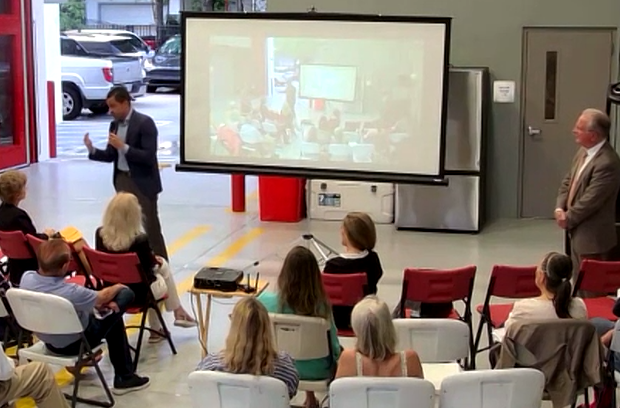
The meeting took place at the new Fire Station No. 4 on Sunset Drive in the evening of April 7 and drew numerous residents who live near the RTZ zone and would be directly impacted by new development. The meeting was also available on Zoom with close to 20 residents watching throughout.
City frames overlay as its last option
Planning and Zoning Director Jennifer Garcia opened the meeting by walking residents through the origins of the RTZ, including the University of Miami Metrorail Station subzone established last year. She explained the city is now proposing to expand its local overlay district to include additional properties around the Mahi Canal.
Although city officials repeatedly framed the overlay as the city’s best, and possibly last, option to retain some control over development, several residents expressed frustration over projects like The Mark (that will be located on what is currently the University Shopping Center) and the broader pace and scale of growth near their neighborhoods.
City officials emphasized that the RTZ, created by Miami-Dade County to encourage transit-oriented development, allows property owners to opt into county jurisdiction effectively bypassing local zoning. City Manager Peter Iglesias described the implications bluntly.
“If they go the RTZ route, that’s basically a Dade County building inside Coral Gables,” Iglesias said. “We don’t control the uses… we don’t control the signage… from a zoning perspective, they’ve taken over certain areas.”
The overlay district, he said, is designed to offer developers an alternative that keeps projects within city review while still allowing increased density. The goal, according to both Iglesias and Mayor Vince Lago, is to preserve local standards and retain millions in impact fees that would otherwise go to the county.
Lago, who described the overlay district as “RTZ lite,” detailed those tradeoffs, noting that projects opting into the RTZ could mean the loss of roughly $6 to $7 million in fees tied to parks, mobility, police, fire, and public art. “If they go the RTZ route, we neither get the money nor control the setbacks, the signage, the height or the design,” he said.
The mayor also stressed the legal reality facing the city. “We are preempted,” Lago said. “Anybody that tells you we can change the RTZ is not telling you the truth… we have to negotiate, because if not, they can circumvent us entirely.”
Residents question strategy — and push for alternatives
But that framing drew sharp pushback from several residents, including Sue Kawalerski, a former member of the city’s Planning and Zoning Board. She questioned both the city’s past actions and its current strategy. She suggested the city should challenge the county more aggressively and even floated the idea of working directly with county officials through the RTZ process.
“I would advocate for residents to ask the county to take this as an RTZ project,” Kawalerski said. “We can go to the county and ask for a better project, because this commission won’t do it for us.”
Exchange between officials and resident escalates
Her comments triggered a heated exchange with Iglesias, who called them “completely incorrect” and then said she was embarrassing herself. Kawalerski and Iglesias had a history going back to last year. At one meeting in 2025, the city manager showed an 18-minute video montage highlighting Kawalerski’s confrontations with staff, fellow board members, and Miami-Dade County Commissioner Raquel Regalado.
The city manager looked ready to continue berating Kawalerski, but was then interrupted by the mayor who referenced her removal from the Planning and Zoning Board.
“She was removed… because she accosted and disrespected a county commissioner,” Lago said. He also dismissed the notion that the county would offer more favorable terms than the city’s negotiated overlay. “The idea that you’re going to get a better deal from the entity that created the RTZ is nonsensical,” Lago said.
Several residents defended Kawalerski and her behavior at the referenced meeting last year. “I didn’t think at all that Sue was disrespectful. I was there, I saw everything,” said one resident, who went on to say that city officials were too deferential to county officials.
Commissioner Melissa Castro, who appointed Kawalerski to the Planning and Zoning Board, was also at the meeting and spoke. She challenged the notion that the city’s hands are tied.
“When somebody tells me there’s nothing I can do… I’m going to ask, how are you fighting this?” Castro said. “I will fight for you guys… (he overlay district) would be my plan B.”
A broader divide over how to confront the RTZ
Beyond governance and legal arguments, residents also raised quality-of-life concerns, including environmental impacts along the canal. Questions about manatee protection and potential marina uses were addressed by staff, who said commercial boat operations would not be allowed and that additional environmental review requirements are already in place.
Still, by the meeting’s end, it was clear that while the overlay district may represent the city’s preferred path forward, it has done little to quell resident concerns or the growing friction between officials and segments of the community over how best to confront the realities of the RTZ.
The tension underscored a broader divide that surfaced repeatedly throughout the evening: whether the city should accept the constraints of county and state preemption or attempt a more confrontational approach.

Author: Coral Gables Gazette News Staff
Originally established in 1996 and relaunched as a digital publication in February 2025, the Coral Gables Gazette is an independent local news organization dedicated to factual, objective and accountable community journalism. Our newsroom reports on the people, policies, institutions and events shaping Coral Gables, Florida, providing residents with timely, informative coverage of the issues affecting their community. Our reporting includes City Hall, local government, municipal elections, public spending, real estate development, business, education, arts and culture, and neighborhood affairs throughout the City Beautiful. We follow City Commission decisions, examine public records and report on the businesses, organizations and individuals contributing to Coral Gables. We believe informed residents are essential to a healthy, engaged community. Stories published under the Coral Gables Gazette News Staff byline are prepared or compiled by the publication's editorial team. We strive for accuracy, fairness, transparency and clear distinctions between news reporting, opinion and advertising. Readers are encouraged to submit news tips, corrections, editorial inquiries and story suggestions through our Contact page and learn more about our standards through our Editorial Policy.











It is extremely difficult for the residents to understand the City’s position. Why did the administration choose not to find a legal way to fight? Our City is known for fighting , spending lots of taxpayers money and losing, even for items that didn’t come from the residents. Remember the WAWA, the plastic bags!!! Did anyone ask the residents about any of those losing battles? Perhaps someone should carefully look at the City Attorney’s past and present expensive outside counsel payments!
I can tell you the problem with that meeting in two words – Vince Lago. When a conman and a bully opens their mouth, people get turned off and tune out. He is absolutely the worst salesman.
I am so sick of Lago and Iglesias repeatedly bringing up that 2025 PZB meeting regarding University Centre/The Mark application for RTZ status, presented by Miami County Commissioner Regalado as ‘already in process’, then blaming board member Sue Kawalerski for what happened. The Landmark Properties Development Team meetings with local residents started in 2023 but I do not recall the Mayor, Vice Mayor, Commissioners, or City Mgr attending any (I attended 5) of those meetings, two years before RTZ was considered as a developer option. Lago and Iglesias’s claims that, “We are doing all we can” and “Our hands are tied” are typical of most the developer-friendly projects currently in various stages in Coral Gables. Stop looking for scapegoats — you all dropped the ball on this issue and the residents are paying the price now.
The personal ad hominin assaults on a resident by Mayor Lago and City Manager Iglesias show a real disregard of the rules of decorum and yet another violation of our City Code – Section 2-81(a)(1) requiring discussion to be confined “to the question under debate”. Silencing dissent is an authoritarian attack on democracy. Mayor Lago’s proposed Charter amendments and his crazy $150,000 vote-by mail (“VBM”) are also attacks on democracy. If we had an independent selection committee chose a city manager as promised by Mayor Lago’s majority, we would not have a city manager assaulting residents by violating our City Code. Unlike normal referendum voting that we had in 2016 with 23,000 voters, Mayor Lago’s 2026 VBM has only 6,000 voters. Mayor Lago’s 2026 VBM and his proposed Charter amendments are an attack on democracy so that Lago will have a better chance of being re-elected as mayor in November with plurality voting (no runoffs) despite his continued City Code violations and resident assaults. He and his real estate developer friends are trying to manipulate our elections for their own self-interest. We should all VOTE NO to the proposed Charter amendments.