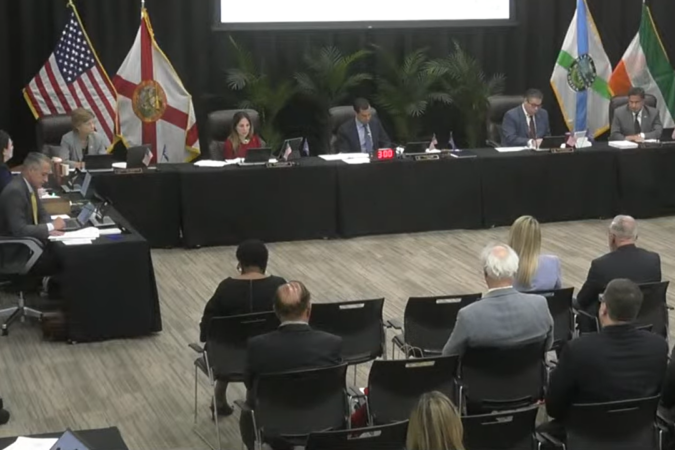
Coral Gables’ proposed property-tax rate failed on its first vote Tuesday night, falling one vote short before a compromise worth nearly $900,000 in refunds and grants brought a fourth commissioner on board.
A separate fight over funding for The Underline followed almost immediately, ultimately taking $500,000 from capital spending after commissioners spent nearly an hour arguing over how much the city should contribute toward the linear park’s maintenance and operations.
A vote that came up short
Commissioners adopted a final budget of $433,309,230 for fiscal year 2027, up from a $318,445,014 estimate the city manager submitted in July. Most of that growth came from $110 million in newly recognized bond proceeds for two capital projects: $40 million for City Hall and $70 million for the Mobility Hub.
The proposed millage rate was 5.5590 mills, the same rate the city has maintained for 12 consecutive years.
Commissioner Ariel Fernandez opened the discussion by arguing for a cut, closer to the 5.39 mills Commissioner Melissa Castro had floated at the prior meeting.
“I’m not willing to keep the millage again this year,” Fernandez said. “I think it’s time to make an effort to reduce the millage rate.”
On the first roll call, Vice Mayor Rhonda Anderson and Commissioner Richard Lara voted yes, joining Mayor Vince Lago. Castro voted no.
Fernandez, who had just argued for a lower rate, said yes when the clerk called his name, then caught himself.
“I meant no,” he said.
Because any rate above the rollback figure required four votes, the ordinance failed 3-2.
The rate stayed the same. Revenue did not.
Holding the millage at 5.5590 is not the same as holding property-tax revenue flat.
The adopted rate is 6.94 percent above the rollback rate of 5.1982 mills — the rate that would generate roughly the same property-tax revenue as the prior year, excluding new construction. As taxable values rise, the city will collect more property-tax revenue even though the millage itself remains unchanged.
The compromise
What followed was roughly an hour of negotiation over what counted as meaningful relief.
“Money is better in the pockets of our residents than it is in the city’s coffers,” Fernandez said.
Anderson countered that a lower millage would deliver its largest dollar benefit to owners of the most expensive properties.
“Increasing homestead exemption helps everybody,” she said, pointing to multimillion-dollar homes that “are going to reap the most benefit from a millage rate reduction, not those who need the help the most.”
Finance staff estimated Castro’s proposed 5.39 rate would have reduced annual property-tax revenue by roughly $4.45 million. A full rollback to 5.1982 would have reduced it by more than $9.5 million.
Amendment 3 also hung over the debate. City projections estimate that the proposed statewide property-tax change would reduce Coral Gables revenue by about $5.7 million in fiscal 2028 and $11.4 million in fiscal 2029 and subsequent years if approved. Lago cited that looming loss in arguing that the city should preserve financial flexibility rather than reduce recurring revenue now. Fernandez drew the opposite lesson, saying the amendment reflected growing pressure for property-tax relief and that the city should respond to residents’ affordability concerns itself.
The debate also turned to the city’s AAA bond ratings and its practice of making accelerated payments toward its unfunded pension liability.
Finance Director Diana Gomez was asked how bond-rating agencies would view a reduction in that extra pension payment while the city also lowered the millage. She pointed to the fiscal practices behind the city’s ratings, including its 25 percent reserve policy and accelerated pension payments.
“In my opinion, those things absolutely will jeopardize our triple AAA rating,” Gomez said.
She later narrowed the point, saying that reducing a policy the rating agencies view as financially strong “could jeopardize our bond ratings.”
The deal that ultimately produced a fourth vote was different: keep the millage at 5.5590, issue a $75 refund to sanitation customers and continue funding the city’s senior relief grant program and its veterans-with-disabilities grant program.
The money would come from savings in the fiscal year ending Sept. 30 rather than the new budget.
Gomez put the cost of the $75 refund at about $846,000, covering roughly 11,280 households, with approximately another $46,000 for the two grant programs.
The combined package was described on the dais as “just under $900,000.”
The millage then passed 4-1.
Castro was the lone no.
“I’m very disappointed, but no,” she said.
Fernandez, Lara, Anderson and Lago voted yes. The relief package passed 5-0 immediately afterward.
A second fight, over The Underline
With the budget still open, commissioners turned to a $1 million request for The Underline’s maintenance and operations in the coming fiscal year.
Lago said the city should commit no more than $500,000 and only for one year.
“I was never under any impression that we would be having to pay for maintenance and overhead,” Lago said. “That completely caught me off guard.”
Earlier that same day, however, Lago had acknowledged that when he backed The Underline years earlier, he had assumed operations and maintenance were already addressed.
“That was my mistake. I own up to it,” Lago said.
The statement contrasted with the city’s own budget discussions a year earlier.
At the Sept. 25, 2025 budget hearing, Lago acknowledged that Coral Gables disagreed with how the maintenance obligation had developed but said the city had reached the point where it would have to deal with the cost.
“It’s not what we agreed upon, I understand, but that train has left the station already,” Lago said then. “We’re beyond that.”
The discussion that night centered on how the city could pay for maintenance, including whether impact-fee money could be redirected. By May of this year, Lago’s position had hardened. “I don’t want to give a dollar,” he told commissioners at the time.
On Tuesday, Lara cited the relief package the commission had just approved in arguing that the city should provide considerably less than the full Underline request.
“Reluctantly and somewhat strong-armed, I took up the offer that Commissioner Fernandez put on the table for the greater good,” Lara said. “I can see funding $200,000.”
Anderson pushed for the full $1 million.
“If you had asked those folks that are residents of Coral Gables, do you want a further reduction in your garbage fee or do you want the Underline funded, I think the answer would have rung completely through that everybody wants the Underline funded,” she said. “You can keep the money for the $75.”
City staff then laid out what finding the full $1 million in recurring capital spending could mean: $400,000 from City Hall project contingency, $100,000 from planned closed-circuit television cameras, $50,000 from new sidewalks, $50,000 from sidewalk extensions and crosswalks, $200,000 from citywide resurfacing and $200,000 from traffic calming.
Deputy Finance Director Paula Rodriguez cautioned that none of the choices was attractive, describing the list as “the least impactful of the impactful reductions to capital.”
Castro argued that the city should provide more than $500,000 without taking the additional money from capital projects.
“They wanted a million. We want 500. Let’s go to $750,000,” Castro said.
She proposed taking the difference from the roughly $9 million the city plans to contribute to the pension above its required payment.
“We’re still funding $9 million extra dollars to the pension,” Castro said. “So it can actually come from there. We don’t have to touch our capital projects.”
The commission did not take that route.
$500,000 comes from capital spending
Commissioners ultimately approved $500,000 for The Underline, funded by reducing capital spending rather than the city’s additional pension payment.
The appropriation was tied to a one-year agreement, with release of the money contingent on Coral Gables securing a seat on The Underline’s governing board whose representative would be selected by the commission.
The city manager was given discretion over which specific capital projects would absorb the cut. The list staff presented for a possible $1 million reduction was therefore illustrative, not the final list of projects that will lose funding.
The amended budget passed 4-1. Lara, Anderson, Fernandez and Lago voted yes. Castro voted no.
“I tried to reach a compromise,” Castro said. “It didn’t happen.”
Minutes later, the resolution adopting the city’s 2027-2031 Capital Improvement Program, amended to account for the $500,000 reduction, passed 5-0. Castro joined the other commissioners in supporting it despite opposing the amount moments earlier.
Closing the hearing
After nearly three hours, Lago apologized to city employees for what he called “the circus.”
He said that in nearly 14 years in public office there had been few occasions when he felt “strongarmed on the commission floor.”
“We sacrifice capital projects to ensure that we protect your pensions,” Lago said speaking to city employees.
The commission adjourned shortly afterward, having preserved a millage rate that failed on its first vote, approved nearly $900,000 in household and targeted relief and committed $500,000 to The Underline — all in a budget whose final shape was still being negotiated minutes before its adoption.