By Coral Gables Gazette staff
Before World War II, Florida was still a largely rural state where fewer than 2 percent of Americans lived. By the end of the war, it had become a major hub for military training, war industry and coastal defense — a transformation Miami military historian Anthony D. Atwood will discuss in Coral Gables this week.
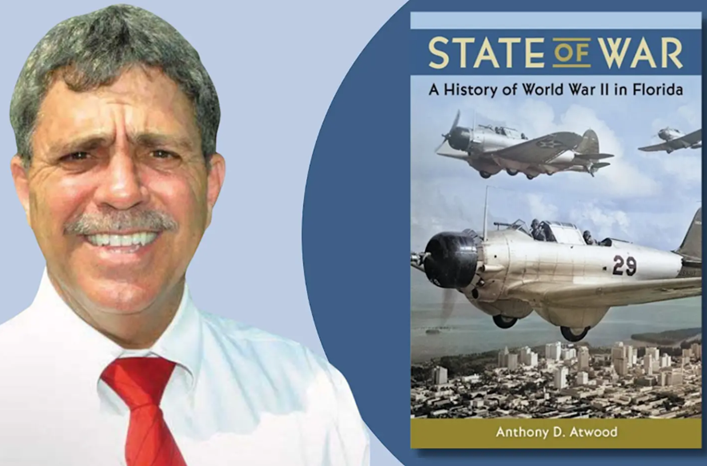
Atwood, founder of the Miami-Dade Military Museum and Memorial, will discuss his debut book, State of War: A History of World War II in Florida, Friday, July 10, at 7 p.m. at Books & Books Coral Gables. The event is free and open to the public, with copies available for purchase.
A state remade by war
Published by University Press of Florida, Atwood’s book examines how Florida’s geography, climate and terrain made it uniquely suited to the demands of a global war. Its long coastline near critical shipping lanes gave it strategic importance, while its year-round flying weather and open land made it ideal for pilot training, bombing ranges and military bases.
By the war’s end, Florida was home to more than 250 military installations. The state also served as headquarters for the Gulf Sea Frontier, the Navy command responsible for hunting German U-boats operating close to American shores.
The book draws on historic photographs, military archives and wartime newspaper reporting to trace how the war reshaped Florida’s population, economy and public life. Atwood also explores the war’s social dimensions, including the entrance of women into shipyards and aircraft plants and the experience of Black Floridians who served their country while pressing for civil rights at home.
Some of the book’s episodes are likely to surprise even longtime Florida residents. Atwood writes that pilots who trained for the Doolittle Raid and crews later involved in the atomic bombing missions trained in Florida skies. He also traces Miami’s role in cargo flights supplying China over the dangerous “hump” route, Florida beaches used to practice amphibious landing tactics later associated with Normandy, and a Navy pipeline built to supply Key West with reliable fresh water.
A legacy that endures
The book connects Florida’s wartime buildup to the state’s modern military footprint. Atwood traces how wartime airfields became commercial airports, how military installations reshaped local economies and how the naval air station at Cape Canaveral helped set the stage for the space program.
Florida today remains deeply connected to the military, with major defense commands, a large veteran population and institutions whose roots reach back to the wartime expansion Atwood documents.
About the author
Atwood is a third-generation Floridian and a retired Navy Chief Warrant Officer. In addition to founding and leading the Miami-Dade Military Museum and Memorial, he serves as resident military historian at the Jack D. Gordon Institute for Public Policy at Florida International University.
Research for State of War was supported in part by the Michael V. Gannon Fund, named for the historian who spent decades documenting Florida’s past.
What to expect Friday
Friday’s event is a book discussion and signing, with Atwood expected to speak about the research behind State of War and Florida’s overlooked role in World War II. Admission is free, but seating is limited, and organizers recommend arriving early. An RSVP guarantees entry but not a seat.
What to know
Anthony D. Atwood will discuss State of War: A History of World War II in Florida at 7 p.m. Friday, July 10, at Books & Books, 265 Aragon Ave., Coral Gables. The event is free and open to the public. The book is available in hardcover, paperback and e-book editions.

Author: Coral Gables Gazette News Staff
Originally established in 1996 and relaunched as a digital publication in February 2025, the Coral Gables Gazette is an independent local news organization dedicated to factual, objective and accountable community journalism. Our newsroom reports on the people, policies, institutions and events shaping Coral Gables, Florida, providing residents with timely, informative coverage of the issues affecting their community. Our reporting includes City Hall, local government, municipal elections, public spending, real estate development, business, education, arts and culture, and neighborhood affairs throughout the City Beautiful. We follow City Commission decisions, examine public records and report on the businesses, organizations and individuals contributing to Coral Gables. We believe informed residents are essential to a healthy, engaged community. Stories published under the Coral Gables Gazette News Staff byline are prepared or compiled by the publication's editorial team. We strive for accuracy, fairness, transparency and clear distinctions between news reporting, opinion and advertising. Readers are encouraged to submit news tips, corrections, editorial inquiries and story suggestions through our Contact page and learn more about our standards through our Editorial Policy.