Coral Gables voters gave Mayor Vince Lago the three candidate victories he wanted Tuesday. But they rejected his proposals to lengthen the mayor’s term and give City Hall greater latitude in awarding public-works contracts.
The contrast suggests a distinction between support for elected officials and willingness to expand their authority. Voters returned Lago to office and elected both commission candidates he endorsed. On the charter, they preserved two existing constraints on municipal government and approved two amendments imposing additional requirements.
The results are consistent with skepticism about giving City Hall greater discretion, even among an electorate willing to support its political leadership. They do not establish that distrust motivated individual votes.
The clearest evidence came in the referendum on four-year mayoral terms. Support for the proposal tended to be strongest in precincts where Lago performed best. Yet the amendment received a smaller percentage than the mayor himself in every one of the city’s 16 precincts.
The candidate races revealed different patterns. Lago received 56.8 percent, nearly matching his share in 2025 despite a much larger electorate. Dominique “Nikki” Whiting won the open Group V commission seat with 56.0 percent. Nestor Menendez, endorsed by Lago and backed by more than eight times as much campaign spending as his opponent, unseated Commissioner Melissa Castro by just 121 votes.
The Miami-Dade County Elections Department results remain preliminary and unofficial until certified.
Twice as many mayoral votes, nearly the same result
Lago’s reelection was not unexpected. The size of his victory was more revealing.
The mayor received 56.8 percent against Laureano Cancio and Jackson “Rip” Holmes, two repeat candidates with limited campaign resources. That was barely above the 55.5 percent he received in April 2025 against Kirk Menendez, then a sitting commissioner with an established record of his own.
The difference was just 1.3 percentage points.
The electorate, meanwhile, had changed dramatically.
Coral Gables’ first November municipal election nearly doubled participation in the mayoral contest. Valid votes rose from 10,054 in April 2025 to 19,904 on Tuesday, an increase of 98 percent.
Those votes represented 65.1 percent of the 30,594 registered voters Miami-Dade County reported on Oct. 1, compared with 29.4 percent in 2025. The figures measure participation in the mayoral contest rather than overall turnout, which includes ballots without a valid vote for mayor.
Participation increased in every precinct, from 59.5 percent in Precinct 608 (Country Club of Coral Gables) to 202.7 percent in Precinct 633 (Wesley United Methodist Church).
Yet the larger electorate produced almost the same mayoral vote share.
Lago received 11,298 votes, compared with 5,577 in 2025. He finished first in all 16 precincts, winning outright majorities in 14. He did best on Election Day, receiving 59.9 percent of those votes, compared with 57.3 percent of early votes and 53.9 percent of mail votes.
His political advantages were substantial.
First elected to the commission in 2013 and mayor in 2021, Lago had years of citywide exposure, a governing record and an established fundraising organization. His campaign and Coral Gables First, a separate political committee associated with him, spent $182,664 during the final reporting period alone.
Cancio and Holmes had neither comparable resources nor incumbent records. Cancio received 4.5 percent in a 2025 commission race, while Holmes received 6.7 percent in a 2023 commission contest.
On Tuesday, the two received a combined 43.2 percent.
Their votes cannot automatically be classified as opposition to Lago’s record. Both offered their own criticisms and policy positions, and the returns do not disclose why individual residents supported them.
Still, the similarity between the two mayoral elections deserves attention. Against different opponents, including two lightly financed challengers this year, Lago attracted almost precisely the same proportion of voters.
His majority proved durable. So did the aggregate share choosing someone else, even as the electorate and candidate field changed.
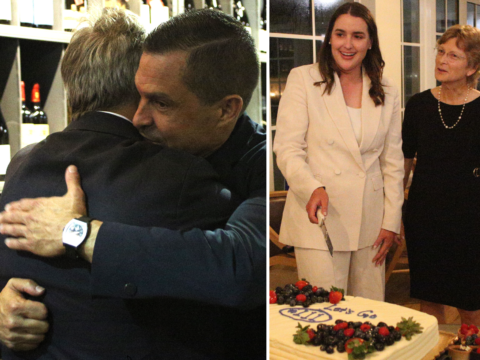
At his election-night celebration, Lago declared, “This is a mandate.”
Castro again resisted the mayor’s political organization
The Group IV race presented the election’s greatest contrast between campaign spending and electoral margin.
Menendez spent $132,639 through Oct. 29, compared with Castro’s $15,805, an advantage of more than eight to one.
He had Lago’s endorsement, professional consultants and extensive mail and digital outreach. Coral Gables First separately financed advertising and a website criticizing Castro’s record and conduct at City Hall.
The resources gave Menendez substantial capacity to introduce himself, communicate his positions and attack the incumbent’s record.
But Castro had confronted a similar financial disadvantage before.
In 2023, she faced Ivette Arango O’Doski, another candidate endorsed by Lago. O’Doski raised $222,350 in monetary contributions, compared with $19,160 for Castro.
Castro trailed in the initial four-candidate election but won the runoff with 59.2 percent.
That victory occurred before she had served a day on the commission.
Three and a half years later, she had developed a recognizable political identity as one of Lago’s most persistent critics. Their disagreements over development, spending and city management frequently played out in public commission meetings.
Her supporters regarded her willingness to challenge the mayor and commission majority as evidence of independence. Critics questioned her judgment and characterized the repeated confrontations as unnecessary conflict.
The Miami Herald editorial board endorsed Castro, acknowledging reservations about her record while emphasizing the value of dissent. She also received support from Coral Gables Democrats, Miami Realtors and the city’s police and firefighters unions.
Her record included a state ethics case. In January, the Florida Commission on Ethics found probable cause to pursue an allegation involving her permit-expediting business. The commission emphasized that probable cause did not establish a violation. Castro has denied wrongdoing.
The election therefore presented voters with competing assessments of an established commissioner.
Her history of challenging Lago, her political following and her experience competing against better-financed opponents may help explain why the Group IV race remained close. Another possibility, which the returns cannot prove, is that some residents supported Lago for mayor while also valuing Castro as an independent voice on the commission.
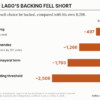
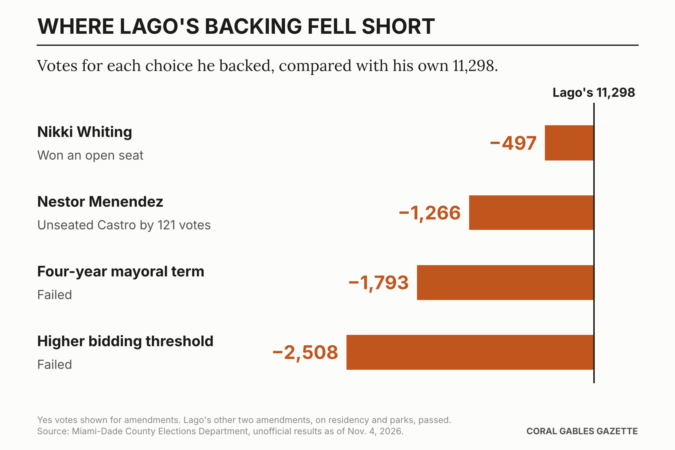
At least 1,266 people who voted for Lago did not vote for Menendez. That is the difference between the mayor’s 11,298 votes and Menendez’s 10,032. Some may have supported Castro; others may have skipped Group IV.
Menendez received a smaller share than Lago in 15 of the 16 precincts.
In 12, the difference was less than nine percentage points. The three largest gaps occurred in Precinct 617 (Coral Gables Fire Station 3), where Menendez trailed Lago’s share by 13.3 points; Precinct 618 (Pinecrest Branch Library), where the gap reached 17.2 points; and Precinct 635 (Christ Congregational Church), where it reached 20.8 points.
In Precinct 635, Lago received 63.6 percent of the mayoral vote, but Castro defeated Menendez, 267 votes to 200.
The voting-method totals revealed a similarly divided electorate.
Castro won mail ballots by 243 votes. Menendez overcame that advantage with a 139-vote lead in early voting and a 225-vote lead on Election Day.
Menendez carried 10 precincts and Castro six. His largest margins were 177 votes in Precinct 608 and 174 in Precinct 615 (Coco Plum Woman’s Club). Castro countered with a 230-vote advantage in Precinct 633 and 174 in Precinct 604 (American Legion Post 98).
Those local margins nearly canceled one another.
Menendez finished with 10,032 votes to Castro’s 9,911, a difference of 121 votes out of 19,943 cast.
“The divisiveness, the tribalness, it’s over,” Menendez told supporters on election night. “We have our differences and we will not always agree, but we share a love for Coral Gables and that should always be stronger than anything that divides us.”
Before the polls closed, Castro posted a message to supporters: “On this Election Day, regardless of the outcome, I already feel incredibly blessed.”
For a second time in three years, Castro proved competitive against a substantially better-financed candidate backed by the mayor. This time, her opponent finished ahead.
Whiting won an open seat with support close to Lago’s
The Group V race produced a substantially wider result.
Whiting received 56.0 percent, nearly identical to Lago’s 56.8 percent, and defeated Gonzalo Sanabria by 2,322 votes.
She carried 14 of the city’s 16 precincts. Her vote share exceeded Lago’s in eight precincts and trailed his in eight. In 14 precincts, the two candidates’ shares were within six percentage points of one another.
Whiting also received remarkably consistent support across voting methods: 55.3 percent among mail voters, 56.5 percent among early voters and 56.1 percent on Election Day.
Her campaign spent $93,040 through Oct. 29, compared with Sanabria’s $32,291, an advantage approaching three to one.
Menendez enjoyed the much larger financial advantage in Group IV but won by a far smaller margin.
That difference illustrates why spending alone cannot explain either contest.
The clearest distinction between the races was Castro herself.
She had already defeated a Lago-endorsed candidate and developed a recognizable record as a commissioner. Group V, by contrast, was an open-seat contest between two candidates without commission voting records.
Whiting brought experience in government and political communications. Sanabria had served on the city’s Planning and Zoning Board.
Their endorsements pointed in different directions. Lago and Vice Mayor Rhonda Anderson backed Whiting, while the Miami Herald editorial board endorsed Sanabria.
Whiting emphasized fiscal stability, pension obligations and maintaining city assets, including the Granada Golf Course. Sanabria raised concerns about the Mobility Hub, downtown parking changes, development oversight and the city’s finances.
The results do not establish which endorsements, experiences or campaign messages were decisive.
Nor did Whiting reproduce Lago’s support in every precinct.
In Precinct 618, the mayor received his highest share, 68.4 percent. Yet Sanabria defeated Whiting there, 384 votes to 336.
The contrast between Group IV and Group V illustrates how the particular candidates and their histories can shape a contest’s circumstances, even when one side benefits from the same mayoral endorsement.
Charter votes kept two limits on City Hall in place
The four charter questions produced a different pattern from the candidate races.
All four were sponsored by Lago and placed on the ballot by unanimous commission votes. Two passed and two failed.
The results are consistent with skepticism toward loosening government constraints. Voters rejected the two proposed changes that would have given mayors longer terms or allowed more public-works projects to proceed without the charter’s existing formal solicitation requirement. They approved two proposals imposing additional residency and parkland requirements.
That does not establish a common motive. The questions concerned different rules and could have attracted support or opposition for different reasons.
But their effects, and the geographic patterns of the votes, are revealing.
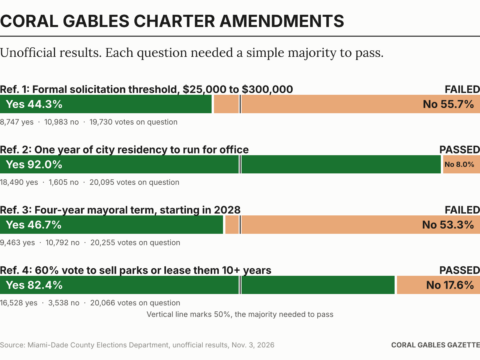
The proposal to extend mayoral terms from two years to four received 46.7 percent support and was rejected with 53.3 percent opposed.
Among the four charter measures, its precinct support most closely resembled Lago’s geographic pattern. Areas where he performed strongly generally gave the amendment more support.
Yet the proposal trailed Lago’s own percentage in every precinct, by margins ranging from 4.7 to 17.9 percentage points.
The amendment passed in only five precincts, four of them among Lago’s five strongest.
In Precinct 618, where Lago received 68.4 percent, the longer-term proposal attracted just 50.5 percent, a gap of 17.9 percentage points.
The distinction also held in actual votes.
Lago received 11,298 votes. The amendment received 9,505 Yes votes, a difference of 1,793.
In every precinct, Lago received more votes than the proposal received Yes votes.
That establishes that at least some Lago supporters in each precinct did not support the amendment. It does not establish whether they voted No or skipped the question.
The measure would have applied beginning in 2028 and would not have extended Lago’s own eligibility under the city’s existing consecutive-service limit.
Coral Gables had tried four-year mayoral terms before. Voters approved them in 2005, then restored two-year terms in 2009 by 73 votes.
The Gazette’s Sept. 24 editorial opposed this year’s amendment, arguing that electing the mayor every two years places three of the commission’s five seats before voters at every regular election, preserving an opportunity to change its majority.
The proposed increase in the formal public-works solicitation threshold also failed.
It would have raised the threshold from $25,000 to $300,000, subject to other applicable procurement laws and requirements. The measure received 44.3 percent support and was rejected in all 16 precincts.
Lago received 2,508 more votes than the proposal received Yes votes.
The other two amendments passed in every precinct.
The candidate residency amendment received 92.0 percent support. It tightened the existing one-year residency qualification by requiring continuous city residence for at least one year immediately before the end of qualifying, rather than measuring the one-year period before Election Day.
The parkland amendment received 82.4 percent. It requires 60 percent voter approval in a citywide special election for specified sales, transfers and leases of 10 years or more involving covered city-owned parks and recreational property.
The parkland restriction was Lago’s own proposal.
He told the Miami Herald that he pursued it because he was “tired of the politics … and the fake news that was being spewed about my intentions for the city.”
That origin matters. The electorate approved an additional restriction sponsored by the mayor while rejecting two other changes he advocated.
The four questions appeared at the end of a lengthy general-election ballot. Nevertheless, three drew more valid votes than the mayoral contest, and the fourth received only 76 fewer.
The results therefore do not support a simple assumption that voters ignored the charter proposals because of their position on the ballot.
Support for leaders, caution about authority
The seven decisions reveal a distinction between electoral support and the willingness to change the rules under which City Hall operates.
Lago’s majority held almost steady as participation in the mayoral contest nearly doubled. Whiting won an open seat with a share nearly identical to the mayor’s. Menendez faced a commissioner who had beaten Lago’s preferred candidate once before, and his substantial financial advantage accompanied a victory of just 121 votes.
The returns cannot prove why those races produced different margins. Castro’s established constituency, her record of opposition to Lago and her previous electoral success provide important context.
On the charter, voters retained the two-year mayoral term and the existing formal public-works solicitation threshold. They also approved tighter candidate residency requirements and a new voter-approval requirement for covered parkland transactions.
In the same election, voters backed the mayor’s candidates and kept the two existing limits his amendments would have loosened. The one new limit on City Hall they approved, restricting certain parkland transactions, was Lago’s own proposal.
Results reflect Miami-Dade County’s Nov. 4 preliminary returns and remain subject to canvassing and certification. Names in parentheses are each precinct’s assigned Election Day polling place, not where its voters live; some polling places are outside city limits.

Author: Coral Gables Gazette News Staff
Originally established in 1996 and relaunched as a digital publication in February 2025, the Coral Gables Gazette is an independent local news organization dedicated to factual, objective and accountable community journalism. Our newsroom reports on the people, policies, institutions and events shaping Coral Gables, Florida, providing residents with timely, informative coverage of the issues affecting their community. Our reporting includes City Hall, local government, municipal elections, public spending, real estate development, business, education, arts and culture, and neighborhood affairs throughout the City Beautiful. We follow City Commission decisions, examine public records and report on the businesses, organizations and individuals contributing to Coral Gables. We believe informed residents are essential to a healthy, engaged community. Stories published under the Coral Gables Gazette News Staff byline are prepared or compiled by the publication's editorial team. We strive for accuracy, fairness, transparency and clear distinctions between news reporting, opinion and advertising. Readers are encouraged to submit news tips, corrections, editorial inquiries and story suggestions through our Contact page and learn more about our standards through our Editorial Policy.