
By Coral Gables Gazette editorial board
A few hours can reveal a great deal about municipal government.
At the May 19 Coral Gables Commission meeting, Commissioner Ariel Fernandez pointed to the city’s 2024 garbage fee reduction as evidence that elected officials had delivered tangible relief for residents. It was, he noted, the first such reduction in city history.
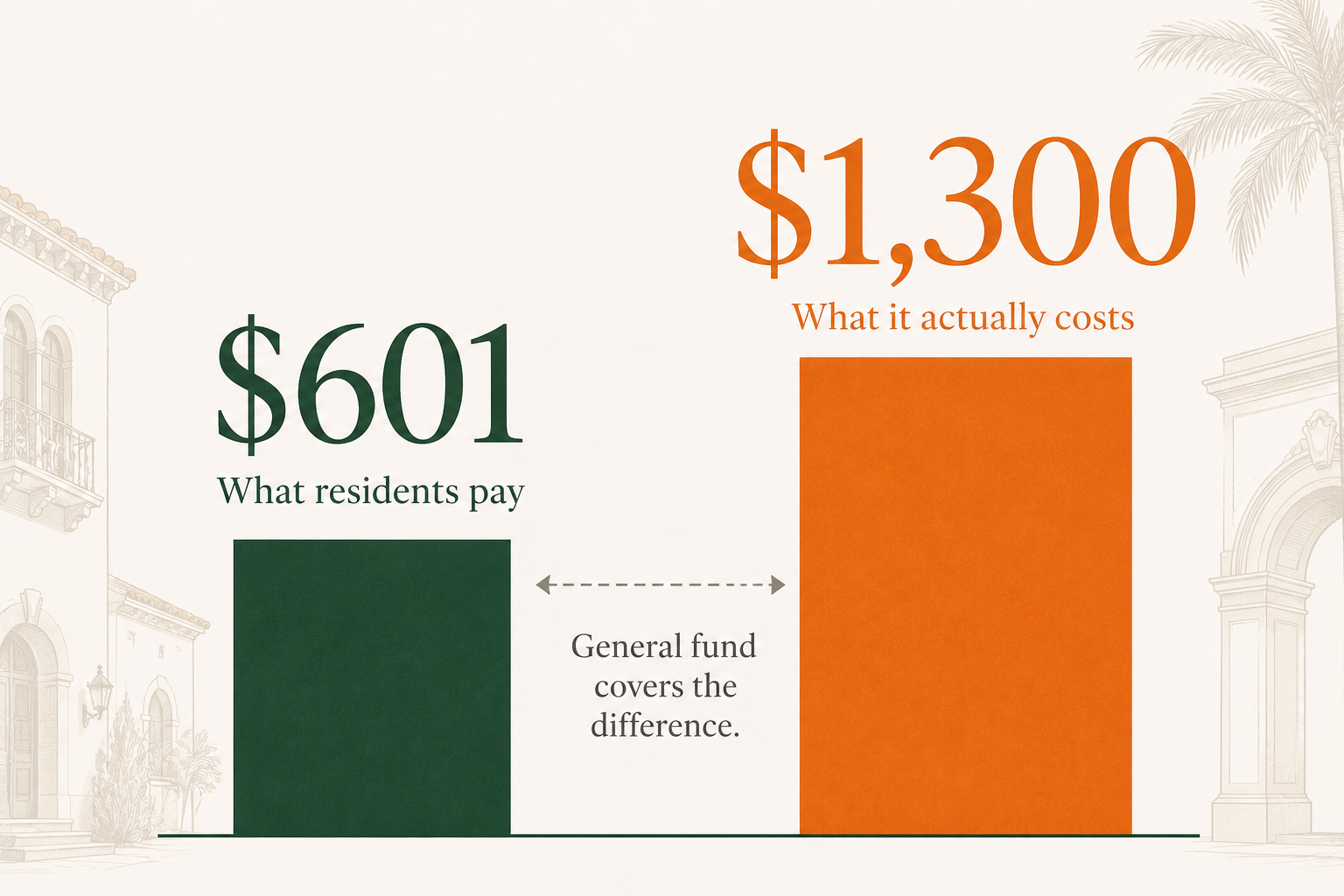
Five hours later, with little discussion and no visible debate over alternatives, the commission voted 4-0 to advance a preliminary 4 percent increase for the coming fiscal year, raising the annual residential solid waste assessment to $601 per dwelling unit, or $572 for residents who pay before August 15. Mayor Vince Lago had already departed the meeting.
The increase itself may be justified. City Finance Director Diana Gomez explained that rising personnel, fuel, vehicle maintenance and disposal costs are driving the adjustment. That is a straightforward accounting of inflationary pressure on a service-delivery operation, and it deserves to be taken at face value.
But Gomez offered a second number that received far less attention than it should have. When Vice Mayor Rhonda Anderson asked what residents would pay if the city charged the full cost of service, Gomez’s answer was unambiguous: roughly $1,300 per household annually. Residents are currently assessed $601 — less than half the actual cost of the service they receive. The city absorbs the remainder through general tax revenues.
That number is the conversation Coral Gables has not yet had.
The $601 assessment is not a secret, and the gap between it and the $1,300 full-cost figure is a policy choice. It may well be the right one. Coral Gables residents pay substantial property taxes, and there is a legitimate argument — made plainly by resident Maria Cruz at the May 19 meeting — that those taxes should fund services residents value without the city layering on fees that approach full cost recovery. That argument deserves to be taken seriously.
But it also deserves to be made explicitly, publicly, and on the record — not left implicit in a brief exchange before a unanimous vote with minimal deliberation.
Garbage collection occupies a peculiar place in municipal finance. It is one of the few city services every resident experiences directly and regularly. Trash is visible, tangible, and arrives each week at the curb. That makes it more than a line item. It is part of the everyday contract between residents and their government — and when that contract is adjusted, residents deserve more than a technically sufficient explanation.
Has the commission formally articulated its position on the relationship between the solid waste fee and the actual cost of service? Is the current gap intentional policy or accumulated drift? Does the commission believe the fee should eventually approach full cost recovery, or does it view the general fund subsidy as permanent and appropriate? What would it take — in operational cost increases, in budget pressures, in competing priorities — for the calculus to change?
These are not abstract questions. The difference between $601 and $1,300 is being absorbed silently by the general fund, where it competes with every other priority in the city budget — parks, public safety, infrastructure, and the capital projects the commission regularly champions. Residents who follow the garbage fee line in their tax bill have no way of knowing that the true cost of their collection is more than twice what they are paying, or that the difference is drawn from the same pool of money that funds everything else.
Cruz was right when she reminded commissioners that residents already contribute significant tax dollars to city services. Her point was that residents deserve an honest public conversation about tradeoffs — including whether rising sanitation costs should be offset elsewhere in the budget before being passed directly to households. That is precisely the conversation the May 19 vote did not produce.
A 4 percent adjustment tied to documented cost increases is defensible on its face. The Gazette is asking that the commission explain clearly what its policy is, why the gap between that cost and the assessed fee is being maintained at its current level, and what residents should expect in future years.
Coral Gables has rightly built a reputation for high service levels and responsive municipal operations. Residents generally accept paying a premium when they can see the value returned. That trust is a public asset, and like any public asset it requires maintenance.
Good government is measured by whether it treats residents as informed stakeholders rather than passive ratepayers.









Stop spending on woke so called quality of life items such as for all kinds of dog parks and art in public places and subsidies for every social activity and use the funds to make trash pickup free for all homeowners. Now there’s a novel idea.
trash pick up should actually be more expensive so that people finally start to think about all the useful stuff that they discard. stroll around the gables on a wednesday or thursday, look at the so-called “trash” piles and see how well off residence are while complaining about expenses left and right. many of those piles are filled with valuable, often new stuff. buy less – repurpose – offer it to others. especially if one has children. they will need to deal with our carelessness some day.
we post the items that we no longer need online for free pick up (craigslist, offerup, nextdoor, for example). big or small, heavily used or not, everything, seriously everything finds a new owner and gets picked up. we would be embarrassed to put anything else than yard stuff out on the street for pick up.
Are you counting those people that don’t pay for tje garbage collection. If people don’t paying they should be fine . But not apply the increase because do.e people don’t paid
Do residents REALLY need garbage holiday pick-up? I imagine that we’re paying overtime rates on a dozen holidays when every household can survive on just a weekly pick-up periodically. Let’s start there.
We need better control of non residents comimg to our city and dumping garbage on pits; especially gardeners dumping all the trash from outside gables
I have noticed this happening as well