
By Coral Gables Gazette staff
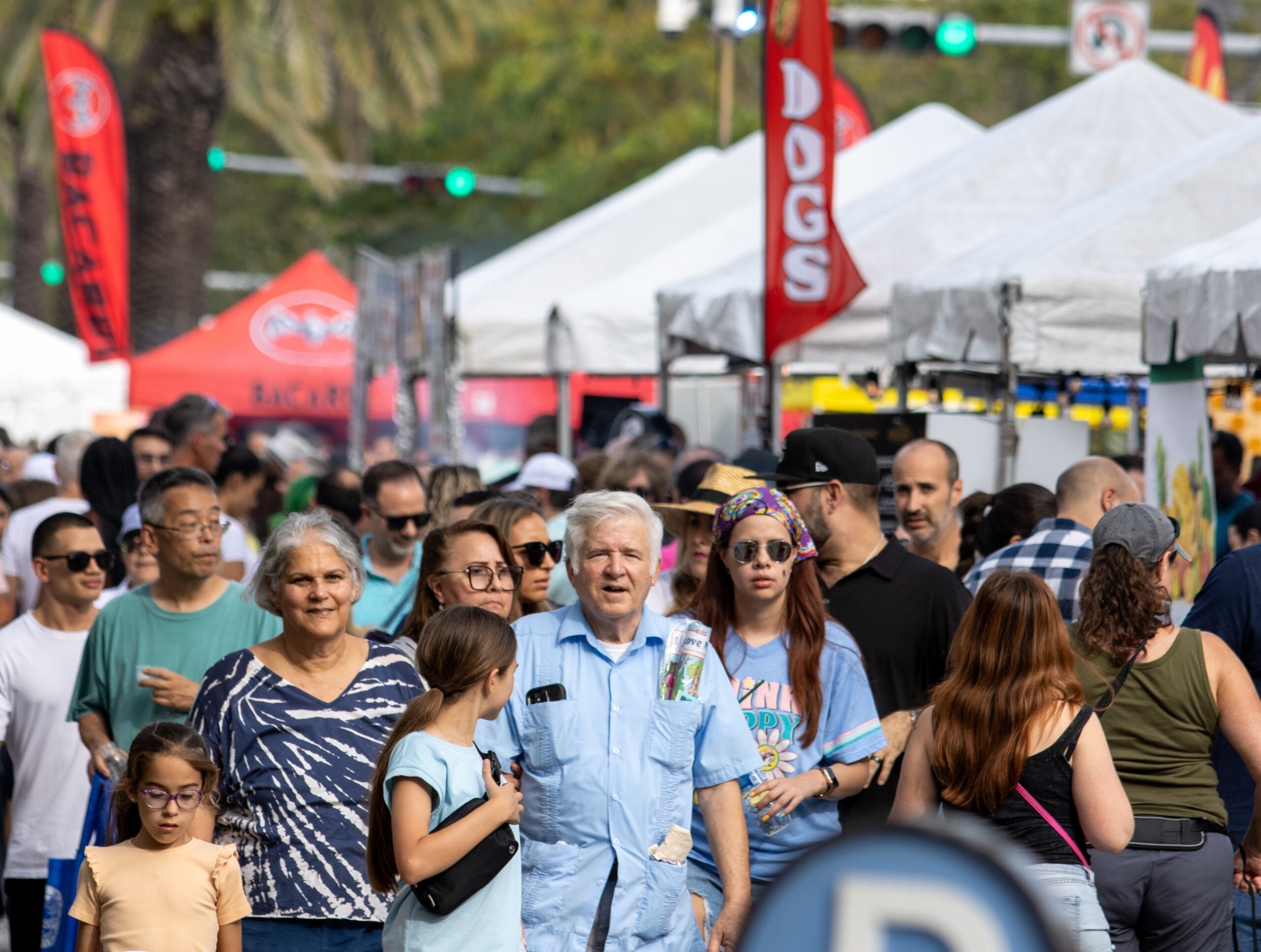
Carnaval on the Mile, the free annual street festival that transforms Miracle Mile into a showcase of live music, regional art, and culinary culture, returns to Coral Gables this Saturday and Sunday, March 7 and 8, from 10 a.m. to 10 p.m. Saturday and 10 a.m. to 7 p.m. Sunday.
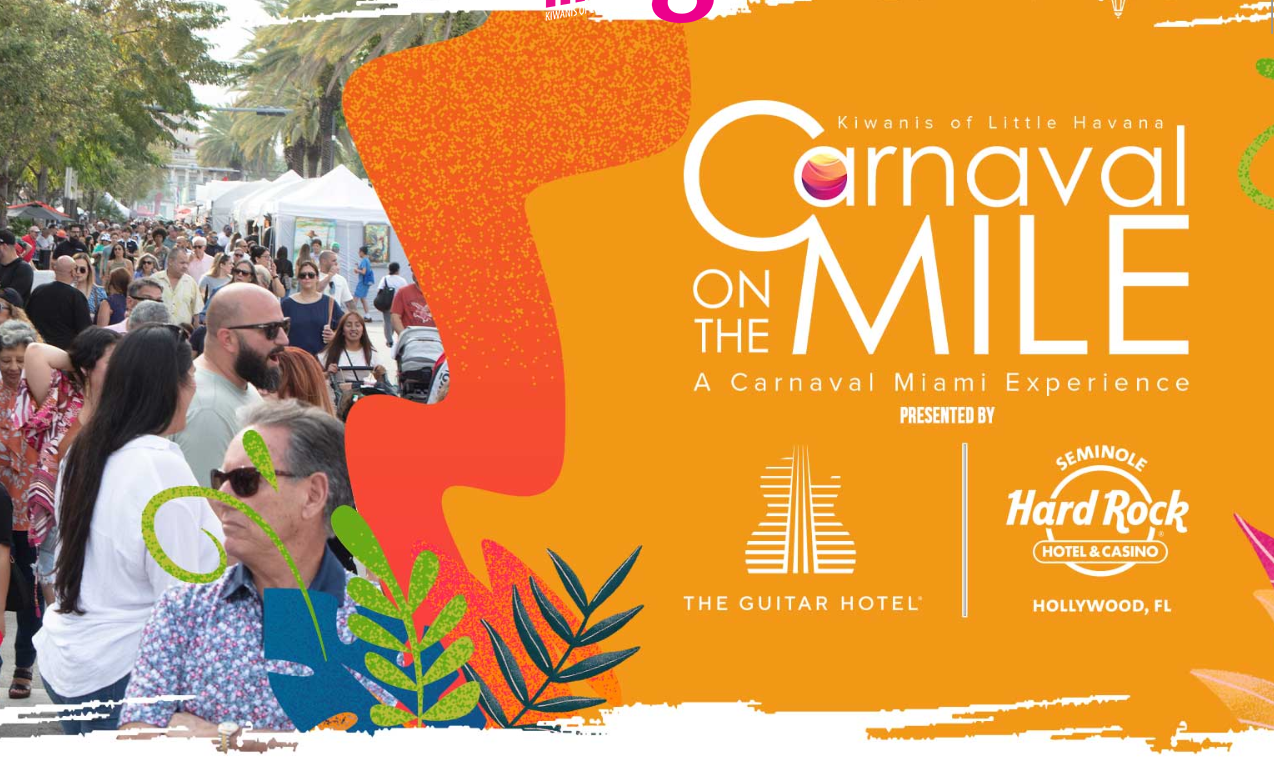
Now in its 27th year, the festival is presented by Seminole Hard Rock Hotel & Casino and organized by the Kiwanis Club of Little Havana — the same nonprofit that in 1978 launched the Calle Ocho Music Festival from a conversation on a paper napkin. Carnaval on the Mile is both a warm-up act for Calle Ocho, which takes place the following Saturday, March 15, and a substantial cultural event in its own right: three concert stages, more than 150 juried artists, dozens of food vendors, family programming, and a confirmed lineup that includes a Latin Grammy winner, a Grammy-associated Cuban piano legend, and a soul-jazz band from Seattle with Billboard chart-topping albums. Admission is free.
The performers: Range, depth and at least one Grammy
The confirmed lineup for 2026 is notably eclectic, which has long been one of the festival’s distinguishing characteristics. Carnaval on the Mile does not present a single musical tradition but a deliberately varied program that reflects the actual breadth of Miami’s cultural landscape.
Daniela Padrón, the Venezuelan-American violinist based in Miami Beach, arrives as one of the event’s most decorated performers. In 2025, Padrón won her first Latin Grammy for Best Folk Album for Joropango, recorded with the band Kerreke — a win that capped a decade of acclaimed work in South Florida and beyond. She has released six solo albums, collaborated with artists including Willie Colón and Aymée Nuviola, and in September 2025 was honored by the City of Miami Beach, which officially proclaimed Daniela Padrón Day in recognition of her artistic contributions and educational work. She also serves as a governor of the Florida Chapter of the Recording Academy and a mentor in the Grammy U program.
Tony Pérez, described on the program as a two-time Latin Grammy-winning pianist, is one of the most accomplished Cuban jazz pianists working today. Born in Sancti Spíritus, Cuba, Pérez trained at Cuba’s National School of Arts before rising to lead Irakere — the most internationally celebrated Cuban jazz ensemble of its era — after Chucho Valdés selected him as his successor in 1998. He has recorded with the Fania Allstars, Celia Cruz, and Giraldo Piloto’s Klimax, among others, and participated in La Rumba Soy Yo, the all-star recording that won at the 2001 Latin Music Awards.
The Delvon Lamarr Organ Trio brings a different temperature entirely. The Seattle-based group, founded in 2015 by organist Delvon Lamarr with his wife and manager Amy Novo, plays what they describe as feel-good music: a blend of 1960s soul-jazz organ tradition, Booker T. & the M.G.’s-style funk, Motown, Stax, and blues. Their debut album, Close But No Cigar, reached number one on Billboard’s Contemporary Jazz Albums chart; their 2021 follow-up, I Told You So, repeated that feat. At an outdoor street festival, their sound — groove-driven, melodic, built for physical response — is a booking choice that reflects shrewd programming.
Puerto Rican conga duo Daniel Díaz and Jafet Murguía, performing with their band Los Potritos, round out the confirmed roster.
The mile of art, the food and the Kidz Nook
The East and West Ponce Artists Village anchor the visual arts programming. More than 150 juried exhibitors will display original paintings, sculpture, photography, jewelry, and crafts along Miracle Mile across both days — the kind of density that turns the festival into a genuine arts fair rather than a backdrop for the music stages.
The 2026 Carnaval Miami poster, created by official poster artist Maria Fernanda Vogel and titled Llegamos Bailando, will also be featured. The original work, which Vogel has described as capturing the spirit of Carnaval Miami through color, rhythm, and joy, will be auctioned to benefit the Kiwanis of Little Havana Foundation’s educational and community programs.
More than 50 food and drink vendors will line the festival footprint, with an emphasis on Miami’s global culinary range alongside festival staples. The Kidz Nook, presented by Academica, returns with interactive games, face painting, a petting zoo, and live performances — and this year adds the inaugural Carnaval Miami Greatest Kids Show, a new feature that has not previously appeared in the festival’s history.
A festival born on a paper napkin, now a civic institution
The Kiwanis Club of Little Havana was founded in 1975, making it the oldest continuously meeting Latin Kiwanis club in the United States. Three years after its founding, in 1978, a small group of members gathered at Centro Vasco restaurant in Little Havana to brainstorm how to ease ethnic tensions in the city and bring communities together. Ideas were jotted on a paper napkin. What emerged was Calle Ocho — now the largest Hispanic street festival in the United States, drawing more than one million attendees annually and carrying a $40 million annual economic impact.
Carnaval on the Mile came later, born from a partnership with The Miami Herald and designed to expand the Carnaval Miami footprint into Coral Gables. Where Calle Ocho is massive and rooted in Little Havana’s street culture, Carnaval on the Mile has always carried a slightly different character — an outdoor arts fair with a robust music program, drawing Coral Gables residents and visitors who might find the scale of Calle Ocho less accessible. Both are expressions of the same underlying mission: to celebrate the diversity of Miami’s Latin and Caribbean communities in public space.
Proceeds from both festivals fund the Kiwanis of Little Havana Foundation, established in 1987, which has provided thousands of children each year with scholarships, sports programs, summer camps, school supplies, and support in family emergencies. The foundation focuses explicitly on financially underserved Hispanic youth in Miami-Dade County. When attendees walk Miracle Mile this weekend at no cost, the economic engine running behind the scenes is entirely philanthropic.
What Miracle Mile becomes for two days
Miracle Mile, Coral Gables’ signature commercial boulevard running between Le Jeune Road and Douglas Road, is known in most contexts for its upscale dining, shopping, and entertainment. On March 7 and 8 it becomes something else: a closed street, a pedestrian corridor, and a shared civic space for the city’s most demographically broad public gathering of the year. The contrast is deliberate and useful. Carnaval on the Mile puts Latin Grammy-winning musicians and Seattle soul-jazz organists on stages in the middle of the same boulevard where the city’s economic life normally moves at a different register.
For Coral Gables, which has made significant investments in its public arts infrastructure over the past decade, events like this one serve a dual purpose: they draw visitors who spend in local businesses, and they demonstrate the civic value of arts programming that is genuinely accessible regardless of income.
Getting there and what to bring
Organizers strongly advise against driving to the festival. Miami-Dade Transit’s Metrorail provides access via the Douglas Road Station; from there, the Coral Gables Trolley runs along Ponce de León Boulevard directly to Miracle Mile. Rideshare vehicles may drop off a block from the festival perimeter, as roads near the event will be closed. Metered street parking and nearby public garages are available for those who do drive, for a fee.
With an expected attendance upward of 125,000 over the two days, arriving early — particularly on Saturday — is advisable for those hoping to move through the art village at a comfortable pace. Sunday hours are shorter, running to 7 p.m., and typically draw a somewhat lighter crowd.
Event details
What: 27th Annual Carnaval on the Mile
When: Saturday, March 7, 10 a.m.–10 p.m. and Sunday, March 8, 10 a.m.–7 p.m.
Where: Miracle Mile, between Le Jeune Road and Douglas Road, Coral Gables
Admission: Free
Transit: Metrorail to Douglas Road Station; transfer to Coral Gables Trolley toward Miracle Mile.

Author: Coral Gables Gazette News Staff
Originally established in 1996 and relaunched as a digital publication in February 2025, the Coral Gables Gazette is an independent local news organization dedicated to factual, objective and accountable community journalism. Our newsroom reports on the people, policies, institutions and events shaping Coral Gables, Florida, providing residents with timely, informative coverage of the issues affecting their community. Our reporting includes City Hall, local government, municipal elections, public spending, real estate development, business, education, arts and culture, and neighborhood affairs throughout the City Beautiful. We follow City Commission decisions, examine public records and report on the businesses, organizations and individuals contributing to Coral Gables. We believe informed residents are essential to a healthy, engaged community. Stories published under the Coral Gables Gazette News Staff byline are prepared or compiled by the publication's editorial team. We strive for accuracy, fairness, transparency and clear distinctions between news reporting, opinion and advertising. Readers are encouraged to submit news tips, corrections, editorial inquiries and story suggestions through our Contact page and learn more about our standards through our Editorial Policy.











Thanks for your posting. I would love to comment that the first thing you will need to complete is to see if you really need repairing credit. To do that you have got to get your hands on a duplicate of your credit profile. That should really not be difficult, since the government necessitates that you are allowed to have one free copy of your credit report yearly. You just have to check with the right people. You can either look into the website with the Federal Trade Commission or perhaps contact one of the leading credit agencies specifically.
The subsequent time I read a weblog, I hope that it doesnt disappoint me as a lot as this one. I mean, I know it was my option to learn, but I actually thought youd have something attention-grabbing to say. All I hear is a bunch of whining about one thing that you can fix in case you werent too busy looking for attention.
woh I enjoy your articles, saved to fav! .